CERN workshop features Ohio physicist, OSC supercomputer
A UC physicist is currently teaching programmers in Switzerland how to write code on an Ohio supercomputer. Read full story here.
Uptown includes all the neighborhoods around the University of Cincinnati including Avondale, Clifton, Clifton Heights, Corryville, Fairview, Mt. Auburn and University Heights, so it's a diverse mix of students and residents in one of the city's most distinct and eclectic group of neighborhoods. Uptown is the home of the Cincinnati Zoo as well as multiple hospitals and the Ludlow shopping district where you can find trendy and unique shops as well as any scent of incense you need. Ethnic restaurants, including a curiously high concentration of Indian eateries, multiple taverns, coffee houses, music venues and the Esquire — one of Cincinnati's finest independent art house movie theaters all make Uptown a one-stop walkable bazaar of exciting entertainment options.
A UC physicist is currently teaching programmers in Switzerland how to write code on an Ohio supercomputer. Read full story here.

Students and faculty have launched their first mobile app suites out of the new UC App Lab on MainStreet. The University of Cincinnati opened the App Lab, a campus mobile application development center, a little over a month ago. It's a physical space where students, faculty, staff and alumni can develop apps for smartphones and tablets. It's located with ResNet and MobileCats wireless store on MainStreet, and is the only space of its type in the region. The first two app suites are geared toward the campus community. One is for current students, while the other is for alumni. Through Blackboard Mobile Learn, current students can access a UC campus map, check grades, track shuttles, access university sports and campus news and events. The app is free for current UC students. The Alumni app accesses campus news and networking events. It allows alumni to donate to the college, volunteer at the college, and connect with other alumni via their social networks, among other features. This is the just the start for the App Lab, which is working with local businesses and organizations to create new mobile apps. "We are moving pretty fast," says Nelson Vincent, vice president of UC Information Technologies. "We're working on a second release of the alumni app, and working with some startup companies to see if they are a good fit." The App Lab is a way to cultivate the region's mobile app development talent. It's a growing part of web commerce and everyday life for millions of smartphone users. In 2012, the average person used some form of mobile 127 minutes a day, Vincent says. "It's a real generational shift," he says. "Who doesn't have a smartphone today with apps on it? And folks who do this work in Cincinnati are in very short supply." As the app development program matures, UC is considering partnering with private businesses for mentorship and co-op opportunities. "This is a really exciting time," says Vincent. "A community of people are coming together to make this happen, and we think this is going to take off." By Feoshia H. Davis Follow Feoshia on Twitter
Today, Detroit-based Digerati launches its Intern in Ohio program to the public, which is sponsored by the University of Toledo. Like eHarmony, the program uses an advanced matching algorithm to match students with internship opportunities. Intern in Ohio is free to both students who are looking for internships and businesses who want to post internships. To register, students and employers visit Intern in Ohio’s website to sign up and create a profile or post internship opportunities. Students fill out a short questionnaire about their preferences, and employers share information about the position. The system then identifies the top seven matches for each student, as well as for each position. When the match is made, both the student and employer are notified, and they must show interest before any contact information is shared. “We encourage diverse companies—large and small, for-profit and nonprofit, government and corporate,” says Wendy Pittman, director of Digerati’s Classroom to Career. “It’s a great chance for employers to broadcast their company and internship program across the state and reach a larger pool of applicants.” Only companies in Ohio can post opportunities to the Intern in Ohio website, but all types of internships are welcome. There are posts for marketing, engineering and social media, among others, says Pittman. The program is open to all students who live in Ohio, whether they’re in-state or out-of-state students. Research shows that not only do internships often lead employment offers after graduation, but that students are more likely to remain in an area where they held and internship. “This is the first replication of the Classroom to Career technology from Michigan to Ohio,” says Pittman. “Experiential learning is a game-changer; and we’re looking forward to working with smaller communities to make a difference.” In 2011, Digerati launched its Intern in Michigan program, which has resulted in more than 127,000 matches and introductions between students and employers. Over 1,000 Michigan businesses have posted 4,824 internship opportunities, and 1,049 colleges and universities in the state use the site. Full disclosure: Soapbox’s parent company, IMG, supplies content to Intern in Ohio on a contractual basis. By Caitlin Koenig Follow Caitlin on Twitter
More than 60 individuals gathered together last week to discuss some of the issues that arise when living in diverse communities. The goal was to share ideas for developing inclusive practices within Cincinnati's neighborhoods. Housing Opportunities Made Equal, in conjunction with a planning committee composed of various city and community partners, hosted a diversity forum to work through a few of the issues and figure out solutions for some of the inequalities and exclusion practices that occur when people of different ethnicities, races, abilities, ages and socioeconomic statuses share space with one another. “We’re so used to seeing people being negative and trying to keep folks out, that to have a room full of people who are trying to work really hard on inclusiveness and that’s it’s obviously important to them—just that positive energy is great,” says Elizabeth Brown, executive director of HOME. “And to hear from so many different neighborhoods—it’s that mutual support that you get knowing that other people feel the same way.” Participants shared ideas about the changing faces of neighborhoods as they transition from places made up of homeowners to areas composed mostly of renters. “Renters are really important for the neighborhood,” Brown says. “There’s a value to reaching out to them and making them feel welcome in the neighborhood—to make them want to stay there and to make it a long-term home.” Community members also came away with the motivation to join together and start a community garden, and to follow in Mt. Washington’s footsteps by creating what Brown refers to as “an old fashioned welcome-to-the-neighborhood book” to give to residents. Since the 1960s, HOME has worked toward moving communities forward through integration; but Brown says it’s time to move to the next stage. “You have the diverse neighborhoods, but they’re not necessarily inclusive where everyone feels that they’re part of a neighborhood,” Brown says. “We want to build these stable neighborhoods where people can take advantage of the diversity—we know it’s a good idea—we know it brings a lot to the people in the neighborhood.” “It’s better for the kids to grow up in these diverse environments, but it’s not always easy; it’s not always comfortable, but people are hungry—how do you make it work? How do you make it better? People are getting out of their comfort zones and that’s a really good thing.” Do Good: • Attend a community council meeting to see who is speaking for your neighborhood. • Talk to your neighbors. • Promote inclusive practices by speaking up if someone is putting a neighbor down because of one's differences. By Brittany York Brittany York is a professor of English composition at the University of Cincinnati and a teacher at the Regional Institute of Torah and Secular Studies. She also edits the For Good section of SoapboxMedia.
At the University of CIncinnati, the display, “Re-Envisioning the Female Body,” was meant to protest previous demonstrations against abortion on campus. It included poster-size images of female genitalia, and critics have expressed concerns about the university allowing the images to be displayed. Read the full story here.
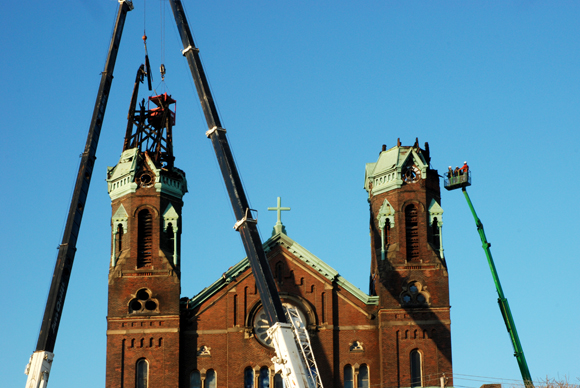
Five years after the destructive fire that left Old St. George Church in Clifton Heights dormant, plans are now surfacing to convert the historic building into a boutique hotel. The fire, which destroyed both of the church’s steeples, occurred Feb. 1, 2008. With restoration underway, it’s clear that the building’s future incarnation will take it far from its past. “We put about $600,000 into improvement,” says Matt Bourgeois, director of the Clifton Heights Community Urban Redevelopment Corporation (CHCURC), a nonprofit dedicated to revitalizing Clifton Heights. “We want to make sure the building is preserved so we can pursue [construction of the hotel].” Repairs and improvements are only the first steps to restoring Old St. George, however. CHCURC plans to have a full understanding of a time frame and funding by late summer, with hopes to start construction of the hotel soon after, says Bourgeois, who estimates the space will include 60 to 70 beds. While he can’t estimate room prices yet, Bourgeois hopes the project help attract more visitors to the surrounding developments and redefine the neighborhood’s dynamic. Making Clifton Heights a destination is one of CHCURC's major goals—to bring more people to the neighborhood and see what it has to offer, Bourgeois says. Construction of the hotel will follow the opening of U Square at the Loop, Old St. George’s neighboring multi-story development, where businesses are scheduled to open in March and apartments in July. By Kyle Stone
As of March 4, West Price Hill’s Caribe Carryout is now near Bogart’s on Short Vine. Several people who wanted to buy into his business had approached Basil Balian, the restaurant’s cofounder, but the traffic at the West Side location didn’t justify expanding. Balian chose to move to Short Vine because of its potential for a higher customer base. “It’s all about location, location, location,” he says. “I’m excited and encouraged by all of the housing and restaurants sprouting up along the street. I believe the street will become a magnet for food lovers, and I trust that we’ll get our fair share of foot traffic.” Caribe’s menu much the same; it features homemade empanadas and rice and stews prepared daily. But Balian and his business partner Russell Laycock have amped up the spice. Laycock is known as “Mr. Spice,” and he’s brought his expertise to Caribe’s spice mixtures and sauces. “Even though Caribbean food isn’t generally spicy, with the exception of Jamaican cuisine, we had a few customers say our empanadas weren’t spicy enough,” Balian says. Balian and Laycock have also recently added a Jerk Chicken Empanada to their lineup. It’s something they introduced to the menu before relocating because they wanted to satisfy their Jamaican customers, Balian says. The pair plans to introduce new recipes to their customers as daily specials, and then add them to Caribe’s menu based on demand. “We want to add to the variety of quality food already on Short Vine,” Balian says. “And we intend to help make Short Vine a hungry person’s instinctive destination.” By Caitlin Koenig Follow Caitlin on Twitter
To raise awareness and provide support to local school districts that want to help prevent bullying—particularly against students who are perceived to be lesbian, gay, bisexual, transgender or queer—the Human Rights Campaign and the YWCA partnered to lead the second annual Greater Cincinnati Anti-Bullying Summit in February. According to Kristin Shrimplin, HRC Diversity & Inclusion co-chair and director of the Family Violence Prevention Project for the YWCA, bullying prevention has been “on the front page for educators to pay attention to,” but there’s a gap in the community. Schools have been trying to prevent an issue without acknowledging that LGBTQ students are at the forefront. “I think they were just too scared to really examine some of the ways the kids were threatening other kids—either verbally or physically—and all those words or actions were based around homophobia and gender stereotyping,” Shrimplin says. According to the Gay, Lesbian & Straight Education Network’s 2011 National School Climate Survey, eight out of 10 LGBT students were harassed at school, while more than 60 percent felt unsafe and nearly 30 percent missed a day of school because of safety concerns. “That was a huge issue for us,” Shrimplin says. “So we said we can talk about these issues, but we need to offer solutions.” So the organizations brought 170 educators together to work toward finding better ways of addressing these predicaments within their schools. Welcoming Schools, which is a national HRC project, was the primary focus at the event, as it is the only evidence-based curriculum available to schools that is inclusive of LGBT issues, ensuring all students, regardless of sexual preference or gender identity, receive a quality education and feel comfortable in their educational environments. “It’s very comprehensive, and it offers tools, lessons and resources, and it focuses from a very young age on what family diversity can look like,” Shrimplin says. “As we discuss all the different types of family structures, we also include that just as a grandmother may be raising her grandchildren, let’s show that there can be two moms or two dads raising a child.” In addition to incorporating discussions about LGBTQ acceptance in the curriculum and providing teachers with ways to address and eliminate name-calling, Welcoming Schools also encourages schools to enumerate their policies on an administrative level. “If you name it, you can really claim it,” Shrimplin says. “Put it in your policy that homophobic bullying, harassment and intimidation against students perceived to be LGBTQ or harassed because maybe their parents might be, is not allowed at the school.” At the local level, Oyler is the first school to have implemented the program within its buildings. “In Cincinnati, you have to understand that’s huge because it was just a few years ago that we had a law on our city books called Article XII, and it had been there for over a decade and it literally said you are prohibited from passing a law to protect individuals who are perceived to be LGBT,” Shrimplin says. “But we had a waiting list of vice principals trying to get in to the Summit, and it really told us that the schools involved are ready—they’re ready to address this.” Do Good: • Support LGBTQ ally programs in schools, and let people know you care for and accept them. Contact the local chapter of GLSEN, and get involved. • Contact Kristin Shrimplin or a Welcoming Schools expert if you are a school that is interested in the project. • Encourage your local school district to implement inclusive language and to enumerate its policy regarding the prevention of LGBTQ bullying. Contact GLSEN if you need assistance or support. By Brittany York Brittany York is a professor of English composition at the University of Cincinnati and a teacher at the Regional Institute of Torah and Secular Studies. She also edits the For Good section of SoapboxMedia.
At Connections: A Safe Place, women form a community of support for one another as they work toward restoration. “Our belief is that if you clean off the lies, the misbeliefs, the things that you have told yourself as a result of experiencing sex abuse—you can clean all that off and shift them, and you can really reconnect to who you’re capable of being,” says Connections’ co-founder Rebecca Born. One in four women and one in six boys, according to Born, “will be touched by sex abuse before the age of 18,”—a statistic that she says most people think is impossible because they don’t know anyone who has been victimized in the past. “The reason you don’t know anybody is because our culture’s in a place where we don’t want to know, we don’t want to speak about it,” she says. “So victims of sex abuse remain silent—they remain isolated.” So Born works to give victims a voice and an outlet for the shame, anger or pain they might be feeling by providing things like therapy and weekly art sessions where women can paint or make pottery in the studio. “So often victims live in their heads and don’t really have a full sense of their bodies, and when you’re learning how to do art and make a pot, it requires your full attention—it requires body use and it really helps them to focus,” Born says. “And then the painting and drawing are a wonderful outlet for expressing some of the pain and some of the things you don’t often know how to say, but you can through art.” Connections isn’t about just meeting once or twice a week for therapy, though—it’s about forming a genuine community for women, with the understanding that the ability to overcome abuse is a long-term effort that requires support. “So we provide sleepovers, family cookouts; we go bowling, we just do all kinds of things,” Born says. The mission at Connections isn’t just to support victims, however. It’s also to challenge community members to take a stand against sex abuse and move beyond prevention to a zero-tolerance policy; and on April 14, as part of The Innocence Revolution: A Global Day to End Sex Abuse, the nonprofit will partner with A Voice for the Innocent to host Stand Up Ohio!. “It’s a family fun festival," Born says. "There’s going to be nothing threatening about it. Nobody’s going to have to worry that they’re going to be taught about sex abuse. Our goal is this: we’re going to celebrate children, and with our presence, make a statement.” Born says that if people don’t take a stand, the issue is going to continue; and nothing is accomplished as a result of denial. “Until we begin to speak about it and begin to create an atmosphere so children and adults can say this happened to me, it’s going to be a silent predator in our communities.” Do Good: • Donate to support the work of Connections. • Attend Stand Up Ohio! at Sharon Woods April 14 from 11 a.m. to 6 p.m. • Like and share Connections' Facebook page, and contact the organization if you are a woman seeking support. By Brittany York Brittany York is a professor of English composition at the University of Cincinnati and a teacher at the Regional Institute of Torah and Secular Studies. She also edits the For Good section of SoapboxMedia.
Mike Hall, 34, says he fell in love with theater at the age of 16 when he began attending Loveland High School and knew he had to make friends. He says he grew up as an “Army brat” who moved around a lot, though most of his family was based in or around the Cincinnati area; and when he moved to Loveland to finish high school, he first turned to “theater people,” who “are for the most part, pretty embracing.” Hall started acting in school productions and never turned back. He attended Northern Kentucky University as a theatre major, then went on to spend his time performing with various theatre companies in the area. Acting, Hall says, was his primary endeavor. That is, until he had a conversation backstage with Josh Steele in 2009, as the two were waiting to begin the night’s production of “Angry Housewives” at New Edgecliff Theatre. “We both wanted to see ‘Ghostbusters’ the musical happen,” Hall says. “We figured big budget movies and musicals like that are successful, and it’s usually the cult classics that make it, so we decided to try to write it.” After talking to a copyright lawyer, however, the idea for “Ghostbusters” had to be scrapped, but all was not lost. “He told us that was the worst idea ever, unless we wanted to be poor the rest of our lives,” says Hall. “But we still wanted to write something based around it, so we decided to turn it on its ear and write about what we know, which is the world of theater—so we decided to write about a group of actors who want to do ‘Ghostbusters’ the musical. They get told that they can’t and still decide to do it by changing the process around completely.” So Hall and Steele did just that and became first-time playwrights with “Don’t Cross the Streams: The Cease and Desist Musical,” which became a hit after its debut at both the Cincinnati and Indianapolis Fringe festivals last year. The two writers didn’t want to stop there, however. According to Hall, they’re “kind of hooked,” so the two recently formed their production company, Hugo West Theatricals; and the first major goal is to produce “Don’t Cross the Streams” as a two-act show, get it published and performed in cities across the country. Hugo West Theatricals, in conjunction with Falcon Theater, will start with a week-long run beginning Friday at Monmouth Theatre. Hall says he and Steele have added a few songs and expanded on the script to create a comedic piece they both feel good about. “I think the audience will be entertained, and that’s probably the most important thing theater can teach—is that we’re really supposed to entertain people—we can’t get too much on our high horse and make it a message all the time,” Hall says. “We have to keep the audience in mind—and when the audience comes to see it, I think they’ll know that we’ve kept them at the forefront.” Do Good: • Support "Don't Cross the Streams" by purchasing tickets to a performance at Monmouth Theatre, March 15-23. • Join and share the Facebook event page with your friends to spread word about the upcoming run of "Don't Cross the Streams." • Like "Don't Cross the Streams" on Facebook. By Brittany York Brittany York is a professor of English composition at the University of Cincinnati and a teacher at the Regional Institute of Torah and Secular Studies. She also edits the For Good section of SoapboxMedia.
Our Partners