Architecture + Design

AdRogues.com broadens opportunities for creative class, advertisers

Tom Hagerty has spent much of his professional life in the advertising business.  And while the means of delivering effective advertising continues to evolve, the crux of a good campaign remains the same: creativity and innovation.Today, companies increasingly are turning to the digital world to capture buyers' attention. But Hagerty, a Pleasant Ridge ad consultant, saw an opportunity by using the same technology to link smaller ad agencies or individuals to companies looking for a great advertising campaign."In the ad business, the Web had been nothing more than a revenue source. The technology itself has not been used to create additional opportunities," Hagerty said.That's why he created AdRouges.com, a site that links creative types like writers, graphic designers and producers with advertisers. The site launched in BETA in November.Hagerty, AdRouges founder and CEO, sees the site as a way for smaller agencies and creative individuals can gain access to more marketplace opportunities. "They are people who have big ideas, but no access to brands because they're not big enough to capture brands," Hagerty said. "That doesn't mean they don't have good, creative ideas or don't know how to deal with strategy. It simply means they don't have access."Here's how AdRouges works. Those on the creative side can purchase a membership to AdRouges, the fees range from free to 59.95 a month depending on the level of service and use on which a member decides. Members can then post ideas and pitches through the site in a secure manner which only they and advertisers can access."They're actually pitching their ideas, from briefs to full commercials. It's unrestricted by length or language," Hagerty said.Advertisers, who can sign up for free, can peruse the ideas. If they see a concept or pitch they like, they can get in touch with the creator and pay them for their work. AdRouges is then paid a commission."They shop for the concept they want, and the characteristics they are looking for. They can also create a relationship with the creative by looking at other work after the initial purchase is made," Hagerty said.The site has built-in protection of ideas. Only subscriber advertisers can view them, and the site has strict condition of use terms, an intellectual property protection statement and an FBI-type warning prior to each viewing and posting session. AdRouges also applies watermarks and bars downloading or emailing postings before a sale. The site also tracks URLs.Hagerty says the site has already gotten some positive feedback, and more than 100 members have signed up. Forty percent of site traffic is outside the U.S. and the AdRouges has been viewed in 39 countries.Writer: Feoshia HendersonSource: Tom Hagerty, founder and CEO AdRouges.comYou can follow Feoshia on twitter @feoshiawrites


Latest in Architecture + Design
Sean Rhiney

In our last ''My Soapbox" of 2010, Managing Editor Sean Rhiney talks about why every building matters in Over the Rhine.

The Year In Photos

Managing photographer Scott Beseler takes a look back at the photos from our top stories of 2010, showcasing some of the people, places and things that define our region.

‘Bearcat Bubble’ adds practice space and energy savings on UC campus

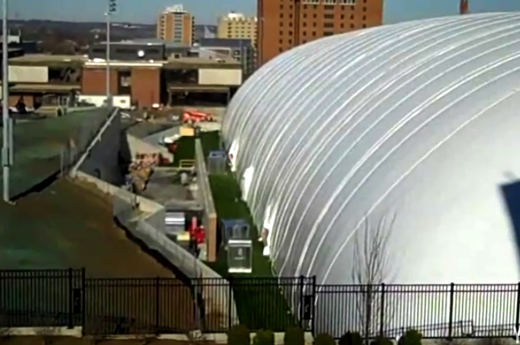
The University of Cincinnati gained its very own 24/7 practice field with the addition of an air-supported "Bearcat bubble" for the cold winter months. Athletes now have the ability to practice year-round in the new 75-foot-high and 370-foot-long bubble covering the new Sheakley Athletic Complex."The football players are excited and grateful to have the opportunity to use it. It gives us the ability to practice all year round with consistent conditions every time you are in there," according to UC Athletic Director Coslen. The field also benefits other varsity sports such as soccer, baseball, lacrosse, and eventually track and fieldBefore the addition of the practice field and bubble, athletes had limited conditioning and practice space. During the winter months they only had the ability to condition inside with the weight-room facility and indoor track. "The football team couldn't get out until the spring. During the winter months, they practiced outside when they could, " Coslon added. The Bubble and field provides 72,200 square feet of usable indoor space for athletic programs but also allowed the school to build a chilled water thermal storage tank underneath the short field to assist the air conditioning systems throughout campus. The addition provides the University $750,000 to $1 million in energy savings a year and adds to the "greening" of campus.According to the University project manager of the complex, Barrett Bamberger, the bubble is energy efficient and less expensive than a permanent structure. The dome consists of two layers that trap air between the two layers, which results in a 40 percent energy savings. Natural daylight also passes through the translucent outer layer, allowing the limited use of electric lights during practices. Because the bubble is transportable, it will only be inflated from November through February, and will return to a normal open-air practice field in the spring. Writer: Lisa EnsmingerPhotography provided by UC

More than a flip, Home Restart’s take on renovation

Mention "real estate flipping," and many people will come back with a less-than flattering image. Maybe it's a shady businessman whose idea of a "rehab" is a new coat of paint and a 200 percent bump in his asking price. Maybe it's a semi-employed hairdresser with more money than experience, whose end product is all style and no structure. It's enough to warn friends and family away from the risks of home ownership, regardless of the many rewards.But there are others involved in the real estate rehabilitation business; professionals whose work walks the fine line between building in value and preserving profit in a rehab project. And these rehab experts are quietly improving the faces of some of the Queen City's most desirable neighborhoods.Locally based Home Restart, LLC, falls into the latter category. The company reports it rehabbed seven homes this year, in neighborhoods such as Hyde Park, Oakley, Edgewood and Fort Thomas, Kentucky. With gross profits on the projects ranging from $50,000 to more than $100,000 over the homes' purchase prices, one might wonder if the company simply "pretties up" the properties. According to vice president Anne Pond, the improvements are very real, and are meant to improve more than just the homes where they're installed."There are a plethora of homes on the market today, many of them short sales and distressed properties that bring down local property values," she says. "We saw an opportunity with Home Restart to help build property values in neighborhoods." She explains that some of the homes Home Restart targets are foreclosed or abandoned properties. Others, however, may be homes where the owners, for various reasons, simply can't maintain a home of a given size or complexity. And while Pond notes that, in the end, the numbers have to make sense before they pursue a project, Home Restart looks for opportunities to make substantive improvements to the properties. They range from installation of high-efficiency windows and HVAC to converting an historic home from four-family back to single-family use.Foreclosed, distressed and abandoned properties could well be considered the windows of Wilson and Kelling's "broken windows effect" - decay invites more decay, driving down the value of an area. No neighborhood, regardless of status, is safe from these problems. But work like that done by Home Restart goes beyond simple profiteering to do something much larger: it is a company tapping a lucrative market niche, for certain. But it's also a service, helping, house by house, to keep Cincinnati's neighborhoods beautiful. Writer: Matt Cunningham

Cincy American Institute of Architects chapter launches leadership dev program

The Cincinnati Chapter of the American Institute of Architects (or AIA) has launched a new program aimed at shaping the next generation of leaders in the profession.AIA's VISION: Architect's Leadership Forum launched in mid-November with its first class of area architects from a variety of backgrounds. The 10-person class includes young professionals from large and small firms, as well as sole practitioners.AIA has spent the last year and half developing program curriculum and raising funds for the program. The inaugural class is a mix of architects identified as potential leaders by their employers and an open call to the region's professionals.The program is designed to teach leadership skills to professionals in their 30s and 40s who soon will be tapped as leaders as current leaders begin to retire. About 40 percent of today's industry professionals are 50 or older, said VISION co-chair Miranda Mote."We recognized there was a gap in support for young architects who will have to move up in firms more quickly as CEO and in firm management than those before them," Mote said.To qualify for the program, architects had to be licensed and able to demonstrate experience in the field.There are only a few programs like this in the country. Some of the most recognized are in Kansas City, Boston and Atlanta, Mote said.The 10-month program includes four keynote lectures by nationally recognized speakers, seminars, workshops, professional networking opportunities, panel discussions and a group service project. Throughout, participants will be asked to consider challenge's that Cincinnati faces including legacy, design, project delivery, politics, management practices, community, education and economics. The class takes place once a month.Keynotes will be publicized and open to the public, Mote said. Each day following the keynote presentation, VISION participants will work one on one with the speaker and offer short presentations on the topic each speaker covers. They will also address these topics in a blog that will be available at aiacincinnativision.com. AIA is working with nationally recognized Architect Magazine to offer blog content to a wider audience of professionals in either an online or print format, Mote said.The presentations are key to building leadership skills, she added."Communication is one of the key skills lacking in the architect community, and this is where the presentation comes in developing those skills," Mote said.Writer: Feoshia HendersonSource: VISION co-chair Miranda MoteYou can follow Feoshia on twitter @feoshiawrites
Joe Brinker & Melissa Godoy, OTR filmmakers

Local filmmakers Joe Brinker and Melissa Godoy talk about their documentary film "Rebirth of Over-the-Rhine."

Video A Casino Meets a Neighborhood

Soapbox and Seven/Seventy-Nine take a closer look at an effort to gather community input to ensure the casino being built at Broadway Commons drives development that reflects positively on the neighborhoods surrounding it.

Riverfront Park progress shows signs of things to come

The construction of Cincinnati's Riverfront Park reached a milestone last week when a newly-relocated stretch of Mehring Way opened to the public. The road's relocation required immense infrastructure work, including new foundations for the Roebling bridge, but was integral to the success of the park, project manager Dave Prather said. It was one of many major planning hurtles overcome in the 13 years since the project began."I can still remember the magic marker arcs drawn on a napkin," Prather said. "We had been asking 'how are we going to build a river-front park with a road so close to the river?"The road's new location, a few hundred feet north of the old one, will make room for a large green space, bike path, labyrinth, fountain and other public gathering spaces near the bank of the river. But the features just to the north of the new Mehring Way will be completed first, by next fall. Those will include three levels of public space. At the top level, an event lawn will gently slope from the future Moerlein Brew House to an event stage, bordering the commercial and residential development called The Banks that is being constructed in tandem with the park.Two stories below the lawn, with parking in between, will be more water features and a large set of stairs flanking the Roebling Bridge. A geo-thermally heated visitor's center and bicycle center will also be constructed on that level."If you want to commute into town, you'll be able to bring your bike into the garage, swipe your card, go into men's or women's showers and locker rooms and walk to work," Prather said. "Or that could be your lunchtime workout."Prather, who has nurtured the project along since it's planning began in 1997, said all the massive changes to the riverfront in recent years, including two new stadiums and the re-engineering of Fort Washington Way, have allowed the park to vie for the land and money needed to become the 40-acre project it is today."I'm really glad we didn't build the ideas we had 12 years ago," he said. "There are many more features now."Though he said the project was "on schedule," Prather said several major steps were reached earlier than initially planned due to the availability of federal stimulus money. After the remaining cash comes in, and the adjacent Lot Two parking garage is opened, much of the asphalt to the west of the Roebling Bridge will become green space too.Writer: Henry Sweets Photography by Scott Beseler

Cincinnati vs. St. Louis: Which Riverfront Would You Choose?

Urban STL compares the riverfronts of St. Louis and Cincinnati. Although St. Louis has the presence of the famous Saarinen's Arch, Urban STL praises Cincinnati for its more active, inviting, and interesting Central Riverfront Park, it's two stadiums, the National Underground Railroad Freedom Center, and the Moerlein Lager House. Read the full story here.

Our Partners

Taft Museum of Art
Warsaw Federal

Don't miss out!

Everything Cincinnati, in your inbox every week.

Close the CTA

Already a subscriber? Enter your email to hide this popup in the future.