Architecture + Design

Architecture firm engages Covington students to add graffiti to Pike Street

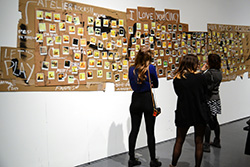
Ben Eilerman says he realized his love of architecture during his adolescent years at Covington Catholic High School.  As a professional in the field at Hub+Weber, he has the opportunity to engage in educational outreach with other students who have that same appreciation for art at the same age he did. Hub+Weber’s latest venture, which not only engaged students in artmaking but also gave them real-world experience, involved Holmes High School’s graffiti club and visual communications class.  Located in Covington since the firm’s founding nearly 40 years ago, Hub+Weber relocated for the first time last year. Though it maintained its roots in the area, the firm moved from its old home on Greenup Street to the city’s former train station on Pike Street.  “Behind it are the old passenger stairs up to an elevated rail line, and that area is largely abandoned,” Eilerman says. “[It had] that kind of urban decaying aesthetic to it that we were drawn to, and we wanted to use that space and address it from our standpoint, and then also to start to make the city aware of it.”  So Hub+Weber reached out to the Center for Great Neighborhoods, who put the firm in touch with Donny Roundtree, the visual communications teacher at Holmes.  “We talked to him and saw that this was a great opportunity to bring his students down and do a real-life project and build it into something bigger, as far as his curriculum goes,” Eilerman says.  So the two joined forces to provide students with the opportunity to create an eight-foot by 16-foot graffiti art mural.  “The students explored different techniques so each of the panels read as an individual panel, and as it draws into the center, it starts to be defined more as a singular mural,” Eilerman says. “It has the background of the Covington skyline across the back, and then it has two trains coming out of the center from a tunnel with the word ‘Pike’ in the middle.”  Eilerman says the area surrounding Pike has undergone a renaissance over the past few years, so the firm wanted to find a way to contribute by livening up the area while also reaching out to a local school district.  The mural is currently on display inside the building, and a week ago, the students showed off their work at a gallery opening hosted by Hub+Weber. They received feedback from local designers who gave advice about what it means to “take the arts into a profession,” Eilerman says.  This month, the mural will inhabit its permanent home—below the underpass where it will be visible from the sidewalk and street for all to see.  “They spent about six months or so on this,” Eilerman says. “We really acted as a client—they brought the sketches and they talked about what their vision was, and we talked about what ours was, and they had to mesh that. They had to provide a proposal for their work—and I think it was a big benefit to the students.”  Do Good:  • Support the arts in your local school district.  • Support Holmes High School's Nordheim Gallery. • Like Hub+Weber on Facebook.  By Brittany York Brittany York is a professor of English composition at the University of Cincinnati and a teacher at the Regional Institute of Torah and Secular Studies. She also edits the For Good section of SoapboxMedia. 

Latest in Architecture + Design
The 25 most amazing campus recreation centers

UC ranks #1 on the list of top rec centers in the nation, according to Best College Reviews. Read the full rankings here.

Modern architecture recognized, celebrated with preservation of Rauh House

The Cincinnati Preservation Association will be hosting Preserving Modern Architecture, a two-day symposium on April 24 and 25. The event is being held to celebrate the gift and restoration of the Frederick and Harriet Rauh House in Woodlawn.   CPA began to restore the Rauh House in Sept. 2011 with funds provided by Emily Rauh Pulitzer, Frank and Harriet's daughter. The house, which was built in 1938, is one of the country's first examples of the International style of modern architecture.   When CPA acquired the house, it was a cinderblock shell with plants growing through it, says Paul Muller, executive director of CPA. It had been slated for demolition—twice—but CPA felt it was a building that needed to be restored rather than destroyed.   “Preservation of the recent past is an emerging issue in the world of historic preservation,” says Muller. “The public has an interest in mid-century modern and modern architecture because buildings that were built in 1964 are now eligible for the National Historic Register, and they’re not considered ‘old’ to us. But once people start looking at what motivated the architects and owners of those houses, then it’s interesting.”   The symposium features two days of papers, case studies and discussion sessions about modern architecture, plus a tour of the Rauh House and another house in the neighborhood. A lecture by Paul Goldberger, Pulitzer Prize-winning author and architectural critic, will conclude the event.   “We hope that the event will increase people’s awareness and appreciation for the incredible modernist legacy,” says Muller. “We want people to realize that a lot of modernist buildings need to be preserved, and can add something to our culture.”   Tickets to Preserving Modern Architecture and the Goldberger lecture are $125 and $35, respectively; tickets for the Rauh House tour are available by emailing info@cincinnatipreservation.org or by calling 513-721-4506. The event is sponsored by Architects Plus, and the house tours are sponsored by Kroger and Crapsey and Gilles Contractors, Inc.   By Caitlin Koenig Follow Caitlin on Twitter

Differential is a hands-on incubator in Cincinnati

The Greater Cincinnati startup scene is diversifying and growing, which is creating opportunities for new types of startup launch platforms. Cincinnati-based Differential is a new company that is leveraging a different type of service and funding model to help startups accelerate their launch. Read the full story here.

Plans for Old St. George rise from ashes

Five years after the destructive fire that left Old St. George Church in Clifton Heights dormant, plans are now surfacing to convert the historic building into a boutique hotel. The fire, which destroyed both of the church’s steeples, occurred Feb. 1, 2008. With restoration underway, it’s clear that the building’s future incarnation will take it far from its past. “We put about $600,000 into improvement,” says Matt Bourgeois, director of the Clifton Heights Community Urban Redevelopment Corporation (CHCURC), a nonprofit dedicated to revitalizing Clifton Heights. “We want to make sure the building is preserved so we can pursue [construction of the hotel].” Repairs and improvements are only the first steps to restoring Old St. George, however. CHCURC plans to have a full understanding of a time frame and funding by late summer, with hopes to start construction of the hotel soon after, says Bourgeois, who estimates the space will include 60 to 70 beds. While he can’t estimate room prices yet, Bourgeois hopes the project help attract more visitors to the surrounding developments and redefine the neighborhood’s dynamic. Making Clifton Heights a destination is one of CHCURC's major goals—to bring more people to the neighborhood and see what it has to offer, Bourgeois says.   Construction of the hotel will follow the opening of U Square at the Loop, Old St. George’s neighboring multi-story development, where businesses are scheduled to open in March and apartments in July. By Kyle Stone

On OFFF: Designers that will blow you away

Even if you didn't get a chance to attend the sold-out OFFF event hosted by the Contemporary Arts Center, you can still experience the mind-blowing designers' work from the comfort of your computer. Slideshow by Soapbox's own mind-blowing photographer, Scott Beseler.

Mason design firm sets up office in Over-the-Rhine

For 45 years, Bayer Becker’s civil and transportation engineers, landscape architects, planners and land surveyors have served the Tri-State area. And last month, the design firm opened an office in Over-the-Rhine.   “There’s a commitment to the urban core here in OTR, and we want to be part of it,” says Mike Dooley, an associate at Bayer Becker. “We want to be closer to the clients we work with and new talent.”   Founded in 1968 by Joseph Bayer and Keith “Sandy” Becker, the firm has served a variety of local and national clients and has consulted on projects in the public and private sectors. The OTR office is Bayer Becker’s fourth office in the Cincinnati area (its home office is in Mason, and there are smaller offices in Fort Mitchell, Ky., and Oxford, Ohio).   Bayer Becker’s new office is in the historic Saengerhalle building next to 3CDC and across the street from Washington Park. The firm looked at buildings in the Central Business District, but the opportunity arose in OTR to be near local architects and other design firms, says CFO and Vice President Tim Bayer, who is the son of founder Joseph Bayer.   “There are lots of businesses and entertainment here, which was very appealing to us,” Bayer says. “We want to be part of strengthening the community’s employment and aesthetic aspects.”   Currently, Bayer Becker is doing land surveying on several properties for 3CDC; they’re in the middle of the bidding process on a property in OTR near the casino. Yard House at The Banks was also a Bayer Becker project.   Bayer Becker wants to be a good business citizen and be active in the OTR Chamber of Commerce and be part of other business associations and endeavors in the business community, says Bayer. “Our goal is to continue to strengthen the community through employment, be part of celebrating client success and help improve downtown Cincinnati.”   The firm wants to help continue enriching the community, and later this month, they’ll be sponsoring the Urban Awakenings series, which focuses on four Cincinnati neighborhoods that are dedicated to revitalization and rejuvenation.   “We want to help OTR be a model for other communities,” Dooley says.   By Caitlin Koenig Follow Caitlin on Twitter

Joinery: A Poster by Brush Factory Design Studio

Design Milk, an online magazine dedicated to modern design, highlights a new poster by Hayes Shanesy of Brush Factory design studio and printed by Northside's Cryptogram Ink. See the full posting here.

Cincinnati enters wearable tech market with Nugg-it recording band

Wearable tech is emerging as the "next big thing" in consumer technology. And a trio of Cincinnati entrepreneurs are developing Nugg-it, a wristband that will easily record snippets of everyday conversation, and investors are taking notice. Nugg-it has raised $600,000 in seed investment, including a total of $250,000 from CincyTech and Design 2 Matter, a Silicon Valley-based industrial design firm. Design 2 Matter is also designing and building the device. "[Design 2 Matter] has a very successful track record of bringing products from concept to shelf," says Nugg-it's co-founder and social media entrepreneur Matthew Dooley. Nugg-it is meant to be worn 24 hours a day. It records live conversations on a 60-second loop, continuously saving them in one-minute "nuggets." To save a memorable part of a conversation, the user touches the device to save the last minute of buffered memory. That recording can be sent to a smartphone, and through an app can be edited, saved and shared. "It's a smaller, lighter weight band," says Dooley. "Right now, we are trying to focus a lot of attention on design. It has to be something that is stylish and comfortable to wear. A lot of the functionality is off the shelf, but we're putting it together in a new way." Dooley is working with former Procter & Gamble brand marketer and engineer Mike Sarow to develop the device. Plans are to deliver the final concept in March, and introduce it to the market by December, Dooley says. “It occurred to us that there are a lot of circumstances in life where we want to remember and share something that was just said—a clever phrase in a meeting, something adorable from our 3-year-old, words of wisdom from a mentor—but we can’t ‘capture’ it,” Sarow says. “Now you can.” Nugg-it is CincyTech's first consumer electronics device investment. “With the rise of the Nike FuelBand and smartwatches such as Pebble, wearable technology is projected to be a $7 billion market by 2017,” says CincyTech's Executive-in-Residence Doug Groh. “We expect Nugg-it to help drive that growth and to do for short audio files what Twitter has done for 140-character content.” By Feoshia H. Davis Follow Feoshia on Twitter

HCBC opens new CoWorks space for entrepreneurs, startups

The Hamilton County Business Center is Cincinnati's oldest incubator, and has evolved over the decades as the economy has changed. Startups are leaner and meaner now than ever before, and HCBC is piloting the region's latest coworking space, where small businesses can get many of the benefits of being in an incubator without the higher overhead. HCBC's CoWorks had a very quiet launch late last fall. With three businesses in the space, which is located in Norwood, Executive Director Pat Longo is now getting the word out about HCBC. "This has grown out of our affiliate program," Longo says. "There were companies that weren't yet ready to apply for the incubator but they wanted to be around it." HCBC has recently upgraded its conference room space, which has been attractive to small companies like SCORE, SBDC and Meetups that want to present themselves more professionally, says Longo. HCBC has 45 companies that last year generated over $18 million in revenues, accessed over $8 million in capital and created nearly 50 jobs. Renting CoWorks space on a month-to-month basis starts at $75 per month, and includes: 24-hour, 7-day-a-week accessWiFiConcierge and receptionist servicesFree parkingFax, scanner and copier servicesKitchenUp to four hours per month of conference room useA mailing address"We talk about having an entrepreneurial ecosystem, but I like to think of (HCBC) as a coral reef," Longo says. "We have a lot of life, people can grow, there is lots of nourishment and places to go and hide if you need a quiet place to work." CoWorkers will have access to the incubator entrepreneurial atmosphere, programming and resources. Some are free, while others have a fee attached. "They'll get the benefits of being a client," Long says. "And we hope when they are ready, they'll move into the incubator." Currently, there is space for about 12 companies, with potential room to grow. Interested businesses can find out more on the CoWorks website, where interpreters can fill out an application. By Feoshia H. Davis Follow Feoshia on Twitter

Our Partners

Taft Museum of Art
Warsaw Federal

Don't miss out!

Everything Cincinnati, in your inbox every week.

Close the CTA

Already a subscriber? Enter your email to hide this popup in the future.