
People who feel their voice matters are healthier and empowered. As divisions nationally appear to become deeper, this series, part of the larger Health Justice in Action project, examines efforts to make voices heard and improve community connections.
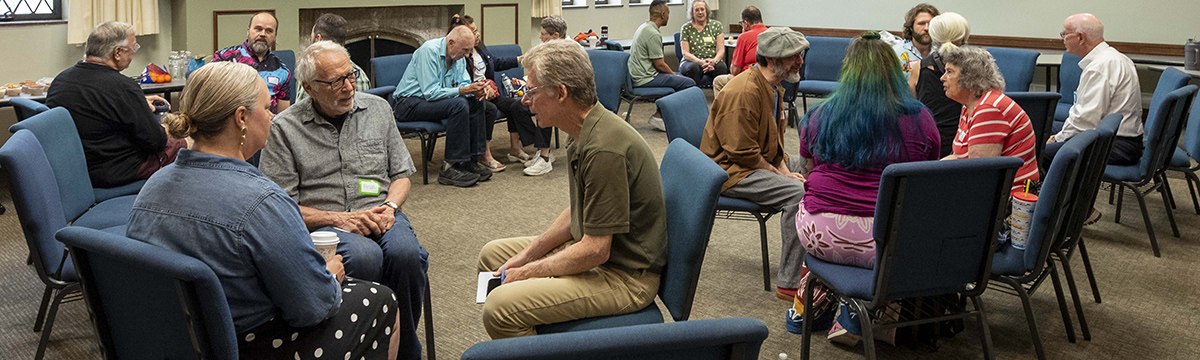
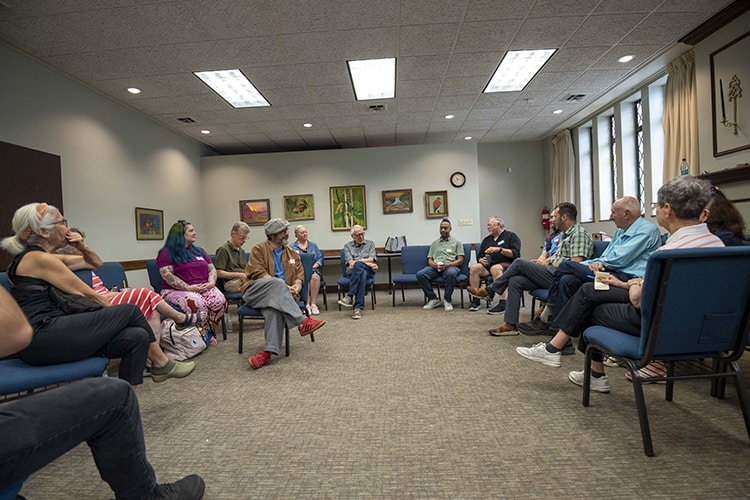
On a Saturday in June, a morning when they could have been shopping, traveling, or enjoying a second cup of coffee, about 20 people gathered in the undercroft of a church in Westwood to go to work building social capital.
Social capital – those valuable connections that create and empower communities – is on the decline, studies show. Neighbors don’t talk much anymore, everyone’s scrolling their phones, and we don’t trust each other. But this gathering was one of five of the Westwood Common Good Project, a community undertaking built around a simple idea: “Strong communities are built on strong relationships.”
“This came out of a desire for people to work for the common good from our common ground,” says Rich Jones, pastor at Westwood First Presbyterian, the host of the Saturday meeting and the four others.
The June get-together was focused on the arts and how they build and sustain communities. Others have focused on investing locally, housing, food, and local entrepreneurship.
The Westwood effort, on a small, neighborhood scale, is a counter to the larger trend of Americans becoming more isolated. It’s a trend we’ve all seen and felt: neighbors don’t talk much to each other anymore. We know this intuitively, but a new survey reveals that the trend has deepened just in the last dozen or so years.
The American Enterprise Institute, the Washington, D.C.-based nonpartisan think tank, surveyed more than 5,000 Americans in the fall of 2025 about their interactions with their neighbors. The bottom line: “As Americans spend more of their time online, the neighborhood—once a primary physical location for real-world socialization—is playing less of a central role than ever before.”
In recent years, it appears we have withdrawn into our air-conditioned houses, enclosed patios, home theaters and video game consoles. Only 40 percent of Americans said they talked to their neighbors at least a few times a week. That “marks a considerable decline in social interaction between neighbors,” the report says. As recently as 2012, nearly six in 10 people (59 percent) said they talked to their neighbors at least a few times a week. The new findings reflect a decline in neighborliness of nearly 20 percentage points in 13 years.
Even more troubling is the age gap uncovered by the survey. The most rapid dropoff in neighborly interactions was experienced by young adults. In 2012, more than half (51 percent) of young adults said they conversed with neighbors a few times a week or more. The latest survey found that only 25 percent now do.
The report’s authors suggest that “shifting personal priorities and social habits” could explain the steep decline in young adults talking to their neighbors. In other words, getting to know the neighbors doesn’t seem as important as it used to be.
But neighborly interactions are a key to overall well-being, to a sense of community and to an overall sense of belonging. Social interactions, with neighbors and others, is essential to good health, studies show. Loneliness and social isolation increase the risk for premature death by more than 25 percent. The impact on health can be as devastating as smoking nearly a pack of cigarettes a day.
This is especially true as more people are living alone. In Greater Cincinnati, the number of adults who live alone has steadily increased in recent years, growing by more than 14 percent over the last decade-plus, according to “Our Health, Our Opportunity,” a 2024 report from Cincinnati-based Interact for Health.
Social connection is also vital for the health of communities. The groundbreaking surgeon general’s report on loneliness and social isolation called it “an important social determinant of health, and more broadly, of community well-being,” important not only to the overall health of the community but to its resilience in responding to disasters such as tornados, floods, violence and economic downturns. But fewer than half of adults in Greater Cincinnati the consider their communities to be “highly supportive,” the Interact for Health report found.
In short, connections with our neighbors are part of vibrant, healthy communities. That’s why 20 people in a church basement in Westwood are doing work that could resonate in that community and beyond.
“Our mission is to connect people, place, and purpose to build a thriving, vibrant, diverse Westwood,” says Stephanie Collins, executive director of Westwood Works, the not-for-profit community development group that sponsored the event. “It’s all about bringing people together and building community, and building social capital.”
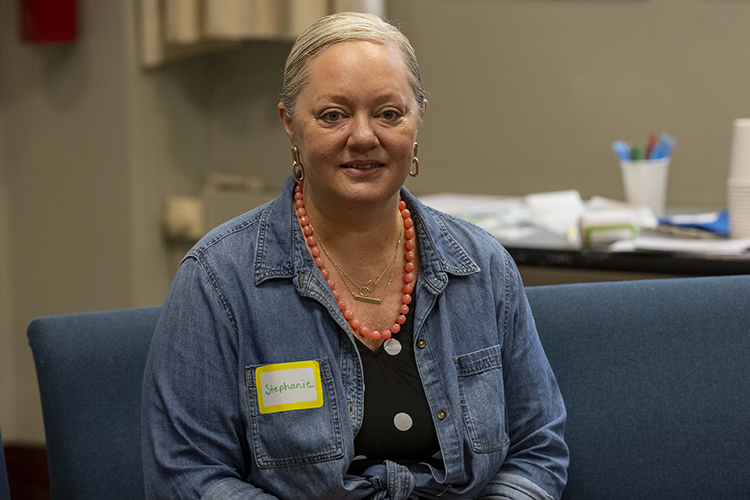
Social capital – the trust, support, cooperation and information we gain from relationships — builds community. Like financial capital, it can be used to construct lasting bonds that hold communities together.
With the social capital account full, as Collins says, “When bad things happen, we have a village to fall back on. Knowing our neighbors is critically important, and it’s something that we’ve really gotten away from in today’s society.”
Westwood Works has organized five such meetings through the fall. The first was focused on the general idea of social capital. A second was on housing and community ownership of land. Later sessions will be centered on growing food and on jobs and entrepreneurship. The Common Good Alliance, a Cincinnati-based not-for-profit that supports community investment, serves as the convenor.
Social capital is more than a feel-good idea. It leads to community building and prosperity. “Social capital means we trust each other and make the place better, so it’s not connection for its own sake,” says Peter Block, co-founder of the Alliance.
Abby Langdon went to the June meeting hoping to get the word out about her fledgling business in Westwood. She and her husband, Jason, both artists, have invested in the neighborhood, purchasing a small warehouse with plans to convert it into Apropos Art Society, studio space for artists, classrooms and a gallery. The Langdons have put a considerable amount of financial capital into the purchase and renovation of the old building. “We’re putting everything we’ve got into it,” she says.
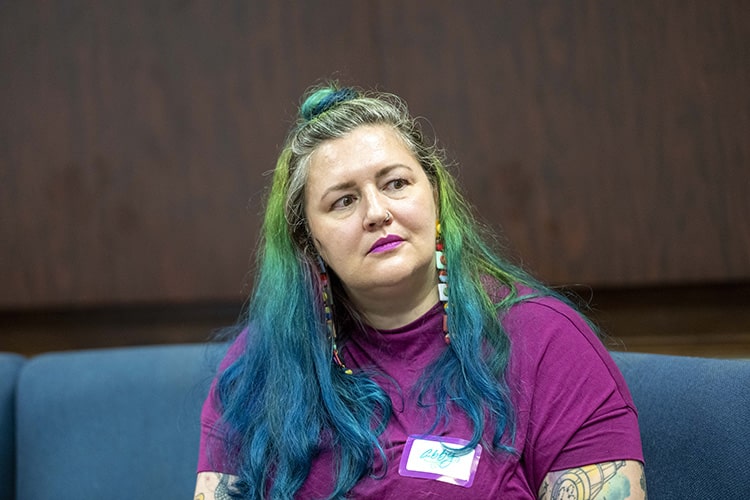
At the church meeting, they found social capital – neighbors supporting neighbors. “We thought we were going in to promote ourselves, and it was much more collaborative than that,” she says. “People had great ideas and resources to pursue, and that was just really helpful.”
In the light of our increasing isolation from each other, the remedy appears fairly simple: spend more time with your neighbors. As the AEI report notes, “One of the strongest predictors of neighborly interaction is also the most obvious: spending time in the neighborhood.”
Talking a walk (with or without a dog), is an obvious one. People who have access to “third spaces” are more likely to meet each other informally and casually and make connections. Those neighborhoods with public parks, walking trails, libraries, coffee shops, and community centers are places where people can spend time relaxing and building community at the same time.
In Westwood and elsewhere, add church basements to that list.
This series is made possible with support from Interact for Health. To learn more about Interact for Health’s commitment to working with communities to advance health justice, please visit here.
Author

Related Articles
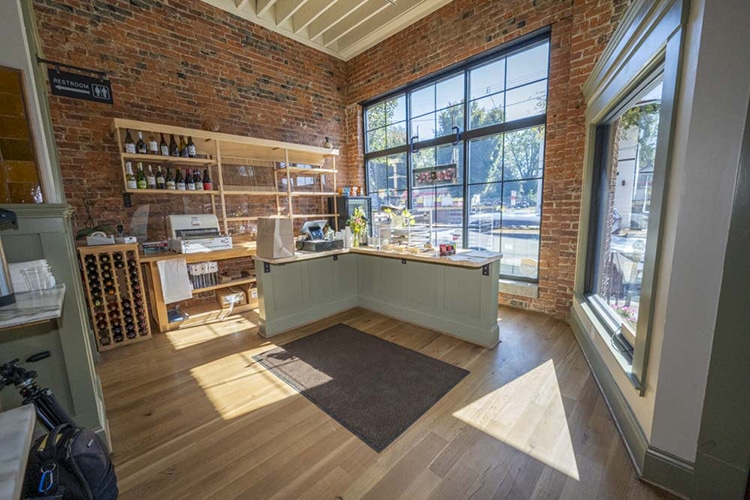
Madisonville’s renewal has been decades in the making
A long-term effort to revive Madisonville’s business district is taking shape through community planning, new development and local entrepreneurs investing in the neighborhood’s future.
New bronze sculpture in Eden Park will honor Women Veterans who served our country
The artist will reveal the monument design this coming Veteran’s Day with an installation planned for June 2027.
In search of the inaugural cultural journalism fellow
Wave Pool and Soapbox partner to support innovative journalistic coverage of culture in Cincinnati.