
Northern Kentucky University: Where Prime Location and Highly Skilled Workforce Converge
The old business success adage location, location, location takes on new meaning at Northern University at a planned developments at the of the growing, dynamic Highland Heights campus.
The old business success adage location, location, location takes on new meaning at Northern University at a planned development at the of the growing, dynamic Highland Heights campus.
First is the 14-acre site at U.S. 27 is developed by the Northern Kentucky University Foundation. It has quick access to Interstates 471, 71 and 75, downtown Cincinnati and the Northern Kentucky/Cincinnati International Airport.
But value of this prime location isn’t just in the land or the infrastructure, it’s also in the high-tech workforce NKU is developing at Griffin Hall, housing the University’s College of Informatics.
The state-of-the-art center seeks to combine technology, available data and real world application to a wide variety of occupations. NKU’s College of Informatics, the only such college in the state, was created by an act of the Kentucky Legislature. In the fall of 2006, 1,057 entered the college under various disciplines.
In addition to new offerings like informatics, the college puts a number of NKU’s existing disciplines under one roof. It includes four departments: Business, Communication, Computer Science and Infrastructure Management. It includes such diverse disciplines as health care, computer information technology, business, enterprise resource planning and research development design.
“NKU is preparing and providing a very skilled a niche workforce in the informatics arena,” said Karen Finan, Sr. Vice President at Northern Kentucky Tri-ED. “The workforce will be there to support a company and to be on that cutting edge of technology.”
It’s one of less than a dozen such colleges dedicated specifically to informatics study in the United States.
“Our focus is on being a regional university, and our focus is very applied. It’s an issue of real-world research that makes a difference with workforce development,” said Dr. Gary Ozanich, director of Strategic Advancement at NKU’s College of Informatics.
Among the most exciting fields this opens for NKU is the area of health care informatics. Griffin Hall will be on the ground floor of a state goal to create a statewide e-health network to improve health care efficiency and quality though utilizing this type of technology. The federal government has mandated a national health infrastructure, which would include e-health records, be in place by 2014. Estimates show at least 200,000 new workers will be needed to meet this goal, and workers will need to maintain, upgrade and assist clinical staff in effectively using the systems, Dr. Ozanich said.
“We have an opportunity in this region to be on the leading edge in establishing a highly skilled workforce. The tri-state region is one of the leading regions right now in health information technology, and we are likely to be first interconnected region of the nation,” said Dr. Ozanich.
Dean of the College of Informatics Dr. Doug Perry, added, “We’ll have revolutionary technology here. Either it will be rare or non-exist anywhere else in the region. This is a building from ground up that will feature ultra high-tech digital application, training, research, development and service.”
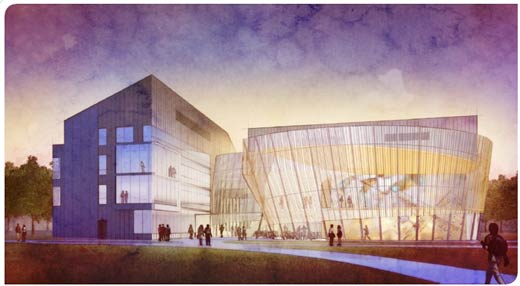
The 110,000-square-foot facility is made up of a central Informatics Common and “digitorium,” flanked on two sides by four-story loft-style academic buildings.
“We can make digital movies, TV shows and produce music and albums and Web sites with very sophisticated mashups,” Dr. Perry explained. “We’re going to have a convergence newsroom. We’re really going to strive to create a news center of future, a journalism program preparing for the new age.”
This space will house a “genius bar” complete with a multi-discipline technology help desk, research flex space, and a café.
Within the common is the two-story glass digitorium, the fully reconfigurable technological heart equipped with audio/visual technology using high-quality LED, digital projection, and intelligent digital displays that allow users to watch, interact with, create and share information.
The digitorium’s transparent skin is designed to reflect the center’s purpose by allowing those outside to witness human interaction, the most basic – yet most complex – of information sharing systems. The center will also be the first ‘green’ campus building, designed for LEED Silver certification. The $50.8 million center is set to open in May of 2011.
All of these high-tech tools will not only will be available to students, but to the business community as well. And one of the mostly highly anticipated in the business community is the planned Computer Assisted Virtual Environment program or CAVE.
“Anyone from a landscape architect, to engineering, product development and marketing firms can use this. If you can imagine it, you can create it inside a cave,” Dr. Ozanich said. “CAVE exists privately in Cincinnati, but is not open to the public. It’s used by corporations for their own research. We’ll make available on a contract basis for a business.”
This all adds up to well-trained students who have real-life business experience. And if the past holds true, the students will stick around once they graduate, because 85 percent of NKU undergrads stay in the region, Perry said.
Sources: Karen Finan, Sr. Vice President at Northern Kentucky Tri-ED, said Dr. Gary Ozanich, director of Strategic Advancement at NKU’s College of Informatics and Dean of the College of Informatics Dr. Doug Perry
Related Articles

Fewer options, fuller ERs: The behavioral health fallout of Medicaid cuts
MHA advocates for state funding that preserves behavioral health care and keeps rural hospitals open.

What does the new childhood vaccine schedule actually mean for your family?
Officials say not much will change. Experts aren’t so sure.

New platform to share ‘Common Ground’ from community ideas and solutions
Issue Media Group, a multilocal network of solutions-based, issues-focused digital publications, has launched a new national platform for increasing the reach and impact of its journalism.