
Cincinnati’s first-ring suburbs face unique challenges. Changing demographics, economic stability, and issues regarding resources and security are common threads among these jurisdictions.
The ways the 49 Hamilton County cities, villages, townships, and municipal corporations not only adjust but thrive is the focus of this series, First Suburbs—Beyond Borders. The series explores the diversity and ingenuity of these longstanding suburban communities, highlighting issues that demand collective thought and action to galvanize their revitalization.
Two years ago, a community fixture that had done business in the heart of suburban Sharonville for 90 years closed shop, an event that could have aggravated a long-term decline of that city’s downtown business district.
Instead, city leaders acted quickly to buy the property, and what could have languished as an empty shell has become a linchpin of comprehensive plan to reimagine Sharonville’s core.
Cliff Hardware was Sharonville’s oldest business, a family-owned enterprise that served as an anchor of the city’s “downtown.” In business for nine decades, it had been owned by Eli Wickemeier’s family for 54 of those years. But it was getting tougher for an independent hardware business to make it. “It’s just slowly declining,” Wickemeier told Soapbox in 2024. “I don’t think there’s any way of surviving another 10 or 20 years.” He put the business and the property on the market.
The store holds down a sizable footprint in Sharonville’s downtown district. If it had been sold to a private, commercial developer, it could have become a parking lot, an uber-convenience store like a Wawa, or a 16-bay gas station. None of those kinds of developments would have furthered the city’s vision of a small-scale, walkable business district that it had rebranded as “The Loop.”
Sharonville, through its not-for-profit community development corporation, bought the property, giving the community control over its destiny. Two years later, the vision is coming into focus. The Cliff Hardware property is expected to be the site of market-rate apartments, which will bring residents back into The Loop, helping to support the small businesses already there and those expected to locate.
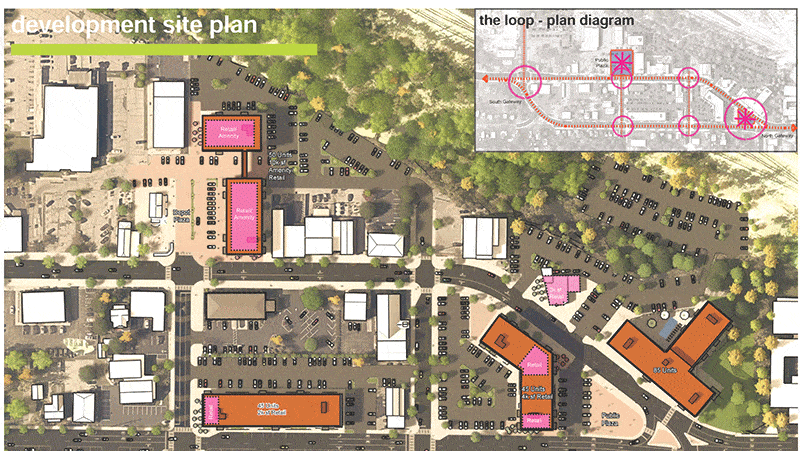
About 200 to 225 apartments are planned, said Economic Development Director David McCandless. The housing and new residents will help sustain small, retail businesses. “We want to increase walkability and density and hopefully create a self-fulfilling cycle of new retail being supported by additional residents,” McCandless said.
Building housing on the Cliff Hardware site is one piece of a much larger plan to create a walkable, mixed-use district in Sharonville’s old downtown. The half-mile long district is bounded by two one-way streets, Reading Road heading south and Main Street going north. The two one-way streets, connected by Sharon Road and Creek Road, create a walkable loop until they converge three blocks to the north at Reading Road. Hence the branding of this budding neighborhood as The Loop.
Sharonville is a sprawling community of 14,000 residents bisected from east to west by Interstate 275 and from north to south by I-75 and U.S. 42. During the workday, its population swells to more than 35,000, as it is home to major employers like the Ford plant and the Princeton school district, as well as the Sharonville Convention Center, hotels, and dozens of restaurants.
City planners want to create a downtown that instills a sense of community identity and is a destination for residents and others. Some older communities already have Main Street-style business districts that were established early in the 20th century. Sharonville, whose expansion as a city dates to the 1960s, does not. Its downtown Loop plan aims to create one by inviting small businesses, pedestrian-friendly development, and slowing traffic, among other goals.
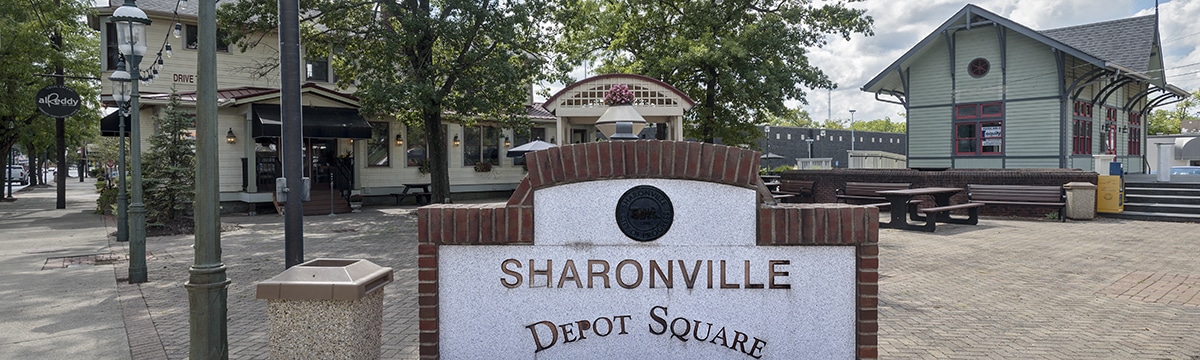
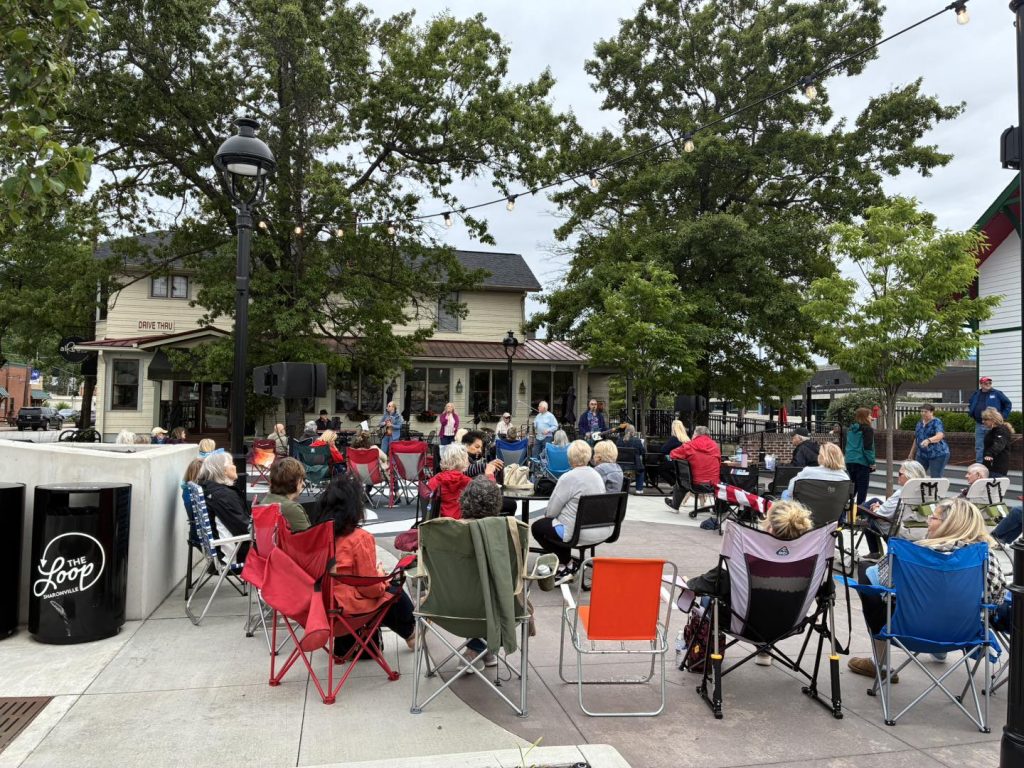
The city has invested in improvements to a portion of the district next to the hardware store site that it calls Depot Square. They include an artistically designed splash pad, a stage, and seating. A building that resembles an old train depot gives the spot its name. AlReddy Café, a Sharonville eatery for 20 years is open for coffee, breakfast, lunch, dinner on the weekends, and live music on Friday nights. The city has made other streetscape improvements to Depot Square, and it’s become a site for community gatherings, holiday events, and live music.
The city is now looking beyond Depot Square and has been active in acquiring more than a dozen properties around The Loop that were vacant or blighted. Some have been demolished and more are slated to be torn down.
“If you want to do something transformative, let’s look to a larger scale,” McCandless said. “It’s more catalytic at scale.”
The scope of the project will cost about $75 million. McCandless said $50 million of that will come from private investment, and about $25 million from public dollars. A portion of the public investment will come from grants and a tax increment financing fund. The city has established a capital fund for such big projects, thanks largely to the income tax from the 20,000 people who work there but live elsewhere.
The plan for new apartments, as well as the demolitions of aging buildings have drawn reactions from Sharonville residents. With 200 new housing units, “Where will people park?” one resident asked on the city’s social media channel. The city says parking space will not decrease and some of the acquired properties may be used for additional parking.
Another asked if the housing would be “projects” or Section 8, although the city has clearly said the housing will be market-rate. (The average rent for an apartment in suburban Hamilton County is about $1,200 a month).
Others have lamented the loss of old buildings in The Loop. But others welcome the new developments. “Change is needed; change is good,” wrote one commentator. “As someone whose family has lived in downtown Sharonville since the 1950’s, it is time to bring it up.”
That is the plan, as the city, guided by its 2030 Comprehensive Plan and a vision for a new downtown, moves forward.
The First Suburbs—Beyond Borders series is made possible with support from a coalition of stakeholders including the Murray & Agnes Seasongood Good Government Foundation: The Seasongood Foundation is devoted to the cause of good local government; Hamilton County Planning Partnership; plus First Suburbs Consortium of Southwest Ohio, an association of elected and appointed officials representing older suburban communities in Hamilton County, Ohio.
Masthead photo: Sharonville’s Depot Square in 2022. The city has recently invested in new improvements to a portion of this district next to the hardware store site. Photo Gary Kessler.
Author

Related Articles

“Print Voices from Kenya: Social and Cultural Reflections” brings Kenyan art, film and culture to Cincinnati
SOS ART and Kennedy Heights Art Center partner on the fifth edition of a biennial series featuring an international art exhibition and Kenyan Movie Festival that encourage cross-cultural understanding and dialogue.

As men fought in cages at the White House, women urged Americans to take a ‘deep breath’
In a city transformed by President Trump’s immigration policies, women came together to watch Jane Fonda’s “Rise Up, Sing Out” event to reaffirm the country they’re fighting for.
In Middletown, data indicates a steadily improving housing market
An historic-home restoration specialist, a new-construction homebuilder, and a rental landlord offer their perspectives on housing opportunities.