OTR “question cart” looks at redevelopment using art, community input
Ethan Philbrick, a University of Cincinnati graduate student and artist, received an individual artist grant award from the city of Cincinnati in 2009 to fund Project CincinnatiUS – a year long series of public performance events tackling societal issues in downtown Cincinnati and Over-the-Rhine. Project CincinnatiUS has already featured collaborations between cultural workers and artists and Philbrick’s most recent effort, The Over-the-Rhine Question Cart,” engages residents the living in Over-the-Rhine and questions their feelings about redevelopment of their neighborhood. Philbrick collaborated with sculpture artist, Chloe Paisley, to create a mobile cart and the resulting short film about the project. Philbrick and Paisley rode around the neighborhood and asked residents questions about the potential in the area or their fears concerning redevelopment. The film shows a diverse collection of people as they each share different opinions and stories.In creating the project, Philbrick, a three-year resident of Over-the-Rhine, noted intense feelings associated with redevelopment in the neighborhood. He had heard mixed respones about how renovation wass great for the city, but sometimes difficult and emotional for the people who have roots in this area that are relocating. He decided to make the film to capture those thoughts and emotions.While many residents expressed excitement about the potential in Over-the-Rhine and efforts to make it a better place, some OTR residents shared stories about their fear of having to relocate and not having a place to live in suburban areas where affordable housing is scant. Others shared concerns that redeveloping may not fix the problem of poverty but only disperse it throughout the city. Philbrick wanted to put multiple voices together and see how it made the spectator feel overall.”The message of the film was supposed to be complex and not a perfect picture of how a lot of people are relating to this neighborhood in different ways,” Philbrick explained. Philbrick has been showing the film around Cincinnati, and plans to continue showing the film, but you can see it now on Project CincinnatiUS’s website. He wants viewers to engage in more complex thinking about future decision in Over-the-Rhine. “I don’t want to think about Over-the-Rhine in polarized manner,” Phibrick said. “I wanted to make it quickly and see what kind of work it can do in the world at this moment.”Writer: Lisa EnsmingerPhotography by Provided.
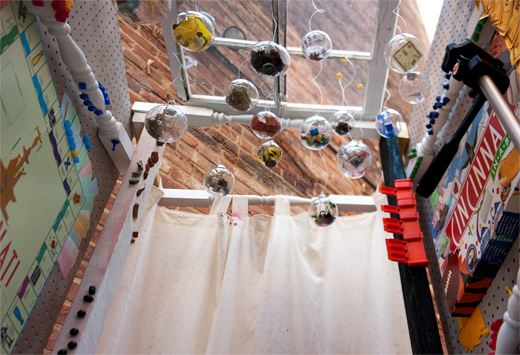 Ethan Philbrick, a University of Cincinnati graduate student and artist, received an individual artist grant award from the city of Cincinnati in 2009 to fund Project CincinnatiUS – a year long series of public performance events tackling societal issues in downtown Cincinnati and Over-the-Rhine. Project CincinnatiUS has already featured collaborations between cultural workers and artists and Philbrick’s most recent effort, The Over-the-Rhine Question Cart,” engages residents the living in Over-the-Rhine and questions their feelings about redevelopment of their neighborhood.
Philbrick collaborated with sculpture artist, Chloe Paisley, to create a mobile cart and the resulting short film about the project. Philbrick and Paisley rode around the neighborhood and asked residents questions about the potential in the area or their fears concerning redevelopment. The film shows a diverse collection of people as they each share different opinions and stories.
In creating the project, Philbrick, a three-year resident of Over-the-Rhine, noted intense feelings associated with redevelopment in the neighborhood. He had heard mixed respones about how renovation wass great for the city, but sometimes difficult and emotional for the people who have roots in this area that are relocating. He decided to make the film to capture those thoughts and emotions.
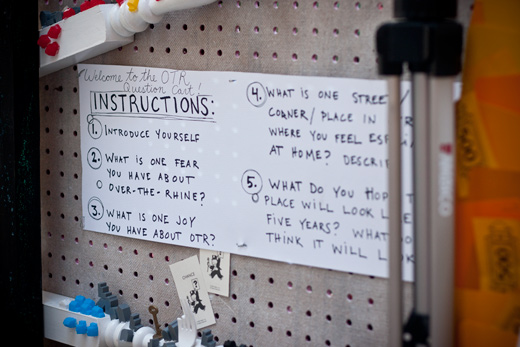 While many residents expressed excitement about the potential in Over-the-Rhine and efforts to make it a better place, some OTR residents shared stories about their fear of having to relocate and not having a place to live in suburban areas where affordable housing is scant. Others shared concerns that redeveloping may not fix the problem of poverty but only disperse it throughout the city. Philbrick wanted to put multiple voices together and see how it made the spectator feel overall.
“The message of the film was supposed to be complex and not a perfect picture of how a lot of people are relating to this neighborhood in different ways,” Philbrick explained.
Philbrick has been showing the film around Cincinnati, and plans to continue showing the film, but you can see it now on Project CincinnatiUS’s website. He wants viewers to engage in more complex thinking about future decision in Over-the-Rhine.
“I don’t want to think about Over-the-Rhine in polarized manner,” Phibrick said. “I wanted to make it quickly and see what kind of work it can do in the world at this moment.”
Writer: Lisa Ensminger
Photography by Provided.
Author

Related Articles
Coming Clean: 5 questions with musician Michael Ronstadt
Hailing from a family of musicians (including aunt Linda), it comes as no surprise that Ronstadt began playing music while in grade school.
Community art and skating event “PaintNSkate” transforms Cincinnati’s Riverfront Rink
At the heart of the mural spanning half of the rink is a powerful concept: celebrate everyday people and years of grassroots engagement at the rink.
Nation’s oldest, continuously operating stained-glass studio calls Middletown home
Inside a historic downtown building, BeauVerre Riordan Studios continues a rare artistic tradition.