Transportation

West MLK Drive improvements include enhancements for pedestrians, cyclists

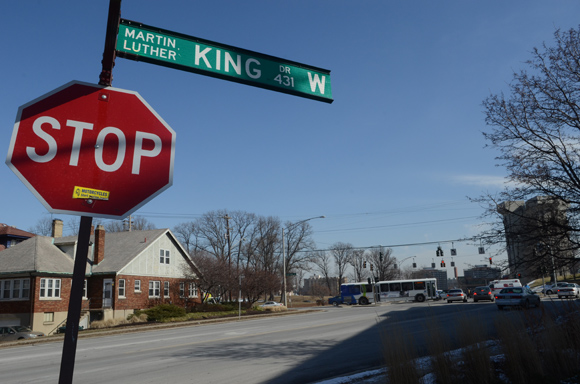
Plans to reconstruct a stretch of Martin Luther King Jr. Drive between Camp Washington and Clifton will drastically change the landscape there while improving safety for motorists and access for pedestrians and bicyclists.Thirty buildings on the north side of MLK between McMicken Ave. and Dixmyth Ave. will be razed to make way for wider lanes and a bike path. The on-street parking currently available in front of the homes, which cause numerous accidents every year, will be removed. Construction is expected to begin in the summer of 2014.The MLK West improvements, which run from McMicken to Clifton Ave., will include a new median, sidewalks and wider lanes in areas. A 12-ft-wide off-street "multi-use" path will run the complete length of the project, and will connect with a path planned as a part of ODOT improvements near the I-75 Hopple Street interchange at the bottom of the hill. When both projects are completed, bicyclists and pedestrians will be able to travel from Clifton to Camp Washington on a path separated from the road by several feet of grass. The intersection of MLK and Clifton will be reconstructed to improve pedestrian safety and traffic congestion there.The plans were selected from several different options that had been floated to the community in past public forums. At a recent public comment meeting on the project, the public left no comments. Project manager Andrea Henderson from the City's Department of Transportation and Engineering took that as a sign that the right option was chosen, she said."This was the most cost effective and actually the most desired option, so we were very happy we didn't have to force this alternative on anyone," she said.Between Dixmyth and Clifton avenues - the eastern portion of the project - property on both sides of MLK is owned by the park system and Henderson said a median and lane expansion were not planned for that area, just the bike path.Residents of the buildings who must be relocated by the City of Cincinnati include University of Cincinnati Students and elderly residents, Henderson said. The process of relocation could prove difficult for some, she said."I suspect that UC students renting there will have no problem finding another place, but it's the older people, or people with some sort of issues, that might need a lot of help and its our obligation to help them," she said.Writer: Henry SweetsPhotography by Scott Beseler.

Latest in Transportation
Cincinnatians Making the Most of their Tweets

Hundreds of millions of people use social networking sites to connect in the online world. Facebook is about friends. LinkedIn is for business. YouTube is all about videos, and Flickr is a place to share photos.  So who is making the most of Twitter in Greater Cincinnati?

Micro lender Bad Girl Ventures embarks on next class of female entrepreneurs

Bad Girl Ventures, Cincinnati's women-focused micro-lender, has narrowed down the finalists for its upcoming business class.BGV, a nonprofit created by local attorney Candace Klein, is based on the micro-financing model of international organizations like Kiva where small loans from individuals are bundled together.  Ten women-owned startups will undergo a six-week entrepreneur curriculum where they will learn the building blocks to starting a business and be responsible for submitting a business plan, WBE application, etc.  Classes are open to anyone who needs training; you can find the class schedule here.The organization's first class finished up last fall and the model has proven attractive to small and large investors alike. Originally Klein had planned on offering one $25,000 loan to one entrepreneur through a competitive process. This time around, BGV has 150K in loans to award businesses that meet loan criteria. Major investors include 5/3 Bank and the Columbus-based Economic and Community Development Institute. Klein is also talking to US Bank and a couple of other lenders that are also looking at investing."We accept much lower credit scores than a traditional lender. We believe that a lot of women have struggled with the economy and divorce, which has affected their scores temporarily. The lenders like us because we can bring the women in, train them and help them raise their credit scores, making them more likely to be a successful candidate for loans in the future," Klein said.This class encompasses a wide variety of entrepreneurs, from a towing company to a couture bridal and evening wear designer. Take a peek at the new class: Allison Kulage, Bare Knuckles Marketing, online marketing Jessica Goldberg, Roomations, connects freelance interior designers with homeowners Lyn Bucalo, Serket Jewelry, high fashion, custom jewelry Andrea Brady, Empowering Innovations, web and mobile application designed to help children overcome fears Lindsey Lusignolo, Lindsey Lusignolo, couture evening and bridal wear Robin Gentry McGee, Just Great Foods, natural, healing foods producer Temeca Jones, Funducate, fun and educational merchandise for children Amanda Kelly, Amanda Kelly Salon, salon for the young professional in downtown Cincinnati Rebecca A. Huber, The Rutile, fine jewelry concierge service Dinita "Dee-Dee" Smith, TriState Towing, family owned towing companyYou can follow Feoshia on twitter @feoshiawrites

All Aboard in Cincinnati?

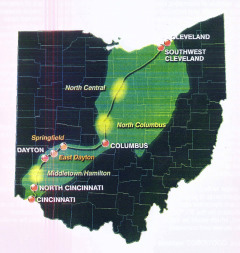
The 3C passenger rail plan would link Ohio's major cities and provide connections to regional hubs in Chicago and on the East Coast, but Ohio's next governor doesn't want it. How about you Cincinnati?

Local author’s history of Cincinnati’s incomplete subway looks to future developments

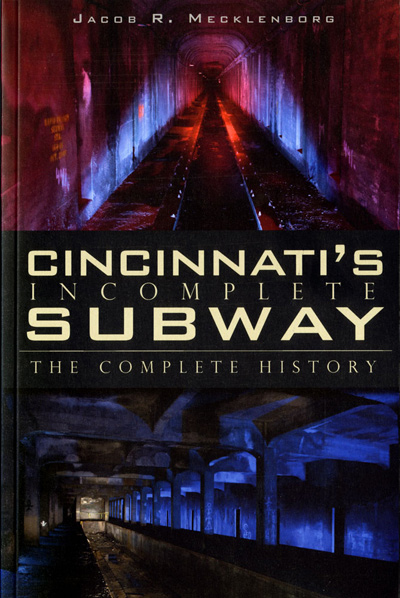
When Jacob Mecklenborg set out to write a book about the two miles of empty subway tunnel that lie beneath downtown Cincinnati - a catacombish network of concrete that has never heard the clang of a rail car - he had no idea how much history he would uncover."I made the mistake of thinking because I had written an article on it ten years earlier that I had a really big head start, but that was not the case," he said at a book signing at Neon's in Over-the-Rhine. "So much of this story had never been told," he added. His new book  "Cincinnati's Incomplete Subway; The Complete History," covers 150 years of rail development in Cincinnati, most famously one called the Rapid Transit Loop which included the two-mile subway tunnel. The bond issue that funded it did not provide enough money to complete the project once material costs skyrocketed after WWI and, as Mecklenborg's book follows in meticulous detail, repeated efforts to resurrect the tunnel over the next 90 years failed as well.  Mecklenborg argues that while pro-automobile federal policy exacerbated efforts to build the line, local smear-campaigns and inaccurate media coverage were what effectively killed it.A photographer and graphic designer by training, Mecklenborg was commissioned by the History Press to write the book after one of their editors read an article about the subway that he wrote and published on his website, Cincinnati-transit.com.A transit-enthusiast, Mecklenborg warned that the same problems that kept the subway from being built still threaten transit issues in Cincinnati."The struggle for all of us who are interested in improving the public transportation situation in Cincinnati is that the local media does not report state law, federal law, and the transit situation here in an accurate way," Mecklenborg said. "People can say whatever misinformation they want, and they don't get rebuked or fact-checked."One common misconception that the subway failed because rail cars wouldn't fit, is entirely false but still persists, he said. That particular myth was promoted by a group of young politicians who were trying to embarrass the political establishment that built the tunnel.Mecklenborg attributed the recent success of Cincinnati's streetcar campaign to the advent of "fact-checking" web sites that informed local voters about where funding for the system would come.  He believes the original subway tunnel might still be used to house light rail transit someday, and tells his readers what infrastructure improvements would be required to do so.Mecklenborg, who has an encyclopedic knowledge of local transit history, sums up his hopes for the future in the book's introduction: "I believe that this book will help clear the fog surrounding the subject, and in doing so remove the subway's construction and nonuse as a dependable "argument" of anti-rail, anti-city forces."Mecklenborg's book is available through History Press.Writer: Henry SweetsPhotography provided.

Terry Garcia Crews, METRO CEO & General Manager

New METRO CEO & General Manager, Terry Garcia Crews, takes time from packing her belongings in Austin to talk with Soapbox Managing Editor Sean Rhiney about public transportation in Cincinnati.

All aboard Metro’s Fun Bus

On December 5, Cincinnati Metro will launch a new route focused on fun. Four brand new 30-foot mini hybrid buses will run a re-routed route 1, now deemed the "One for Fun!" Presented by Hollywood Casino, the vehicles (funded 100% with federal stimulus dollars) will seat approximately 25 people and the route will run from 6 a.m. to 7 p.m., every 30 minutes, Monday through Sunday, offering around 54 trips a day. The re-vamped beat will stop at dozens of Cincinnati's best spots for arts and entertainment. The attractions include the Cincinnati Museum Center at Union Terminal, Music Hall, Great American Ballpark and Paul Brown Stadium. "The One for Fun bus will make it even easier for visitors and people in this region to participate in the unique and special arts & culture of our community - the theater, music, dance, galleries, museums, zoo, and more," said Margy Waller, vice president of ArtsWave. "Our arts make the community vibrant and fun. And here at ArtsWave, we're excited that Metro is making it so easy for everyone to come together through the arts," Waller added. The route replacing the current Rt. 1 Museum Center-Zoo will improve the route for both local residents and visitors to Cincinnati. "It's going to be such a convenient route for visitors," said Jill Dunne, public affairs manager at Metro. "If someone is staying at a hotel downtown and their spouse is going to a conference or if they're on vacation, they can hop on Route 1 go to the attractions, get back on and get back without having to call a cab or finding other transportation or parking. It will be the best way to hit all these attractions, making it a great asset to the city."The Metro, which has been serving the Cincinnati area since 1973, has received positive reactions during an open house held in October. The increased frequency on the route, the new busses wrapped in cool, distinctive designs and the added locations hope to attract more riders who haven't had the chance to get familiar with the Metro system. The route will still service the same neighborhoods and hospitals as the previous route did. Metro has also partnered with the Cincinnati Park Board to have Eden Park and the Krohn Conservatory on the new One for Fun bus route. "The Krohn Conservatory is free admission to the public, and adding the direct bus service makes it even more accessible for our citizens," said Julie Horne, chief public information officer for Cincinnati Park Board. The Krohn Conservatory partners with the Cincinnati Zoo and area students on research projects; the new service will improve the ability for students to visit for their projects.The One for Fun will visit 55 unique attractions and the route is around one hour from end to end. Riders can purchase an unlimited monthly pass for $70, buy tokens at the Mercantile Building in Government Square or pay the standard route price of $1.75 in cash with exact change. For more information, check out the One for Fun route and Cincinnati Metro.Writer: Rene BrunellePhotography provided.

New report discovers faster initial travel times for Ohio’s 3C Rail system

A new report released by the Ohio Rail Development Commission (ORDC) shows that initial speeds for the proposed 3C Rail Corridor could be faster than first thought.  The ORDC worked with Woodside, an industry leading railroad modeling firm, to produce the report and find new travel efficiencies.The new report included a draft schedule that showed passenger trains traveling the corridor's entire length, 259 miles, in just over five hours.  The five hour travel time equates to average speeds of 50 miles-per-hour.According to Amtrak, the initial travel speeds are some of the fastest of any recently developed system, and the third fastest since 1980."All statewide intercity rail systems in the United States were first introduced at lower speeds and evolved over time to higher speed service," explained Ken Prendergast, executive director of All Aboard Ohio.Trips between Columbus and Cleveland are projected to be even faster and boast average speeds close to 60mph.  This would result in a two hour and twenty minute trip from downtown Columbus to downtown Cleveland - about the same as driving an automobile.Project officials say that negotiations with the freight railroads are ongoing and could result in even faster speeds.  For now though, Ohioans should expect a system that has top speeds of 79mph and average speeds between 50 and 60mph.Cincinnati's service would include three daily trains.  Based on service to a proposed Lunken Airport-area station, northbound departures would leave at 6:30am, 12:30pm, and 4pm.  Southbound arrivals would roll into town at 12:01pm, 6:01pm, and 9:31pm.The 3C Rail Corridor is part of a larger Midwest regional rail plan that connects most major cities throughout the mega-region with one another.  Officials say that the $400 million 3C Corridor could be operational as early as 2012 and create more than 8,000 jobs.Stay connected to ongoing progress and news on Ohio's 3C Rail Corridor by becoming a fan on Facebook.Writer: Randy A. SimesImage ProvidedStay connected by following Randy on Twitter @UrbanCincy

SORTA’S Colin Groth makes Mass Transit’s 40 Under 40

MassTransit, sponsored by New Flyer, published its 2010 Top 40 Under 40 Award, recognizing the leadership and dedication of individuals in business. SORTA'S Colin Groth made the list, as he rose to the position of government relations director due to his commitment, professionalism, and work ethic with political environments of local, regional and national governments. Groth is now a part of the development of the intermodal transit center in Cincinnati. He is actively involved with the community and will help improve the public transportation system by meeting the community's needs and enhancing Cincinnati's competitiveness in the global economy. Read the full story here.

Cincinnati’s bikers, scooterists will get more city parking free of charge

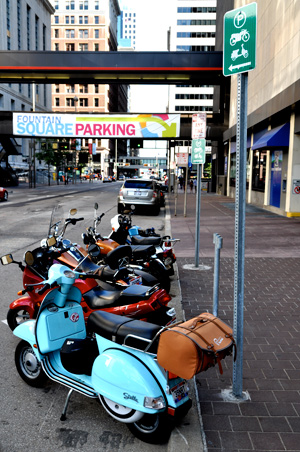
The City of Cincinnati took a big step last week to help out the two-wheeled motorists traveling in its borders.They voted to set aside funding to maintain, improve and expand a free parking program for motorcycles and mopeds in Cincinnati. The next two spaces will be built in Clifton; one on McMIllan and one on Calhoun streets, in the next two months.A pilot project begun in 2009 provided a few parking spaces for motorcycles and mopeds downtown, mostly near Fountain Square. The spaces were striped for three or five bikes at time but motorists quickly maximized the use of that space, packing in as many as 10 and sometimes overflowing onto the sidewalks or adjacent spaces."Basically every spot was having twice as many vehicles parked in it as we anticipated," Melissa McVay, a planner in the Transportation and Engineering department who works on the project, said.The overwhelming response encouraged the department to expand the project, and propose two-wheeled parking fees to fund construction of new spaces. The council was adamant that the spaces remain free, McVay said, and they opened access to another funding source last week.The new corral-type spaces will allow motorists to "self-regulate" the layout of their bikes in the most efficient way possible within a painted border, she said."Riders are very respectful towards each other," McVay said. "They pack them in as closely as they can."The city's director of transportation and engineering, Michael Moore, said his department plans to install motorcycle and motor scooter parking spaces downtown and in surrounding neighborhoods as new streetscape and sidewalk improvement work allows.Three more spots were planned during the pilot phase, but the city will contact two-wheeler communities to see if they still consider the new locations to be ideal before they are constructed, McVay said. One is slated for Central Parkway near the Coffee Emporium, a second on Main Street behind the Aronoff, and a third near the intersection of McFarland and Elm Streets.McVay said the project was begun because riders are not allowed in most parking garages downtown. She said she thought the program has already encouraged people to choose their two-wheeled mode of transit over their car.A map of current locations can be found here - anyone interested in suggesting locations for new spots, or providing feedback on the three mentioned above is encouraged to email twowheeler@cincinnati-oh.gov.Writer: Henry SweetsPhotography by Scott Beseler

Our Partners

Don't miss out!

Everything Cincinnati, in your inbox every week.

Close the CTA

Already a subscriber? Enter your email to hide this popup in the future.