Trans Empowerment Network is building infrastructure where formal systems often fall short
Trans mutual aid is not a substitute for public services, nor is it charity. It is a practice rooted in shared responsibility, relationships and trust.
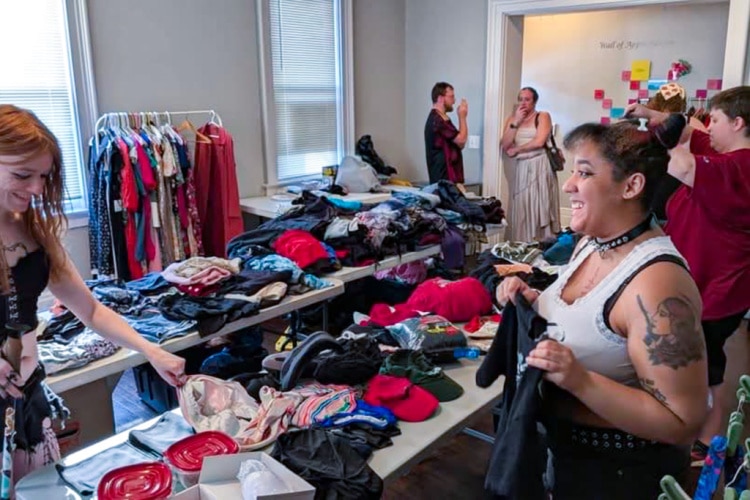
On a recent afternoon in Cincinnati’s Northside, a clothing rack fills a room at CAIN (Churches Active in Northside). There is no cash register. No intake form. No eligibility checklist. People browse, talk, laugh and share food. Some are newly transitioning and looking for clothes that finally fit their sense of self. Others are unhoused and just want something warm. No one is asked to justify why they are there.
This is what mutual aid looks like in practice for TEN, the Trans Empowerment Network, a trans-led community network quietly building infrastructure where formal systems often fall short.
TEN began several years ago as a storytelling group for trans and gender-nonconforming people. Over time, it evolved into something broader and more durable: a web of support that blends social connection, material aid, and collective care. The group is volunteer-run and largely self-funded, operating without nonprofit status or major grants.
“We’re not a charity,” said Noelle Ash, a board member with TEN. “We’re just people volunteering to help each other.”
On a day-to-day basis, TEN functions through shared digital spaces and in-person gatherings. The group maintains active online spaces where members check in, trade resources, vent, joke, and process trauma. The simplicity of the model is intentional. For many trans and gender-questioning people, especially those early in their journeys, being seen as fully human in ordinary moments can be grounding.
Monthly events bring that connection into public space. Some are purely social: board game nights, community walks, and a book club. Others are more targeted. TEN hosts support groups for trans femme participants and for anyone who is not cisgender, welcoming those who are still questioning their identities.
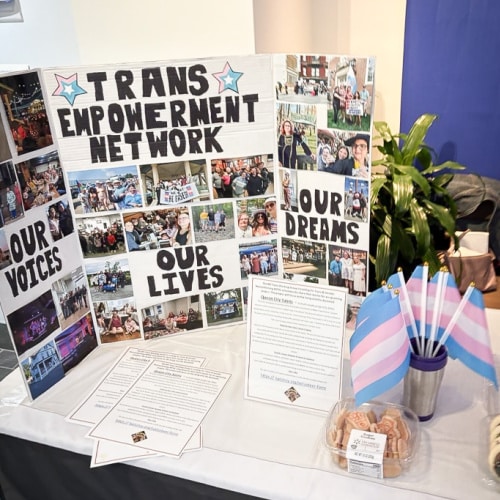
A central effort is a monthly free queer pop-up shop hosted at CAIN. What began as a safe place for trans people to shop for clothes as they transitioned has expanded over time. The pop-up now functions as a hybrid clothing swap, potluck, and outreach space.
On shop days, organizers stock an outdoor community fridge with food, often preparing meals themselves. Free clothing is available not only to trans participants, but also to unhoused neighbors who stop by. Volunteers sort donations, assist shoppers, and create a space where people can linger without pressure to leave.
CAIN, a long-standing Northside nonprofit focused on housing stability, homelessness prevention, and community support, plays a key role in making this kind of low barrier work possible. By opening its space to TEN’s monthly pop-up, it becomes part of a shared neighborhood safety net where different forms of care intersect rather than compete.
This approach reflects how TEN understands mutual aid. The focus is not crisis response alone, but dignity and autonomy. People are trusted to identify what they need. Help is offered without surveillance or judgment.
The stakes for this kind of community-built infrastructure are high. National data consistently show that transgender people experience significant gaps in support. A recent Pew Research Center survey found that a majority of LGBTQ+ adults believe there is little or no societal support for transgender people in the United States, even as acceptance for other LGBTQ+ groups has grown. Other national surveys have linked lack of support to elevated risks, including mental health crises and social isolation.
Youth data underscore the urgency. The Trevor Project reports that nearly half of transgender and nonbinary young people in the U.S. have seriously considered suicide in the past year, and that many who sought mental health care were unable to access it. Researchers consistently identify community connection and affirming support as protective factors.
What networks like TEN interrupt is not only material deprivation, but isolation itself. Isolation is a risk factor. Community spaces reduce that risk by making people visible to one another, creating informal accountability, and ensuring fewer people fall into crisis unnoticed. Mutual aid functions here as prevention as much as response.
As the network has grown, so have its connections. TEN members are entwined with other mutual aid efforts across Northside and the greater Cincinnati area. Referrals move in both directions. Someone may arrive through another group or be redirected elsewhere if their needs fall outside TEN’s scope. Rather than competing for visibility or resources, the goal is to strengthen the broader ecosystem of care.
TEN also supports and promotes the Transgender Advocacy Council and its Trans Emergency Fund, which provides small emergency grants to trans people in the Cincinnati area. Rather than duplicating that work, TEN acts as a connector, helping people access existing resources as part of a wider safety net.
Ash traces her understanding of this work back to an early experience at a support group years ago, when a trans woman leading the meeting said, “To be trans is to be an activist.” Not because every trans person seeks that role, she said, but because visibility itself becomes political.
The emotional toll of that reality is real. Ash acknowledged that there are days when leaving the house feels heavy. What sustains her, she said, is knowing she is helping others face the same conditions together.
Care extends inward as well. TEN is guided by a seven-person board, each bringing different skills. Over time, many events have become largely self-sustaining as community members step into leadership and take ownership of programming.
TEN also maintains boundaries. Some events are trans-only, creating space for conversations that require shared experience and privacy. Others explicitly welcome allies and families, offering opportunities to bridge understanding without placing the burden of education on those already carrying it.
For people unfamiliar with mutual aid, TEN’s work challenges common assumptions. Mutual aid is not a substitute for public services, nor is it charity. It is a practice rooted in shared responsibility, relationships, and trust. For trans communities, that trust can be socially essential.
Author

Related Articles
No Kings, no party lines: A different crowd takes shape in the Queen City
Speakers addressed the fragility of democracy and authoritarianism. Civic organizations recruited people for voter registration, mutual aid, nonviolent disruption, strikes, boycotts and other coordinated-action efforts.

Superintendent Debbie Houser retires in August leaving Middletown City Schools in a good place for her successor
During her tenure, programs increased student proficiency, reduced chronic absenteeism and included a collaborative initiative to introduce students to wider career opportunities.
An ambitious vision, the Triangle Trail would connect more than a dozen communities. It’s making progress.
The 42-mile path would improve access to recreational opportunities in communities through the Mill Creek Valley.