Cincinnati

Queen City Angels host 10th annual entrepreneur boot camp

Cincinnati venture mentoring and investment firm Queen City Angels held its 10th annual Entrepreneur Boot Camp June 6 and 7 at the Health Foundation of Greater Cincinnati's offices. For two days, entrepreneurs networked, met and learned from guest panelists, Queen City Angels' experienced members and each other."These are entrepreneurs who are starting their first business, or haven't raised money from strangers before," explained Jim Cunningham, Queen City Angels member and executive director of C-Cap, Cincinnati's angel capital hub. He noted that the two-day seminar focused heavily on financial and funding matters. "That's what we do, and most entrepreneurs don't have a financial background."As local entrepreneurs and experienced venture capitalists discussed topics ranging from online branding to creating a business plan that appeals to investors, attendees took copious notes and enthusiastically asked questions. Often, one attendee would help answer another's question, giving the seminars a sense of thorough, complete engagement on both sides of the speaker's table.Jocelyn Cates, who founded the Cincinnati Innovates prize-winning business Venue Agent, said she attended the boot camp after her experiences in Queen City Angels' Morning Mentoring program. She noted that much of the seminar served to reinforce the value of coaching and networking, two key aspects of her business as she prepares to seek additional financing."I want to make sure I have all the tools under my belt," she said.Selena Cuffe, founder and CEO of wine importer Heritage Link Brands, said being part of the boot camp helped her clarify plans to handle her company's early growth; in the first six months of 2011, she said the company has already exceeded its 2010 sales by 40 percent."I came here to try and decide how to best move forward," she said. "When you're going through the steps of taking your business to the next level, it's nice to have somebody you can bounce ideas off of before you do that," she said.Queen City Angels chairman Tony Shipley said the boot camps don't only offer a chance to help entrepreneurs like Cuffe and Cates move forward; they also inspire and energize the veterans who come to provide advice."It's always good to be engaged with people who are passionate about taking good ideas and bringing them to market," he said. "From the investment standpoint, you get to see all these neat ideas and meet people making the ideas happen. It's high-energy stuff." Story: Matt CunninghamPhoto: Courtesy of Queen City Angels


Latest in Cincinnati
Countywide landbanking plan in the works

Steps are being taken to take advantage of a state law passed last year to form a County Land Reutilization Corporation (CLRC), or "Land Bank" in Hamilton County. A CLRC helps communities recover from foreclosure and blight which negatively impact property values, increase insurance costs, and decrease tax revenue. If implemented, it could help stem the repercussions from foreclosures in Hamilton County that increased 168% between 1999 and 2010. To accomplish this it will first require some cooperation amongst the county's 49 villages, townships, and cities. According to Ohio HB 113, a CLRC could assist the county acquire vacant and abandoned properties through tax foreclosures from lenders, banks or even on the open market. After clearing title and any liens against the properties, a CLRC can redistribute them or enter into negotiations and contracts for purchase and development."The purpose of the land bank is to take properties that the private sector sees no value in touching and clearing title, extinguishing liens [and] place them back into a situation where the private marketplace can do what it does best - develop," said Assistant Hamilton County Administrator Jeff Aluotto, who is overseeing this project. Funding is one of the first issues that must be addressed, so county administrators are reaching out to local governments to explain the benefits of establishing a CLRC. The creation and annual operating of a CLRC adds 5% to the amount collected through the County's Delinquent Tax and Assessment Collection Fund (DTAC). Delinquent taxes are collected by the County on real property, personal property, and manufactured and mobile homes. Hamilton County currently receives 5% of all delinquent taxes collected countywide which is evenly divided between the Treasurer and Prosecutor for use in connection with the collection of these delinquencies. The creation of a CLRC would enable the county to collect an additional 5% of delinquent tax revenue, or a projected $379,735.60 from the City of Cincinnati, and the county's villages and townships, according to data supplied by the Hamilton County Planning Partnership.Aluotto said there are several administrative steps which must be taken first in order to legally establish a CLRC including creating a board. He anticipates resolutions will be prepared for County action later this summer, formally creating the entity that will oversee the process. That Board will be given latitude about whether it pursues foreclosed properties alone, or accepts property donations or even purchases properties. Alutto said that the Port Authority of Cincinnati could be tapped to manage the CLRC. "Leveraging the economic development powers of the Port is certainly high on the county's agenda and it appears to be so at the city as well. Any opportunity we can take to participate jointly with the city on this is very important," Aluotto said. And while countywide 'buy in' isn't technically needed for creating a CLRC, Aluotto says these communities are necessary in order for it to be successful, and in many cases, may be the first to benefit from its work. "The demand for the establishment of the land bank has come primarily from many of these communities which are really on the front line of battling the problems of blight and abandoned propertied spurred in part by the foreclosure crisis."Writer: Sean RhineySources: Assistant Hamilton County Administrator Jeff Aluotto, Catalina Landivar-Simon, AICP, Hamilton County Planning Commission

Sustainability partnership enhances businesses, collaborative development projects

 Local green-minded companies have established a network that compliments their respective development projects in the region.Collectively known as Sustainability Partnership of Cincinnati , it's the brainchild of Ben Haggerty, owner of Green Streets. His company specializes in storm water mitigation and vegetative roofs. The other companies are complimentary to Green Streets, and vice versa and include Environmental Services, specializing in water conservation and landscaping; Greener Stock, construction materials and workshops; Eco Environmentals, geothermal systems; Tre Sheldon, environmental law expert; Patterned Concrete of Cincinnati; and Greenbau, architecture and construction."We're very new," Haggerty says in reference to the Partnership that was established last fall. It's looking to secure its first collective bid, he adds, but the companies involved have seen an uptick in referrals. "This is baby steps without a doubt, and I honestly think this is a franchisable business model," Haggerty says. "Our ideal scenario is that we are approached by an individual who is looking to build and we are able to provide them with two architects, all the green building materials they could wish for and almost every complimentary and environmentally friendly service that anyone could ever wish for. It's almost a one stop for design and build, even though we're separate companies."Haggerty says he got the idea of forming a green network after he met a solar panel expert at a home and garden show."It became apparent that he wasn't aware that when you place solar panels around a vegetative roof ... it actual makes the solar panels more efficient because you're lowering the roof temperature by a significant amount."The light bulb turned on, he remembers. "Why not trade off on that relationship and create a reciprocal one in that respect?"Greener Stock was one of the first companies to join the Sustainability Partnership, as it and Green Streets were collaborating months before. Greener Stock's owner and lead architect Heather Curless says the partnership makes perfect sense."We're all working in different circles, so we're all hearing about different projects at different times. The nice thing is that most of us in the partnership are one or two-man shows," she adds, "and it gives us an opportunity to bounce ideas off of people, to talk about new technologies and to get ideas from people that larger companies would have in-house."As Greenbau's Tony Beck explains: "I can refer to others in the partnership to answer questions a client may have or refer the client to them."For now, the partnership is meeting on occasion. Haggerty is without a doubt the most vocal member among the partnership, which he deems an honor system of sorts."This is a small community in a small town, and I'm a firm believer of doing business on a handshake. When I'm in a meeting, I pitch for every business."Writer: Rich Shivener

Chill Shaved Ice brings cool twist to summer treat at Findlay

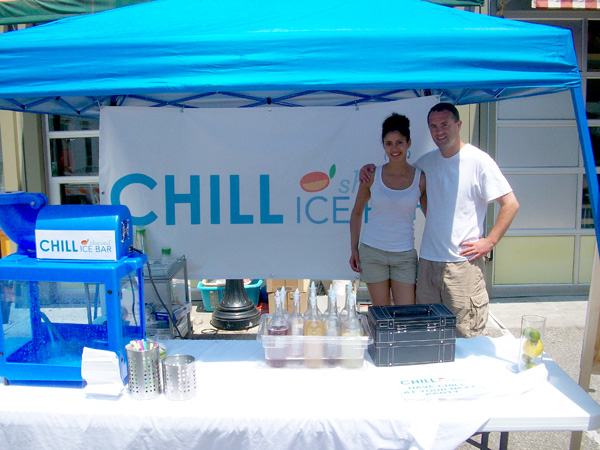
 Just in time for rising temperatures, a new business at Findlay Market is bringing natural ingredients to an old summer standard: shaved ice. Cincinnati local, Alia Ali, started Chill Shaved Ice to share her passion for natural ingredients and healthy eating through a tasty summer desert. Stationed at Findlay Market on the weekends, and at other local mobile destinations during the week, Ali has already received positive feedback for her new and exciting idea. Ali, a fitness instructor, always wanted to increase community awareness about the importance of what you eat. "I feel passionate about eating healthy and showing people that there are other alternatives and how it is not as hard as one may think," Ali explained.So two months ago she began experimenting with different fruits, flavors herbs and natural cane sugar to make her natural syrups. She recently made watermelon mint syrup by cooking and mixing cane sugar. Ali said she adds other herbs to weaken and strengthen the flavor of the syrup. Her first taste-test weekend at Findlay Market was a success as many people were pleasantly surprised with the new twist on an old favorite. "People were a bit hesitant at first, asking questions because it wasn't something they were used to like your standard chemically processed syrups. But customers were pleasantly surprised, asking questions about the process and other services I may provide," Ali said.She plans to stay at Findlay Market for the whole summer on the weekends and travel around to different local destinations during the week."Findlay Market is a neat place. I love the people and the energy at the market. I feel like there are a lot of progressive people involved at the Market, which makes it a nice environment for me as a beginning business owner," Ali said.Ali said future plans include selling bottles of her syrups, selling her product to local bars to provide a new alternative for mixed drinks, and maybe even opening up her own store. Writer: Lisa Ensminger

Wasson Way bike path advocates hope to transform rail spur

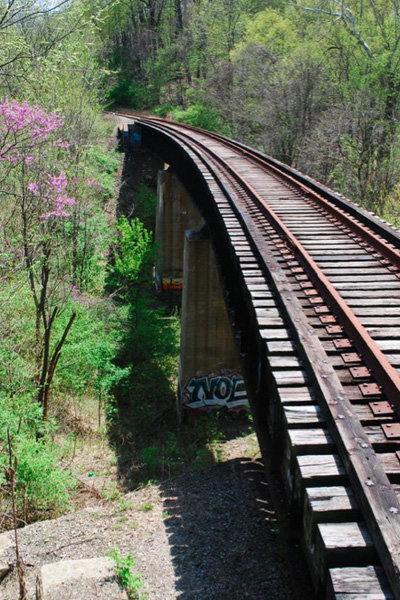
A group of residents from several Cincinnati neighborhoods spoke at the June 7 meeting of Cincinnati City Council's Quality of Life Subcommittee. Their subject? A recently closed railroad spur and a proposal to change it into a 6.5-mile cycling and walking path."This could really serve as an important connector for the many [multiuse path] projects Cincinnati has going on," said project advocate Jay Andress.The proposed project would convert a Norfolk Southern Railroad spur into a path that would connect with the Little Miami bike trail in Newtown and run into the heart of downtown. Advocates at Tuesday's meeting pointed out that the path would only cross seven roads in its entire length, making it a true rarity: a nearly uninterrupted trail running through several neighborhoods in a major urban area.But beyond the health benefits and transportation options that the path could provide, some residents at the meeting brought up another point: building the path could resolve a growing problem with the semi-abandoned line.Hyde Park Neighborhood Council President Anne Gerwin said the point where the line crosses Wasson Road has been a maintenance and safety issue for years. "We struggle many times each year to have the city and railroad maintain it," she said. The neighborhood's council passed a resolution supporting the project.Likewise, Hyde Park resident Lindsay Felder, who said her home is within sight of the track, said there's been a visible deterioration of it - and an uptick in people loitering along the weedy path - since it became inactive in 2009."We've always wondered about the tracks," she said, explaining that she began going door to door to drum up local support after meeting Andress and learning about the proposed project."We see it as a great upcycling of existing property that is underutilized," she said.Subcommittee chair Laure Quinlivan said there are a number of details to clarify before the project moves further forward, such as determining if Norfolk Southern has future plans for the line, and if an arrangement can be made that would allow the city to adapt the path into light rail if that becomes a future transit option."This is really a great proposal," she said. "The best ideas don't always come out of City Hall. If we could make this happen, it would be such a great asset to so many residents."Story: Matt CunninghamPhoto: Wasson Way Project

Teens find glee in Cincinnati Harmony Festival

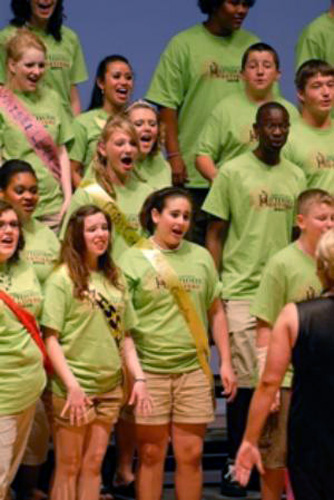
While their classmates may be hanging out at the pool or lounging on vacation, nearly 100 hopefuls pack their bags and head to Northern Kentucky University for a chance to learn new songs, discover new ways of singing and meet like-minded teens. They mix multi-part vocals and specialized choreography. And after four days and three nights of professional vocal music education, rehearsals and coaching, they perform. Oh, yes, they perform.At the sixth annual Greater Cincinnati Harmony Festival, teens create a Glee-like evening of song and dance. "Gone are the days when families would gather around a piano and sing together for fun, so we strive to support the school music programs in their efforts to encourage?young people to find the enjoyment of making music," says Paul Coleman, music chair of the Harmony Festival and director of The Delta Kings Chorus.The festival celebrates the American folk art of barbershop singing, which blends four parts of a cappella voices together in tight harmonies that when executed perfectly, creates the sound of a fifth voice, also known as expanded sound. As performed since the late 1800s, barbershop mixes African-American musical devices, European hymn-singing culture and the American tradition of social, recreational singing.The festival also gives teens from around the region a chance to live on a college campus and get a sneak preview of college living. After three nights in a dorm, they are ready for the festival's finale, a public performance alongside their peers and professional singers, including coach Brody McDonald, whose high-school ensemble The Eleventh Hour competed on NBC's "The Sing-Off" last year.Do Good:• Watch the video. Find out more about the Harmony Festival when you watch participants in action.• Go to the show – for free! Doors open at 7 p.m. on June 25; show starts at 7:30 p.m. Be sure to arrive early to Greaves Concert Hall to snag a good seat.• Sponsor a scholarship. It costs less than $300 to sponsor a camper. You can even donate online.By Elissa YanceyPhoto courtesy of Greater Cincinnati Harmony Festival

Energy assessments offer layers of savings for homeowners

For a limited time, homeowners in Hamilton, Boone, Campbell and Kenton counties can spend just $50 for a $400 to $500 review of potential energy inefficiencies in their homes, and then apply that $50 toward improvements that will help lower their energy bills.An initiative of the non-profit Greater Cincinnati Energy Alliance, the discounted three to five-hour energy assessment includes an in-depth examination of how well your home's heating and air conditioning are working, as well as trouble-shooting for potential leaks and gaps in insulation. "It doesn't matter if a home is five years old or 105 years old, there are cost effective energy upgrades in almost every home we've ever looked at," says Andy Holzhauser, GCEA's executive director. "It's our job to make the process easy and affordable for everyone in our community."Holzhauser believes connecting homeowners with local contractors who have been trained to find affordable, environmentally sustainable ways to retrofit homes creates a powerful motivation for living green. So, after the energy assessment, the GCEA will discount up to 35 percent of the cost of projects that assessors recommend. "We make the retrofit more affordable," Holzhauser says. "In the case of a $5,000 retrofit, we will put $1,700 to $1,800 of our dollars on the table right alongside the homeowner's investment."Best of all, there are no income restrictions on the discounted assessments and retrofit projects, both of which can lead to lower monthly living costs and better environmental stewardship. "The notion of an investment on a home actually generating a cash return back to you is something that is new," Holzhauser says. "It's at the heart of what we do."Do Good:• Watch a home energy assessment in action.• Find out how much you could save. Sign up to learn your potential savings and request an audit of your own.• Tweet and learn. Follow GCEA on Twitter.By Elissa Yancey Photo by Scott Beseler

New research could shift cities to emulate

We have issues. Specifically, health, social and economic issues in Greater Cincinnati that local researchers explore and write about on the Community Research Collaborative Blog.Monthly entries feature content from researchers at the United Way of Greater Cincinnati and the University of Cincinnati http://uc.edu . On the blog, three 2011 Community Research Collaborative fellows, along with other community contributors, work to describe the socio-economic health of our community.Each month a new post offers a new analysis. The May 2011 post, for example, compares the 1999 and 2009 data about Cincinnati's income growth, which is a measure of all sources of personal income, including wages, health insurance and a wide range of other benefits. The results showed significant progress as well as sobering realities. While the metropolitan area moved from 58th to 24th place out of 366 areas around the country, Cincinnati, along with many of its regional peers, grew slower than the national average. But Cincinnati wasn't alone. Nearly all of the regional competitors that the CRC uses to track our region's progress posted slowed growth. Those cities include: Austin, TX, Louisville, Charlotte, NC, Cleveland, Columbus, Denver, Indianapolis, Minneapolis, Pittsburgh, Raleigh, NC and St. Louis. CRC fellow Janet Harrah, who serves as the senior director of Northern Kentucky University's Center for Economic Analysis and Development, suggests that it may be time to examine similarly sized cities that are managing to beat the national averages when it comes to personal income. Those include Oklahoma City, Virginia Beach, Baltimore and Washington, D.C.Do Good:• Educate yourself. Read about 2010 Census data for our region and see what you could do to make a difference.• Subscribe to CRC's newsletter so you will get the latest news and updates from the researchers.• Check more data. You can download the 64-page report online.By Elissa YanceyPhoto by Scott Beseler

Video The Boys of Summer

Walk the Moon has had a pretty good start to their summer. The local band is percolating on the national music scene with a new album, an opening gig with indie rock icons Weezer, and slots at Bonnaroo and Lollapalooza. Fitting then that the video for the band's single "Anna Sun" has been ordained by Esquire Magazine as their "official song of summer." 

Library’s all-ages reading challenge rewards healthy summer learning

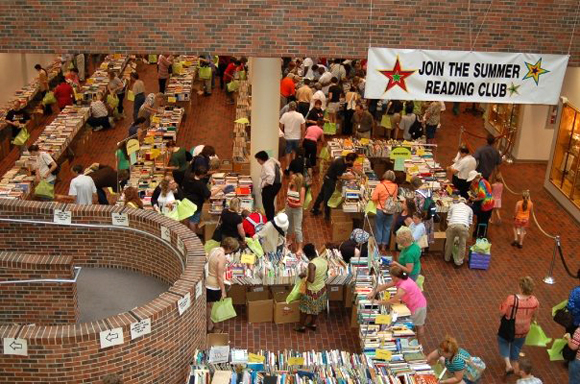
Read five books to your baby and earn a free book. Have your teen read for 12 hours and she'll get ear buds, a book and a chance to win a family four-pack of passes to a Reds game or Coney Island. It's all part of the 38th year of the Summer Reading program at the Public Library of Cincinnati and Hamilton County. Proponents of reading, from Oprah to elementary school teachers, understand that reading improves memory and exercises the brain and imagination. The library's program adds levels of achievement, prizes and activities to fuel the spirit of competition among regional readers.The rules are simple and easy to manage online. Spend hours reading and log your time online (adults can sign up here). Read a little and you'll earn a voucher for a free book at the giant Friends of the Public Library Book Sale. Read a lot and you, and children you read with, can win one of 164 sets of four passes to Reds' games or Coney Island's pool and park. Read the most of anyone at your branch in your category, and you'll win one of 123 Nook color e-readers. Do Good:• Visit the biggest book sale of all. The annual downtown sale at the Cincinnati Public Library runs through June 10. Friday is bag day – buy a bag and get everything you can fit inside it for free.• Find a great gift. Shop at the Friends' gift shop on the mezzanine level of downtown's library.• Be a friend. Join the Friends organization IRL, and on Facebook.By Elissa YanceyPhoto courtesy Public Library of Cincinnati and Hamilton County

Our Partners

Taft Museum of Art

Common Ground Is Brewing

Support local stories and receive our signature roast straight to your door when you join at the Standard level (or above).

Drink Better, Read Local

Close the CTA

Don't miss out!

Everything Cincinnati, in your inbox every week.

Close the CTA

Already a subscriber? Enter your email to hide this popup in the future.