MedCity News reports on Innov8 For Health accelerator class
A Cincinnati accelerator for health IT startups that models itself on groups like Rock Health, Blueprint Health and Healthbox has named its inaugural class of companies. Read more here.
A Cincinnati accelerator for health IT startups that models itself on groups like Rock Health, Blueprint Health and Healthbox has named its inaugural class of companies. Read more here.

As many areas of Cincinnati are being rejuvenated, including OTR and Washington Park, the City of Cincinnati approved a comprehensive approach to focus on development in the city as a whole, not just targeted neighborhoods. Last Friday, the City Planning Commission approved and adopted Plan Cincinnati, which was designed with input from residents. The Plan is an opportunity to strengthen what people love about the city, what works and what needs more attention, says Katherine Keough-Jurs, senior city planner and project manager. The idea is to re-urbanize suburbanized Cincinnati; in a sense, to return to the strengths of the city's beginnings. Cincinnati was established just after the American Revolution in 1788 and grew into an industrial center in the 19th century. Many of those industries no longer exist in the city, which is part of why Cincinnati has become more suburbanized in the past 50 years. One of the long-term goals of the Plan is to bring new industries to Cincinnati. With a new approach to revitalization, Cincinnati is blazing the trail for other cities. With a focus on building on existing strengths rather than tearing down structures and creating new ones, the Plan aims to capitalize on the city's “good bones” and good infrastructure. Cinicinnatians had a huge role in developing the Plan. The first public meeting for the Plan was held in September 2009, when residents offered their insights into “what makes a great city?" and "what would make Cincinnati a great city?” A steering committee of 40 people representing businesses, nonprofits, community groups, local institutions, residents and City Council helped develop the Plan. The Plan also got support from a grant from the Partnership for Sustainable Communities, which the City received in 2010. The grant allotted $2.4 million over three years to support the Land Development Code, which combines and simplifies Cincinnati's codes, reviews the development process, implements Form-based Codes and considers more creative uses for land. The grant allowed the city to start implementing some of the ideas voiced in public meetings. Visionaries included youth, too. City staff worked with community centers and Cincinnati Public Schools to develop an art project for children. They were given clay pots and asked to paint their fears for the city on the inside and their dreams for the city on the outside. The children saw the big issue was quality of life, just like the adults did. “It was an interesting way to get the kids involved and thinking about the future,” Keough-Jurs says. The Plan aims to strengthen neighborhood centers—the neighborhoods’ business districts. It maps out areas that people need to get to on a daily basis and found that most are within about a half-mile of the business districts. But in some neighborhoods, residents can’t access their neighborhood centers. The accessibility of a neighborhood center is based on walkability—not just for pedestrians, but also about how structures address walking. For exampke, if a pedestrian can walk from one end of the neighborhood center to the other without breaking his or her pattern (the window shopping effect), the area is walkable; if he or she has been stopped by a parking lot or vacancies, it’s not walkable, Keough-Jurs says. The neighborhood centers are classified in one of three ways in the Plan: maintain, evolve or transform. Some neighborhoods have goals to maintain levels of walkability, whereas others need to gradually change or evolve. Still others need to completely transform in order to strengthen their business districts. “Cincinnati is at the heart of the region,” Keough-Jurs says. “If we strengthen Cincinnati, we strengthen a region.” The next step for the Plan is to go before the Cincinnati City Council, specifically the Livable Communities Committee, which is chaired by Vice Mayor Roxanne Qualls. By Caitlin Koenig Follow Caitlin on Twitter
Imagine the work that goes into a batch of cookies: mixing, rolling, baking, decorating and washing. Now imagine baking 1,000 cookies per month. That’s how many Debbie DeGeer typically creates at Mt Lookout Sweets, a bakery she runs from her Mt. Lookout home – complete with a commercial kitchen in the basement – each month. That’s 12,000 cookies a year, but DeGeer isn’t counting. Baking helps keep her hands busy and her creative mind active while she cares for her aging mother, who helping instill in DeGeer a love of floury hands and blustery ovens. DeGeer’s mother lives with Alzheimer’s, and the duo spends their share of quiet nights at home. Baking started as “a kind of therapy,” and DeGeer often arrived at Comey Shepherd, the real estate agency where she works, laden with cookies. Her creations with the company logo on them were particularly popular for the company’s open houses, and from there, the requests grew. DeGeer specializes in hand-decorated sugar cookies that are part art and part dessert, and she has a design for everyone. When Keidel, a Cincinnati-based plumbing, cabinetry, appliance and lighting contractor, celebrated its 100th anniversary, DeGeer created confections in the shape of bathtubs, light bulbs and even toilets. “I never thought in my life I would make a cute toilet, but I did,” DeGeer says. Active with other cookie pros, dubbed “cookiers,” on Facebook, DeGeer has about 1,200 Facebook fans for her business, and says it’s a top source of referrals, along with word-of-mouth. Mt Lookout Sweets averages three to four orders per week, with DeGreer's capacity filling up quickly around the holidays and in late spring or early summer as couples plan their weddings. DeGeer typically requests a week’s notice for each order and more during busy seasons. By Robin Donovan
San Francisco, Boulder, New York City. These are the kinds of cities you expect to hear in a lineup of top cities with startup activity. But there’s something in the water in Cincinnati. Read an interview with Brandery co-founder Dave Knox here.
Ethan Snider has had a love affair with food for nearly a quarter of a century. Raised on Cincinnati’s west side, he worked up through the ranks at Macaroni Grill, and eventually became an executive chef. In short, it was a dream come true. Until he hated it. “The corporate stuff just did not appeal to me,” Snider says. “I was there for less than six months.” He ended up at the Culinary Institute of America in Hyde Park, N.Y., where he graduated with a bachelor’s degree in 2004. After that, Snider moved around a lot. He worked at a tiny Batesville, Ind., restaurant that was run out of a three-car garage and after that, at a fine-dining restaurant in Boca Grande, Fla. Moving around was great for a while, but Snider eventually grew homesick. “I liked it a lot, but I started to miss being here; I always wanted to make a name for myself in Cincinnati because this is where I’m from,” he says. After moving back to Cinicnnati, Snider got started with his own food venture at local farmers’ markets because they have low overhead and a home-grown touch. With an eye toward the need for more locally sourced vegetarian and vegan options, Snider launched Summuh (pronounced “SOU-mah”), a specialty hummus shop, first at a farmer’s market in Madeira and, then in Northside and Hyde Park. Most recently, he joined Findlay Market, where he plans to weather the winter months. Snider calls his wares “the Ben & Jerry’s of hummus,” and promises that “you’ve never had hummus like this.” Two of his core flavors are a chickpea hummus with lemon and rosemary and one spiced with cumin, coriander and cilantro and topped with red onions. There are also 12-15 seasonal flavors, including “Squashbuckler,” which features a butternut squash and navy bean base with ancho chili powder, garlic and a spicy black bean relish on top. Though his hummus is organic and local, Snider says he’s no food evangelist. “I’m not trying to convert anyone to what I believe in or change the world." he says. "I just feel that if I believe in something, other people will start to believe in what I’m doing, too.” By Robin Donovan
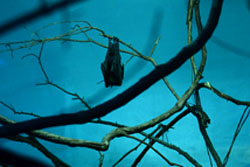
In honor of the season, Soapbox once again partners with the acclaimed literary journal The Cincinnati Review to offer you a tasty tidbit of poetry. Enjoy Brian Barker's "Bats," and read why CR editors fell under its spell.
Born and raised in Cincinnati, Katie Burroughs now devotes her life to making her hometown a better place in a new role as director of the nonprofit Adopt-A-Class. She learned about community involvement through Walnut Hills High School’s community service program as well as her parents’ dedication to volunteer work. Burroughs left home to study English at Wake Forest University in Winston-Salem, NC, and then received her law degree at the Catholic University of America in Washington, D.C. After practicing in northern Virginia, though, Burroughs returned to Cincinnati. She worked as a prosecutor for the City of Cincinnati and Hamilton County and was exposed to children living in horrifying conditions. The experience fueled her passion for mentoring children living in poverty. Then last year, she served as co-president of the PTA at Pleasant Ridge Montessori, where her two children attend school (her twins attend preschool). She realized the impact education has not only on children’s lives, but also the life of a community. Burroughs had attained her professional goals as a prosecutor, so she felt ready to transition into a different, more proactive role in changing children’s lives. “By getting involved in education, my hope and desire is that we will touch lives and in the end there will be fewer people at the back end, where I always saw them [as a prosecutor],” Burroughs says. “If you can direct a kid in the right direction, or just give them that glimmer of hope, or show that someone believes in them and that there is a life outside of poverty and the environment that they’re in, then just may be my former coworkers won’t see them on the back end.” Burroughs is settling into her new role at Adopt-A-Class, a local nonprofit that connects under-resourced students with professional mentors. Founded by Bill Burwinkel, Adopt-A-Class currently works with 24 schools, reaching about 8,000 students. The mentors, typically groups of professionals, form pen pal relationships with the students throughout the school year. Weekly, mentors who are available go to classrooms for activities. Burroughs hopes to increase the number of classrooms adopted. Although there is a waiting list for new schools to get involved, Adopt-A-Class wants to finish meeting the needs of the schools that they are already committed to. “You can’t solve every problem; you’re not going to save every child—I’m not naïve—but you can touch lives,” Burroughs says. Do Good: • Refer a friend to Adopt-A-Class. • Donate to Adopt-A-Class. • Attend the Rusty Ball and choose Adopt-A-Class as your charity. By Stephanie Kitchens
A collaboration between the Uptown Consortium and Hark + Hark sets its sights on engaging community members in Uptown in the arts in new, creative, and super cool ways. Together, they host monthly art events as Modern Makers. This month, Modern Makers presents performances from ALICE (in wonderland) by Cincinnati Ballet II Second Company at the Clifton Cultural Arts Center on Wed., Oct. 17, from 6 to 8 p.m. Modern Makers is sponsored through Uptown Consortium and Hark and Hark, both nonprofits. “Bringing and highlighting arts and the arts environment to uptown Cincinnati by featuring and displaying different art programs and opportunities for everyone…is the main key of what we’re trying to do,” says Janelle Lee, Uptown Consortium’s Director of Business and Community Affairs and a member of the Cincinnati Ballet Board of Trustees. Most of the monthly art shows are held in Corryville on Short Vine or on Glendora Avenue, right behind Bogart’s. About a year and a half ago, Uptown Consortium partnered with Hark and Hark, an art and community-based firm started by two former University of Cincinnati DAAP graduates, Catherine Richards and Ahn Tran, to create Modern Makers. The second season of Modern Makers coincides with UC’s school year, with different art shows each month from August until June. This year’s MM season kicked off with a chef, who prepared food through art. The event was an overwhelming success, according to Lee. All MM events are free and open to the public; food is provided by a restaurant on Short Vine. Each event also features an interactive creative art project; for example, last year for Mardi Gras, participants created masks. In November, Modern Makers will present the second annual “Light Up Short Vine,” Wed., Nov. 28—a Christmas celebration complete with lights, a Christmas tree, Santa Claus and CCM carolers. By Stephanie Kitchens
Walk into Oyler School in Cincinnati and take a right, past the office and through a set of double doors, and you’ll find what basically looks like a LensCrafters. Read more.
Even before it publicly opened last week at Oyler School, doctors at the nation’s first school-based, self-sustaining vision center discovered a fifth-grade boy who has been living virtually blind. Doctors detected the boy’s acute vision problem while testing equipment to prepare for the public opening and dedication of the OneSight Vision Center inside the Lower Price Hill school last week. The self-sustaining vision center also outfitted the boy with glasses, as it is expected to do for hundreds more children. “If you grow up in a world where you don’t know any different, you think this is the way it is,’’ says Craig Hockenberry, Oyler's principal. “You can imagine the impact on learning when a child cannot see the board or a read a book. The vision center will help us get these kids the vision care they so desperately need.” The full-service vision center will provide comprehensive eye exams, glasses, fittings, adjustments, medical eye care and vision therapy with an onsite optometrist, ophthalmic technician and optician. It is expected to serve about 2,000 students per year. A group of public and private partners spent the last two years working to open the center: • Oyler School, at 2121 Hatmaker St., donated the space and will provide for its ongoing maintenance. • The Cincinnati Health Department will operate the center. • The Ohio Optometric Association and American Optometric Association provided expertise, guidance and funding. • OneSight, which is a leading global vision care charity sponsored by Luxottica, provided all exam equipment, eyewear, operational expertise and $300,000 in start-up funding to support the staff. Dr. Marilyn Crumpton, director of the Cincinnati Health Department’s School and Adolescent Health Division, says that the year-round center will be completely self-sustaining through insurance payments, primarily through Medicaid. The issue for many children who need vision services is a barrier to access – not a lack of insurance, she says. About 90 percent of Oyler students are Medicaid recipients. The center now will provide that access and will handle all the insurance filings. In addition, Dr. Crumpton says, the center will provide transportation to other students who do not attend Oyler but are in need of services. They will also deliver glasses to students so they don’t lose learning time in their home schools. Hockenberry says the center fits into the holistic approach to education at Oyler, which is one of the leading community learning centers in the city. Oyler provides medical and psychological services in the school, which is open from about 6 a.m. to 10 p.m. year-round. “We never stop. The whole concept is that we want to be the central hub of activity in our community,’’ says Hockenberry. “The vision center fits perfectly into that.” Hockenberry says that at the same time the center was being dedicated, a team of about 70 educators, politicians and others from New York City were visiting Oyler to see what they're doing and model it back in New York. “I can’t be more proud of what we are doing,’’ he says. Crumpton agrees: “This shows the kids that the community – the whole community – is investing in them to succeed. They are our future. It really makes me proud to call Cincinnati home.” Do Good: • Like Oyler School on Facebook. • Read more about OneSight and its mission. • Read and listen to National Public Radio’s ongoing series “One School One Year” series, which focuses on Oyler. By Chris Graves Chris Graves is the assistant vice president of digital and social media at the Powers Agency.
Our Partners