Cincinnati

Special Report: Emanuel’s transformation

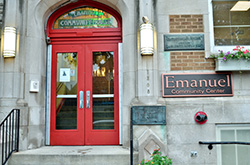
Emanuel Community Center has entered into an agreement to sell its historic Over-the-Rhine building and operate an urban squash program to teach children the racquet sport more commonly associated with Ivy League universities than inner city neighborhoods.  Emanuel, which has struggled financially for the past several years, will sell the 141-year-old building at 1308 Race Street to Grandin Properties, a Hyde-Park based real estate management company, says Emanuel Board Chairman Russ Naber. Grandin plans to convert the building into office space targeted at budding entrepreneurs to grow the area’s burgeoning startup community, says President and CEO Peg Wyant. The agreement comes just weeks after Emanuel abruptly shut its doors, let its staff go, dismantled its daycare and early learning center and notified its handful of tenants they had to relocate. The move shocked many as the board said it was reviewing several options, which included evaluating if Emanuel would continue to exist. The purchase price was not disclosed; however Wyant estimated the total cost—including renovations—will be near $4 million. Neither Naber nor Wyant would disclose how much will be paid to Emanuel. Naber says the deal will allow Emanuel to resolve its debt and become financially stable. The nonprofit listed liabilities totaling nearly $600,000 in 2010—including a $150,000 personal loan made by Naber, according to Emanuel’s tax return. Naber said the nonprofit had not yet paid back that loan. More recent tax returns were not available. But the agreement does call for Emanuel to lease back—at $1 a year—8,000-square-feet for the next 25 years, a value estimated at about $2.5 million. The 37,672-square-foot building and equipment were valued at nearly $2.6 million in 2010, according to the tax return. Plans call for Emanuel to convert the building’s existing gym into squash courts and to fund the racquet program, Wyant says, adding that she is hopeful that “Emanuel’s attractive donor list will be positively influenced by this’’ and those donors will help to fund the gym’s conversion to squash courts. Wyant approached Emanuel in August when she says she heard they were looking at possibly selling the building. Naber calls that meeting serendipity. “What they brought to us was unique. It was truly distinct,’’ he says. “It is what is best for Emanuel and the community.” Naber says details of the agreement need to be worked out, but adds that the Grandin plan meets the nonprofit’s three criteria. “It allows us to continue as a nonprofit, it lets us stay in our current location, which is very emotional for us, and it puts us in a stronger financial place,’’ he says. “Financial stability was key to us.” In addition to the office spaces, which Wyant says she foresees serving as a “hub of entrepreneurial activity,” she hopes to add a restaurant and rooftop gardens, including some that could be used as teaching gardens. The renovation timetable has yet to be finalized, but she says she hopes the work can be completed in six to 12 months, with the squash program up and running in 12 to 18 months. Wyant says several companies have expressed interest in potential office space and at least two have visited the building. “The Brandery and Cintrifuse are interested,’’ she says. The business and innovation incubators on nearby Vine Street will likely need more space to house startup companies they launch in the future. Many want to remain in Over-the-Rhine, she says.    Wyant founded Grandin Properties nearly 25 years ago with a keen eye toward historic preservation and says she has been interested in Over-The-Rhine for nearly 20 years. She says she has been looking for the right building to develop as well as the right opportunity to combine her family’s love of squash with their commitment to giving back to the community. The squash program Emanuel will operate will be modeled after urban programs endorsed by the National Urban Squash and Education Association, co-founded by Wyant’s son, Tim, in 2005. The organization operates 12 programs in 11 cities, including CitySquash in the Bronx and METROsquash in Chicago.  Wyant’s other three adult children are heavily involved in the sport as is her husband, Jack Wyant, who is founder and managing director of Blue Chip Venture Co. Daughter Missy Wyant Smit is on the board of directors of SquashDrive. Jack Wyant is head coach of the University of Pennsylvania’s men’s and women’s squash teams. He has also coached the United States Junior Women’s World Championship teams and competed on the professional Squash Association. The youngest sibling, Chris Wyant, is an avid squash player but is not as invovlved in the game, said brother Tim Wyant.  “We have watched these youth squash programs for years and we know they work,’’ Peg Wyant says. “Not all of these programs work for kids, but these do. We’ve witnessed it. We wanted to bring this to Cincinnati. “Jack and I are committed to Cincinnati and squash—and this program—is something we know about,’’ she adds. “Squash is the hook, but education is really the goal.” Tim Wyant says he has worked with his mother for at least 12 years looking for the right builidng in the right neighborhood to house a nonprofit squash program, which combines academic, athletic and community service for students starting in the third grade. Wyant, who operates the Bronx program and lives in New York, visited Emanuel first in August and again when he was back for the Thanksgiving holiday.  "It's an amazing building,'' he says. "This is really an ideal situation.'' Wyant, who speaks passionately about the program, readily admits that some may see the game as elitist. That is not a bad thing, he adds. "What this does is introduce students to a community very different than their own,'' he says. "Squash is a culture that values education. And the ultimate goal is to have these students go on to college and end the cycle of poverty for themselves and their families." He estimates the programs have collectively sent between 300 and 400 students not only to college, but to very good universities, including Harvard, Cornell, Wesleyan and Amherst. Most students were awarded scholarships. "This is really an inch wide and a mile deep program. We really want to transform the lives of the kids,'' says Wyant, who adds many students are involved a minimum of three times a week and many participate five to six days a week in both the sport and educational programs.  Wyant said he was unsure the cost of coverting the gym into squash courts, but estimated first year operating costs to be between $150,000 to $200,000. In later years, operating costs could reach between $500,000 to $750,000.   "We and the Emanual board have a lot of work to get done on how this will all get done,'' he says. Peg Wyant and Naber both say that another residual outcome of putting the squash program inside an office building with young, talented, smart, engaged and educated entrepreneurs is that they will serve as mentors and role models to the kids in the program. Naber says he hopes the program will serve 70 to 100 children a year and they hope to work with area schools and other programs. Jean St. John, founder and operator of My Nose Turns Red, the youth circus nonprofit that was housed at the Emanuel Community Center, says she is continuing to search for a new space to call home. “We are very sad about the change," St. John says. "There are many successful youth circus programs around the country with a similar focus and I wish they had approached us to explore expansion." They moved to Emanuel as a startup company and she said she expected their rent to grow as it had in the past from $150 per month to $250 per month. “I think they had the right idea under their noses all along and sorry that they never worked with the companies that were already there,’’ she says. Kelly Leon, who used the Emanuel gym for her OTR Jazzercise classes for the past four years, is also looking for a new space that will let people of all income levels work out together. “There were so many bonds created there,’’ says Leon. “It was a very special group.” Naber says the options facing Emanuel were dire. “These are never easy choices. But at some point we had to put our business hats on. We were draining money and we had to do something to fix it.” The building is not Emanuel, he says. It is what the nonprofit has done and will continue to do in the future that is its reason for being. “To me, this is a good thing for the city," he says. "You have to step away and assess it. In the end it will help the children and youth reach their potential and be a success in life. That is what we are all really passionate about. This sustains that.” Do Good ·        Contact my Nose Turns Red nonprofit teaching circus if you know of a suitable space where they might relocate. ·        OTR Jazzercise is also looking for a gym or workout area in or around Over-the-Rhine.  Drop them a message on their Facebook account. ·        Track ongoing developments on Emanuel Community Center’s web site. ·        Contribute to the National Urban Squash Education Association. By Chris Graves Chris Graves is the assistant vice president of digital and social media at the Powers Agency.

Latest in Cincinnati
L’Oreal USA expands, create 211 jobs in NKY

Cosmetics giant L’Oréal USA is expanding in Northern Kentucky, investing more than $42 million in a plant expansion in Florence. The expansion will create 211 new jobs. Hiring will start early next year, nearly doubling the plant's current workforce. Additionally, the French-based global cosmetics and hair care manufacturer has 60 employees at its Walton distribution center. L'Oreal USA Florence Manufacturing Facility is currently 560,000 sq ft. The 110,000 sq ft plant expansion is expected to create 211 jobs.  Since 1993, the Florence facility has nearly doubled in both size and staffing. “L’Oréal’s business is growing globally, and the expansion will enable us to meet increased consumer demand for the popular hair care brands we are producing in Kentucky,” plant manager Eric Wolff said in an accouncement. “The Florence plant is a center of manufacturing excellence for the L’Oréal Group, and the decision to expand U.S. production here will result in significant economic benefits for Kentuckians.” L’Oréal USA is the largest wholly-owned subsidiary of L’Oréal SA, based in Paris, France. In business for more than a century, L’Oréal has built a portfolio of 27 international beauty brands. The company employs more than 68,000 people worldwide. “L’Oréal’s decision to expand their manufacturing operations in Kenton County is a great example of our existing companies’ commitment to Northern Kentucky,” added Kenton County Judge-Executive Steve Arlinghaus, former chairman of Northern Kentucky Tri-ED’s board of directors. “This is great news that drives our economic development focus in Northern Kentucky and the ongoing cohesive efforts of Tri-ED, the local community and the Commonwealth.” By Feoshia Henderson Follow Feoshia on Twitter

Light Up OTR to illuminate the neighborhood on Dec. 14

Celebrate Over-the-Rhine’s new developments, restaurants and stores with the community at Light Up OTR on Dec. 14. It’s the third year for the event, and it's double the size of last year's event.   This year, Light Up OTR covers an eight-block radius in the neighborhood. Lasty year, there were 1,000 luminaries between Sycamore and Vine, with each street north of Central Parkway and south of Liberty. This year, there are 2,000 luminaries on these streets, plus Race and Elm, says Micah Paldino, CEO of Peanut Butter & Jelly, which, along with Agar, is one of the presenters of the event.     “It’s great to see everyone come together to create a beautiful luminary display,” says Paldino.   “Without traditions, people have no shared culture,” he adds. “It’s our hope that this event, and others that occur annually, will continue to thrive throughout OTR. Without them, we’re just a bunch of people who live in the same neighborhood. Light Up OTR is special because it takes place during the holiday season, when traditions such as tree-lighting ceremonies and luminaries, all borrowed from other cultures, are given to others and passed down so that we keep a sense of our origins in tact as we go into a new year.”   At 10 pm, a 30-foot tree will be lit in front of KAZE, OTR’s newest restaurant, at 1400 Vine Street. The tree will be topped with a one-of-a-kind topper made by Such N Such. After the tree lighting, there will be an after-party at KAZE, featuring DJ Emmit Jones, who is also the creative director at PB+J, drinks, dancing and a Framester Photo Booth.   Not only does Light Up OTR work to create a sense of community, but it also benefits the Freestore Foodbank. People can adopt a cart, donated by Kroger, for $100. Cart sponsorship comes with luminary supplies; the carts can be decorated or branded one hour before the start of the event. The carts are then used to distribute the luminaries throughout OTR.   Do Good: • To volunteer for Light Up OTR, meet up at 6 pm to put together the luminaries. Then at 8 p.m., help distribute the luminaries around the neighborhood. • Adopt a cart and donate to the Freestore Foodbank. • Join community members for the annual tree lighting and after party at KAZE at 10 p.m. By Caitlin Koenig Follow Caitlin on Twitter

Simple Portrait Project captures personalities in 30-minute sessions

Commercial photographer Jonathan Robert Willis shares an almost stereotypical weakness with some fellow creatives: he hates artificial deadlines. “I’m really good with hard, fast, we-need-it-yesterday commercial deadlines,” he says, describing the focus of his self-named photography business. When friends and family nagged him for photos, he launched The Simple Portrait Project, which mixes the speed of commercial work with traditional group portraits. In sessions held once or twice a year, Willis gathers dozens of families or small groups, shooting each in the same space with the same prop. He spends just 30 minutes on each family from start to finish. “It’s great because it’s just enough time to get the best out of the kids before they melt down, and it’s short enough for dad who doesn’t want to be there to begin with in many cases,” Willis says. That means that the family comes in and is posed, photographed and advised about prints, all in a half hour. For the last few minutes, Willis turns a critical eye to each set of photographs, helping subjects select a handful of the best photographs.  Still, he compares the sessions to a marathon, admitting: “It’s literally nonstop from about 9 am until 8:30 pm. I’m a little intimidated by it.”  The project turns the angsty hair-pulling of traditional family photography on its head and, as it happens, yields eye-catching photos. The families don’t look like a J.Crew catalog, but they don’t look scruffy, either. Not everyone beams, and not everyone is even looking at the camera; Willis says his goal is comfortable, natural poses. There’s one simple rule for participants: no matching clothes. “I can’t think of a single image where I’ve seen everybody in the same sweater where I’m like, ‘Wow, that was a great idea,’” Willis says. “You have to trust that I’m going to make something great, but you’ve also got to do your part, which is following that rule.” Willis’ final session for the project in 2012 is Saturday, Dec. 8, with the potential for Sunday sessions depending on demand. He hopes to schedule the first session of 2013 around Easter. By Robin Donovan

Simple Portrait Project captures personalities in 30-minute sessions

Commercial photographer Jonathan Robert Willis shares an almost stereotypical weakness with some fellow creatives: he hates artificial deadlines. “I’m really good with hard, fast, we-need-it-yesterday commercial deadlines,” he says, describing the focus of his self-named photography business. When friends and family nagged him for photos, he launched The Simple Portrait Project, which mixes the speed of commercial work with traditional group portraits. In sessions held once or twice a year, Willis gathers dozens of families or small groups, shooting each in the same space with the same prop. He spends just 30 minutes on each family from start to finish. “It’s great because it’s just enough time to get the best out of the kids before they melt down, and it’s short enough for the dad, who doesn’t want to be there to begin with in many cases,” Willis says. That means that the family comes in and is posed, photographed and advised about prints, all in a half hour. For the last few minutes, Willis turns a critical eye to each set of photographs, helping subjects select a handful of the best photographs.  Still, he compares the sessions to a marathon, admitting: “It’s literally nonstop from about 9 am until 8:30 pm. I’m a little intimidated by it.”  The project turns the angsty hair-pulling of traditional family photography on its head and, as it happens, yields eye-catching photos. The families don’t look like they're from a J.Crew catalog, but they don’t look scruffy, either. Not everyone beams, and not everyone is even looking at the camera; Willis says his goal is comfortable, natural poses. There’s one simple rule for participants: no matching clothes. “I can’t think of a single image where I’ve seen everybody in the same sweater where I’m like, ‘Wow, that was a great idea,’” Willis says. “You have to trust that I’m going to make something great, but you’ve also got to do your part, which is following that rule.” Willis’ final session for the project in 2012 is Saturday, Dec. 8, with the potential for Sunday sessions depending on demand. He hopes to schedule the first session of 2013 around Easter. By Robin Donovan

Soapdish: At 21C Museum/Hotel, ‘c’ stands for ‘cool’

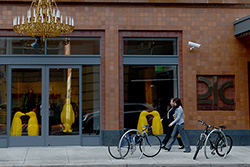
Clearly the “c” in 21c stands for “cool.” In fact, sitting where it is, adjacent to the Zaha Hadid-designed Contemporary Arts Center, we may have one of the more potent, one-two combinations of cool in the greater Midwest, not to mention another notch in our impressive belt of cultural tourist attractions.

Kilgour School awarded $24K innovation grant to boost tech access, entrepreneurial skills

A new financial literacy enrichment course at Kilgour School is expanding, spurred by a $24,000 innovation grant awarded by tech communications company MiCTA. The grant builds on a class that Cincinnati's Partnership for Innovation in Education (or PIE) piloted at the school, called Student MBA: Bringing Business to the Classroom. Mary Welsh Schlueter, PIE's founder and chief executive, developed and taught the five-week class at Kilgour as part of a student enrichment period. Schlueter, a Kilgour parent, modeled the class after a Harvard Business School course. "I taught basic concepts, including the SWOT analysis, the five Ps of marketing and the product life cycle," says Schlueter. Students' tech, financial and entrepreneurial skills were tapped when they were asked to find ways to increase lemon sales. "They developed many new ideas and used lemons in different ways, not just as a food source or cleaning agent," says Schlueter. The project led to the creation of an Android app, a game called Lemon Smash. "The goal of the game is to smash lemons to make lemonade so you can make some moo-lah," its description reads. Proceeds from the 99-cent app go back to the school. The class and app creation brought on some big partners. Sprint donated the technology, UC's Economics Center wrote and compiled all the achievement assessments and NKU’s Center for Applied Informatics helped students design and develop the app. There are plans to make it available for the iPhone as well. "This was a $100,000 project, and all of the work was done pro-bono," Schlueter says. The MiCTA grant will allow the class to continue. It will also fund 20 new handheld tablets for the school's gifted program. NKU will partner with the school to offer an app development class, which will also be available to any Cincinnati Public Schools student who has access to take the class virtually. PIE is looking to expand funding opportunities for the STEM-aligned program using app development and technology to "incubate" students' entrepreneurial efforts and promote across the globe,  says Schlueter.  It's a way to help students learn valuable skills, provide a new revenue stream for schools, and allow deeper tech uililzation for K-8 students and teachers across all subject areas. Do Good: • Find out more about Kilgour School. • Like Cincinnati Public Schools on Facebook. • Find out more about MiCTA's grant program. By Feoshia H. Davis Follow Feoshia on Twitter

Trend Boutique flaunts affordable fashion in Oakley

Although she has a background in finance, and experience sussing out business plans during a career launched at IBM, Stephanie Rozanovich says she was surprised by some intial costs at her Oakley-based Trend Boutique.  One thing she didn’t want customers to be worried about?  The cost of clothing at her boutique. Tired of the equation of “boutique” with “expensive,” she now offers most of her items for $100 or less. The demographic for her store is roughly women 25-45. Rozanovich, herself 37, says she looks for designers that offer a young, contemporary look and whose fashions “don’t look like the stuff you see in chain stores.” She takes buying trips each year, traveling to Chicago, New York and as far as Las Vegas, but stays focused on clothes that will work in the Midwest. Compared to, say, Los Angeles or New York, Rozanovich says her picks are a touch more conservative and take Ohio’s cold winters into account. “A lot of the designers in Los Angeles can do lighter knit year ’round, whereas we need warmer stuff in the winter, like coats that are a little bit thicker.” “I start out honestly buying things I like because I don’t feel comfortable selling [clothing] to people if I don’t like it, I don’t like the fit, I don’t like the brand,” Rozanovich adds. She chose her Oakley space for its proximity to her east-side home and the area’s up-and-coming vibe. After weeding out a few out-of-town landlords – she was concerned they didn’t havea vested interest in the neighborhood – she found a local landlord whom she liked and who serves on an area community council. Today, Rozanovich employees three part-time staffers and spends time on the sales floor as well. The Trend Boutique is open seven days a week on Oakley Square and online. By Robin Donovan

For Good Special: Emanuel’s transformation

This week, we bring you a special, in-depth look at the recent sale of the Emanuel Center in Over-the-Rhine, a nonprofit organization that we've covered before in Soapbox.

My Soapbox: Sherry Carran, Covington’s mayor-elect

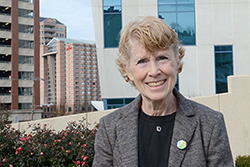
Covington's first female mayor, Sherry Carran, takes office next month. The alum of the University of Cincinnati’s architecture program and long-time Northern Kentuckian shares her thoughts on her election, her goals, and bikes in Covington with Soapbox’s Hannah Purnell.  

Our Partners

Taft Museum of Art
Warsaw Federal

Don't miss out!

Everything Cincinnati, in your inbox every week.

Close the CTA

Already a subscriber? Enter your email to hide this popup in the future.