Western Hills

Western Hills encompasses the neighborhoods furthest west of Cincinnati, including Bridgetown, Cheviot and Monfort Heights. Bridgetown's tight-knit community, mostly residential, takes on a family-first attitude. It's home to Oak Hills High School, once the largest high school in Ohio, and several private Catholic schools. Summertime brings parish festivals almost every weekend and the annual third of July firework celebration at local Kuliga Park, giving the neighborhood a festive vibe. The quaint city of Cheviot offers family-owned restaurants, shops and bars for local entertainment.

ESCC helps nonprofits maximize output

In 1995, a small group of retired business executives came together with the intent of giving back to their community by investing their time and talents in work that would assist nonprofits. Now, nearly 18 years later, Executive Service Corps of Cincinnati is the recipient of an $85,000 award that will help more than 130 volunteers provide low-cost, high-quality strategic thinking, planning, training and coaching to other nonprofits in need.  The recent funding will help the ESCC implement its Community Benefit Business Model, which, according to Andy McCreanor, executive director and CEO of the organization, is a model that has essentially always existed within the nonprofit, but has now been refined and strengthened. The model helps nonprofits maximize results so that they may receive additional funding to better fulfill their missions, which ultimately works to improve the communities they serve. “It enables investors to get more out of the nonprofits that they’re investing in, and secondly, it helps the nonprofits because we’re affordable," says McCreanor. "We’re merely a vehicle so that the community gets the benefit that they’re trying to get." The ESCC has worked on long-term projects with more than 500 nonprofits in Cincinnati, Northern Kentucky and Southeast Indiana since 1995, including most recently the Jewish Federation of Cincinnati. ESCC also offers a 10-month program at its Nonprofit Leadership Institute each year; and at its culmination in June, more than 100 nonprofit leaders from Cincinnati will have graduated.  McCreanor says that because of the recent economic downturn, nonprofits have suffered and organizations are reevaluating and assessing their goals and missions. “We’re here to help,” he says. “If you’re struggling out there, it really doesn’t cost anything to talk about what you’re dealing with, and if in fact there is a way for us to help, it’s going to be done at a very low cost, so it’s kind of the best of all worlds.”  Do Good: • Sign up to attend classes at the Nonprofit Leadership Institute. • Volunteer your business skills and experience to serve other nonprofits. • Reach out to the ESCC if you are a nonprofit that could benefit from its services. By Brittany York  Brittany York is a professor of English composition at the University of Cincinnati and a teacher at the Regional Institute of Torah and Secular Studies. She also edits the For Good section of SoapboxMedia.
Shield gives back to those who give daily

The Shield started in September 2000 during a crisis. A Cincinnati police officer was killed in the line of duty, and his family, which was from out of town, couldn't afford to fly in on short notice. Tom Streicher, who was Cincinnati’s police chief at the time, knew something had to be done; he offered up his credit card to ensure the officer’s family was where they were needed—by the fallen officer’s side.  “It was a leadership issue,” says Satch Coletta, a retired officer and trustee for the nonprofit that was soon to launch. “What are the odds, should something happen? Something should be there.”  In that moment of need, police chiefs came together to make contributions and began to fund a new nonprofit. The organization has continued to operate ever since, thanks to community donations, and in large part, to the willingness of officers who take payroll deductions to contribute.  The organization’s board, which is composed of 10 officers—current and retired—works entirely on a volunteer basis. They meet monthly during lunch breaks to fulfill The Shield’s mission: to assist the families of officers killed or critically injured in the line of duty.  Policing is a dangerous job, and according to Coletta, “It’s not a matter of if we’re going to pay money out, it’s a matter of when and how much.”  The funds are available to families immediately—prior to workers’ compensation or life insurance, says Coletta. “If it happens at one in the afternoon, at 1:01 p.m., there’s a benefit committee that’s ready to spring into action to aid an officer or his family.”   Coletta knows the circumstances surrounding the loss of an officer all too well. In 1978, Officer John Bechtol, next-door neighbor and friend whom Coletta trained with, died after a vehicle struck his police cruiser. There was no immediate support available for the family . “Back then, policemen, not that they make a great fortune now, made even less; and to be able to set funeral arrangements and getting people in and situated—things along that line…” were very difficult, he says. The funds are not just meant for funeral arrangements and families’ transportation, however. “Say he would have survived the crash,” Coletta says, “he would have been in very serious condition, say in ICU for a long time. You would expect the spouse to be there in ICU. If their job doesn’t pay, The Shield would entertain paying the spouse’s wages because they’re already down one. We don’t want them to suffer additionally.”  In times of need, Coletta says people always want to help, but the organization’s goal is to create an emergency fund that can create interest, so that there is enough money available to families, prior to the moment when the unthinkable occurs. “The family knows what’s needed, and we work on the things to try to aid them,” Coletta says. “But it’s one of those things where at the time, that’s one less thing they have to worry about.”  Do Good: • Provide corporate or community support by donating to The Shield. • Contact The Shield about volunteer opportunities and upcoming events. • Connect with The Shield and share the organization's page on Facebook.  By Brittany York  Brittany York is a professor of English Composition at the University of Cincinnati and a teacher at the Regional Institute of Torah and Secular Studies. She also edits the For Good section of SoapboxMedia.  

Breaking the cycle of bad eating, one banana at a time

The Nutrition Council of Greater Cincinnati is working to break the cycle of unhealthy eating habits, one banana, one yogurt parfait and one recipe at a time.   And, they are doing it one family at a time.  The Council, in its 35th year, just wrapped up its latest series of "What’s Cooking?" classes for parents and caregivers of kids in Camp Washington and Winton Hills.  The classes, offered each fall and spring, are a four-part series that meet for about an hour after the school day ends at schools with Head Start programs. They are designed to show parents how to make quick, affordable and healthy meals for their families. Each week is themed, and participants receive take-home tools like measuring spoons and grocery cards. Parents also get multiple recipes that encourage cooking at home, rather than relying on packaged and processed foods.  The classes and the Council’s work come at a time when the nation—and Cincinnati—is getting fatter. Childhood obesity has more than tripled in the past 30 years, according to the Centers for Disease Control and Prevention. Currently, one in four Cincinnati Public School kindergarten students is overweight (13.9 percent) or obese (11.7 percent).   “I think what strikes me is that things I am aware of and take for granted, not everyone does,’’ says Tracy Wilking, the nonprofit’s special project manager, who worked at the Winton Hills location this fall.   In 2011, nearly 100 families participated in the cooking sessions. And of those, according to the Council’s web site:  • 85 percent reported they changed one action to improve a targeted health behavior.• 67 percent of families increased their consumption of fruits and vegetables.• 67 percent said they decreased their child’s sweetened beverage intake.  Wilking says it is not uncommon to hear parents share how the instruction really does change cooking habits, from eating as a family to introducing fresh fruits and vegetables at meals. One recent participant told one of the Council workers that she had completely changed how her family was eating.   The Council targets very young children, before habits are established and before they start kindergarten. Wilking says many parents may not have been taught how to eat healthy, and the earlier the Council and others can share information with parents, the more likely the cycle of poor food choices can be broken.   In addition to the cooking series, the Council also visited 38 Early Childhood Education classrooms in the Cincinnati area over 17 days to teach parents and their kids how to make healthy snacks. Recently, they made fruit and yogurt parfaits.   “A little education really can go a long way,’’ says Wilking. “This work is reaching individuals and those with the power to reach someone else.”  Do Good: •  Make a donation •  Volunteer your time or skills. • Like the Council on Facebook.• Follow the Council's news on Twitter.  By Chris GravesChris Graves, assistant vice president of digital and social media at the Powers Agency, is using several of the Council’s recipes at home with her two teens.  

Faces Without Places founder wants to see homeless program expand

Karen Fessler has a message she wants you to hear loud and clear: Faces Without Places is alive, well and kicking.  For years, the nonprofit, grassroots organization that has provided nearly $1.5 million in educational support for homeless children in Greater Cincinnati was affiliated with the Cincinnati Public Schools. But about two years ago--and for a variety of reasons--the organization split with the school system, says Fessler, who is a board member and a founding member of the 17-year-old group.   But its mission remains intact, says Fessler.  “The most important part of the program is that we get kids out of shelters, we get kids off the streets and we show them that education is a way to experience a larger world,’’ says Fessler. “We want to broaden our reach. We want to broaden our horizons.”  Fessler declines to discuss what led to the parting of ways, but adds the founders of the program all left their jobs at CPS as well.   “But none of us lost our passion for the kids and the mission of Faces Without Places,’’ she adds. “I want people to know that we are here, and we are committed to providing services. We are toughing it out through thick and thin--for the kids.”  The nonprofit helps about 3,000 school children annually in Greater Cincinnati. Last year, the group provided 7,702 services to 3,013 children, according to its website. Those services included providing taxi services to school for 112 students, uniform vouchers for 777 students, backpacks and supplies for more than 839 students and Payless gift cards for 320 students so they could get a new pair of shoes, a luxury for many, Fessler says.  The nonprofit is best known for its Yellow Bus Summer Camp, which completed its 15th year this past summer. Last year, 152 children attended the eight-week camp that focuses on reading and day trips.  Earlier this month, the group’s biggest fundraiser--the Yellow Bus Ball--raised more than $23,000, most of which will go to fund the camp.   “The ball is critical because we have to have money to pay teachers and buy supplies,’’ Fessler says. “We can get grant money for field trips, but the fundraiser really helps us be able to put on the camp to the degree we have always done it.”  Fessler has worked with thousands of homeless children over the years, and she readily admits she is biased toward teens.   “A lot of people don’t realize this, but these kids are completely out on their own; they are either staying at friends' or living eight, nine, 10 kids piled up in an apartment,’’ she says. “They are squatting and some are living on the streets trying to negotiate life … they are all living life on the edge. I am most impressed by their sheer tenacity and their desire to find a better life.” Do Good:  • Register for the Mt. Adams Yellow Bus Pub Crawl on Saturday, Nov. 17.  • Attend the 5th annual Chili Taste Off on Dec. 9 at Northside Tavern.  • Contribute to Faces Without Places' wishlist of school and personal hygiene supplies.  • Sign up for the monthly email newsletter.  • Give back while you shop.  By Chris GravesChris Graves is the assistant vice president of digital and social media at Powers Agency

FENNOfashion founder tackles many roles

Megan Fenno doesn’t just have a radio spot, a jewelry business and a writing gig with CincySavers. She also has a few tips for women looking to stay on trend this fall. “Anything that’s glitzy and has a shine to it, that’s really popular right now,” she says, noting that sparkly rhinestones are trendy. Color blocking with deep hues such as navy or burgundy set against brighter accents (think bright yellow), she says, are also popular this fall. A Cincinnati native, Fenno moved to Tallahassee, Fla., as a teen, then attended the Savannah College of Art and Design. She moved to Austin, Texas, after graduation, where she launched FENNOfashion, which features vintage-inspired necklaces, bracelets and jewelry. “I loved Texas, but nowhere is home like Cincinnati,” she says. Her collection this season highlights a few of her own favorite design elements, especially a vintage “found” look and antiqued gold. Fenno says that sites like Pinterest have led to a surge in popularity of stacked bracelets, sometimes called “arm candy,” that she’s having trouble keeping them in stock. As much as Fenno is an accessories designer, she’s also something of a free spirit, and encourages others with creative startups to resist the urge to plan each step or to stick rigidly to a business plan. “Five years ago, I had no idea that I’d be back in Cincy working on my favorite radio station, but that all derived from starting my own business," she says. "It’s OK. Opportunities present themselves throughout your business career that you can’t predict.” By Robin Donovan

FENNOfashion founder tackles many roles

Megan Fenno doesn’t just have a radio spot, a jewelry business and a running writing gig with the CincySavers website. She also has a few tips for women looking to stay on trend this fall. “Anything that’s glitzy and has a shine to it, that’s really popular right now,” she says, noting that sparkly rhinestones are trendy. Color blocking with deep hues such as navy or burgundy set against brighter accents (think bright yellow), she says, is also popular this fall. A Cincinnati native, Fenno moved to Tallahassee, Fla., as a teen, then attended the Savannah College of Art and Design. She moved to Austin, Texas, after graduation, where she launched, FENNOfashion, which features vintage-inspired necklaces, bracelets and jewelry. “I loved Texas, but nowhere is home like Cincinnati,” she says. Her collection this season highlights a few of her own favorite design elements, especially a vintage “found” look, and antiqued gold. Fenno says that sites like Pinterest have led to such a surge in popularity of stacked bracelets, sometimes cheekily called “arm candy,” that she’s having trouble keeping them in stock. As much as Fenno is an accessories designer, she’s also something of a free spirit, and encourages others with creative startups to resist the urge to plan each step, or stick rigidly to a business plan. “Five years ago, I had no idea that I’d be back in Cincy working on my favorite radio station, but that all derived from starting my own business," she says. "It’s OK. Opportunities present themselves throughout your business career that you can’t predict.” By Robin Donovan

For C’est Cheese, MoLo, new locations spell opportunity

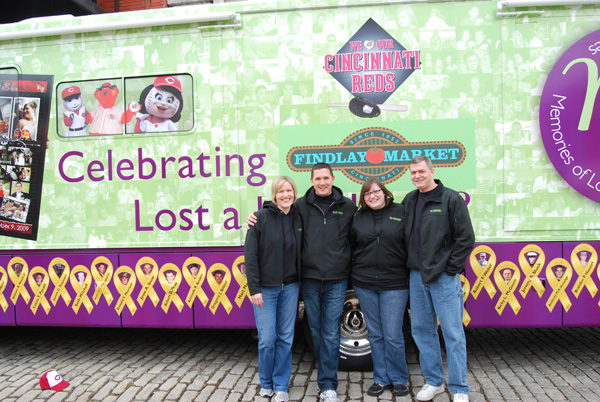
Two local start-ups, the C’est Cheese grilled cheese truck, and mobile keepsake digitizer Memories of Loved Ones (MoLo) are celebrating new digs this month. C’est Cheese, whose founder, Emily Frank just completed the Bad Girls Ventures program, is putting the tires to the pavement with a new food truck that made its first appearance at the City Flea on July 14. C’est Cheese’s menu features 19 grilled cheese sandwiches – up to six available on a given day – and two soups, including the obligatory tomato, and a selection of homemade, flavored pickles. Frank says finding the truck was a matter of patience and perserverence. “It was just spending hours and hours and hours every day searching online through several different sites to find the right vehicle. I ended up finding one in Chicago where I had just moved from. It was a former chocolate burrito truck painted with this crazy spray paint. With a little TLC, she has come a long way.” Meanwhile, formerly mobile-only MoLo moved into a permanent – and stationary – office space at 6020 Harrison Ave., while keeping its RV for home visits. The keepsake digitizing services, which prepares posters, photo books and more for funerals, special events and celebrations, needed more space, says founder Katy Samuels. “Over the past two years, we’ve had more celebration orders; now,  we can be a one-stop shop for everything people need,” she says. The company now offers an extended suite of services for weddings and other events, including creating logos, invitations, programs and even websites, as well as reception displays and guest books.   Up next for these two companies on the move?  “Getting people to know us,” Samuels says. “That’s the challenge.” By Robin Donovan

For C’est Cheese, MoLo, new locations spell opportunity

Two local start-ups, the C’est Cheese grilled cheese truck, and mobile keepsake digitizer Memories of Loved Ones (MoLo) are celebrating new digs this month. C’est Cheese, whose founder, Emily Frank, just completed the Bad Girls Ventures program, is putting the tires to the pavement with a new food truck that made its first appearance at the City Flea on July 14. C’est Cheese’s menu features 19 grilled cheese sandwiches – up to six available on a given day – and two soups, including the obligatory tomato, and a selection of homemade, flavored pickles. Frank says finding the truck was a matter of patience and perserverence. “It was just spending hours and hours and hours every day searching online through several different sites to find the right vehicle. I ended up finding one in Chicago where I had just moved from. It was a former chocolate burrito truck painted with this crazy spray paint. With a little TLC, she has come a long way.” Meanwhile, formerly mobile-only MoLo moved into a permanent – and stationary – office space at 6020 Harrison Ave., while keeping its RV for home visits. The keepsake digitizing service, which prepares posters, photo books and more for funerals, special events and celebrations, needed more space, says founder Katy Samuels. “Over the past two years, we’ve had more celebration orders; now, we can be a one-stop shop for everything people need,” she says. The company now offers an extended suite of services for weddings and other events, including creating logos, invitations, programs and even websites, as well as reception displays and guest books.   Up next for these two companies on the move? “Getting people to know us,” Samuels says. “That’s the challenge.” By Robin Donovan

MoLo Mobile digitizes keepsakes on the fly

Among the many tasks plaguing families during funeral preparation is trying to create posters and photo-display boards, which often is time-consuming and damages precious photos of loved ones. Online services abound, but Katy Samuels and her brother, Scott, wanted to bring the process closer to families. The siblings, along with a talented extended family, launched Memories of Loved Ones, affectionately dubbed “MoLo,” in late 2009. They’ve received as few as 40 up to as nearly 400 photographs in preparing for funerals and celebrations, often graduation parties and the like. Turnaround times are quick; Katy says her team once created nine collages and a 40-minute DVD from 395 photos in less than 24 hours. MoLo also has a very visible presence: a 35-foot, green and purple RV that houses their camera and scanning equipment, as well as seating and snacks for families who climb aboard with photos, trophies, stuffed animals, quilts and other memorabilia in tow. Katy says the RV offers a handful of advantages, “When we go meet a family, they’re making a ton of decisions in a short amount of time. We don’t want people to feel like they have to pick up for us.” Families also don’t have to worry about photos being damaged or lost, as all the scanning is done before they leave. Once inside, family members relax while Katy and the MoLo team get to work photographing and scanning each item. With three-dimensional things, such as medals or knitting, they typically photograph the item, and use image-manipulation software to create collages. For example, a favorite quilt may be photographed while draped over a blank poster board. In a final collage, the quilt will be digitally placed so that it “hangs” over a photo. MoLo isn’t a service just for funerals, either, as Katy and Scott field requests for everything from graduation parties to nonprofit awareness events. They donate services regularly for anyone who dies in the line of duty, whether that be as a firefighter, police officer or military serviceperson. A 60 to 90-minute scanning process usually evolves into much more than that; Katy says she’s even received standing ovations from families as she delivered collages and poster boards. Somehow, in between scanning, chatting, snacking and sharing, a bond forms. “Most people will tell us it’s the best experience because they get to remember, tell stories and laugh. That’s the fun of going through pictures, and it helps you go through the grieving process,” Katy says. “We go from meeting a perfect stranger to feeling like we’re a part of the family.” By Robin Donovan

Metro makes bus rides easier

In late spring or early summer, Metro riders will no longer have to look under couch cushions and in forgotten pockets to scrounge together $1.75 to take a ride.   Efforts to increase accessibility and convenience started last November when Metro installed new fareboxes on all of the operations’ 342 buses. A new Glenway Crossing transit center opened in December. This year, Metro launches new payment options.   The new transit center gives riders on the West Side a more convenient place to board buses and establishes a park-and-ride with 70 parking spots. The new fareboxes will help Metro track rider numbers on routes in an effort to increase efficiency and serve riders better.   New payment options include change tickets, which will print out after a rider uses a five, 10 or 20-dollar-bill to pay. The ticket can then be used on subsequent trips until the change is depleted. Metro’s current monthly passes will be replaced by rolling 30-day passes that allow riders to start using them for any 30-day period, instead of just from the beginning to end of a month. Two other options are pre-paid cards, or a reloadable, go Smart card.   “Other cities already have options like this,” says Jill Dunne, public affairs manager for Metro. “We’re moving up to become one of the better public transit agencies.”   The 30-day rolling passes could be available as soon as March, with the three other options soon after. Another annoyance soon to be eliminated? The need for exact change. Since fareboxes don’t produce change, new prepaid options will make riding the Metro much simpler.   Riders will be able to take advantage of the new options in several places, including online and a vending machine at Government Square.   By Evan Wallis  

Our Partners

Solutions journalism takes time, trust, and your support.

Close
Psst. We could use your help today!

Don't miss out!

Everything Cincinnati, in your inbox every week.

Close the CTA

Already a subscriber? Enter your email to hide this popup in the future.