Downtown

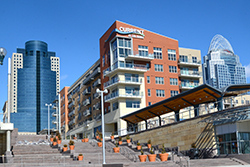
Downtown Cincinnati is the place to live, work, and play populated by restaurants, cafes, bars, arts and culture venues around every corner, plus a long-awaited and busy Kroger's that anchors recently-renovated Court Street Plaza. The downtown urban core is alive with programming, including music during the summer and ice skating in the winter, and features the largest living room 'television' in the region overlooking The Genius of Water at Fountain Square. Downtown has experienced dramatic expansion and population growth with residential developments, including condos and apartments in all price ranges, many of which boast scenic views of the hillsides and the river and offer unparalleled access to nightlife and recreation.

Tap into maple season with Cincinnati Parks

For the past month, Cincinnati Parks’ naturalists have been busy tapping sugar maples, collecting sap and boiling it down to produce real maple syrup. They’ve even taught the public how to make use of their own backyards to do the same.  With March quickly approaching, maple season will come to a close, but not without celebrating what Explore Nature! program assistant manager Erin Morris refers to as “Maple Madness.”  Maple in Mt. Airy and Pancakes in the Woods are “for those who maybe aren’t interested in doing it in their backyard, but for those who love the sweet success of the season, who want to taste that and who want to learn a little bit about the history,” says Morris.  For decades, Cincinnati Parks’ representatives have worked to relay the importance of nature education to the public. “When we started in the 1930s, technology was pretty minimal—we only had vehicles in the last 20 years, so people were outside,” says Morris. “There was no air conditioning, and they’d often sleep outside during the summer season, so people were much more connected to the outdoors and natural experiences.”  With a changing culture and a technologically oriented society, Morris says people have lost the connection with the outdoors. The Explore Nature! program aims to remedy that, however, and celebratory maple sugaring events are some of the ways in which it teaches people about the outdoors.  At both maple events, participants begin with a pancake breakfast, where they enjoy the syrup that’s been produced by the trees surrounding them. They then go on to learn the story and process behind maple sugaring.  Following breakfast at Maple in Mt. Airy, participants are immersed in the time period. They ride through the woods in a hay wagon to an area where naturalists dressed as Native Americans and pioneers teach about the first uses of maple syrup in the United States through taste-testing and hands-on experiences that explain photosynthesis and the ways trees provide nutrients for both humans and nature.  “When people think of maple sugaring, they think of Canada because they have the sugar maple leaves on their flag, but Ohio’s been producing maple syrup since the Native Americans in the 1700s,” Morris says. “It’s getting back to our history in Ohio—and even history in Cincinnati—but also having that connection with local products.”  Maple Madness events take place throughout the first two weekends of March.  Do Good: • Register your family, friends or student group for Maple in Mt. Airy. • Enjoy pancakes cooked by celebrity chefs and learn about maple sugaring at Pancakes in the Woods at the California Woods Nature Preserve. • Like Cincinnati Parks on Facebook, and join and share their events with your friends. By Brittany York Brittany York is a professor of English composition at the University of Cincinnati and a teacher at the Regional Institute of Torah and Secular Studies. She also edits the For Good section of SoapboxMedia.   

Food truck owners unite to build business, opportunities

With shows like the Food Network’s The Great Food Truck Race, food on wheels has evolved from trend to craze in big cities all across the country. Cincinnati is home to 28 food trucks and trailers, and 11 of them have recently joined the Cincinnati Food Truck Association, a nonprofit that aims to reinvent food truck vending.     In 2010, Café de Wheels was one of the only food trucks in town; in 2011, Taco Azul popped on the scene. And last year, there was a huge boom in the local food truck business.   “Food trucks are the fastest growing sector of the food industry, and it’s growing here,” says Emily Frank, 38, of C’est Cheese. She also serves as CFTA’s president. “People are excited about food trucks.”   With so many trucks, there was a need for a unified voice to represent them. In June 2010, the Mobile Food Vendor Pilot Program, which was strongly supported by City Councilmember Laure Quinlivan, was born.   The Pilot Program allowed food trucks and trailers to serve street food in certain areas of downtown's Central Business District on a first-come, first-served basis, with proper permits. Food trucks were allowed one to two spaces in Sawyer Point, six spaces at Court Street Market and 12 spaces in a parking lot at Fifth and Race Streets.   Building off the Pilot Program, a group of UC urban planning students who were interested in food hubs held a meeting for food truck owners and operators in September. The students got everyone talking, but since they were only working on the project for a semester, it was up to the food truck owners to do something.   Frank, Elizabeth Romero of Sugarsnap! Truck and Tracy Sims of Taco Azul formed CFTA last fall. They held a meeting and extended an invitation to join the CFTA to the 25 other food trucks in town.   “We didn’t know what to expect from our peers, but it was very positive,” says Romero, 29, CFTA’s secretary. At the first meeting, two other trucks joined CFTA.   Currently with 11 members, CFTA hopes to see at least four other trucks join this spring. Right now, food trucks are part of the Night Owl Market downtown and are staples at Sawyer Point—CFTA is even part of Taste of Cincinnati this year. In the future, CFTA hopes to plan one or two food-related events throughout the year.   For example, Atlanta’s food trucks are in the suburban parks, says CFTA’s treasurer, Sims, 32. CFTA will soon be meeting with City Parks and discussing the possibility of having food trucks at park events.   “All of the money made during the event would be given back to the park to help build a strong relationship with them,” says Sims. “It would be very seasonal, but very profitable.”   One of CFTA’s immediate goals is to work with the city to increase the number of available mobile food vending spots that are outlined in the Pilot Program. “We want to represent Cincinnati and be part of the community,” says Romero. “We want the city to be proud of food trucks and show them off like the brick-and-mortar staples in the city.”   Members of CFTA are C’est Cheese, Café de Wheels, Catch-A-Fire, Eat! Mobile Dining, Eclectic Comfort Food, Goldstar Chili Mobile, Kaimelsky’s, Mr. Hanton's Handwiches, Queen City Cookies, Sugarsnap! and Taco Azul.   By Caitlin Koenig Follow Caitlin on Twitter

OTR Foundation preserves history, promotes community

From organizing events involving beer and historic churches to providing affordable housing and jobs to those who have struggled to attain them in the past, the Over-the-Rhine Foundation does a little bit of everything. And it's all for the purpose of reinventing and celebrating a diverse, historically-rooted community. At the beginning of February, Kevin Pape, who’s lived in Cincinnati his whole life and who grew up with a fondness for the OTR community, stepped up to the role of president of the foundation.  OTR has been a part of Pape’s family history for multiple generations, so he’s someone who understands what the community has to offer.  His grandparents lived in OTR and operated a business there until 1935, though it was actually started back in 1850. Pape lived in the community himself for about four years in the 1970s, and his office at Gray & Pape—a cultural resource management and historic preservation consulting firm—just celebrated 23 years at its Main Street location. Pape says because of his background, he deals with the renovation of historic buildings all the time, but his vision for OTR contains much more than the preservation of buildings. “I think my interest really is in community-building,” Pape says. “The message is that it’s really all about putting people back into historic buildings and finding ways to do that in a meaningful way.”  One way Pape and the OTRF plan to build on that vision is through their strategic plan, which entails owner-occupied redevelopment, historic preservation and the goal of making OTR the greenest historic neighborhood in the country.  “We also want to encourage people who are investing in the neighborhood to seek ways to provide meaningful employment and jobs for people that live in the neighborhood who may not have had access to opportunities before,” Pape says.  While working to show that “green buildings, sustainable buildings, LEED certification and historic preservation are actually compatible,” the OTRF also helps organize events like Bockfest, which Pape says showcases what’s good and great about the community. This year, the nonprofit, in conjunction with American Legacy Tours, is offering historic church tours, which will highlight the architecture and stories of four different 19th century landmarks within the community.  “When you think about the size of OTR and the number of churches, it gives you a good sense about the density of people and the diversity even at that time that would have such a population to support a variety of churches,” says Pape.    It’s that diversity that has withstood the test of time, and which Pape says the community embraces at all levels.   “Socioeconomic, racial, ethnic, you name it,” Pape says. “It provides residential density that allows people to share ideas and celebrate those differences in being able to all live in a compact place at one time. It’s about not only economic vitality, but residential vitality.”  Do Good:  • Attend Bockfest, and register for the Historic Churches of OTR Tour. • Support the Over-the-Rhine Foundation by becoming a member. • Volunteer to help the organization preserve and revitalize OTR. By Brittany York  Brittany York is a professor of English composition at the University of Cincinnati and a teacher at the Regional Institute of Torah and Secular Studies. She also edits the For Good section of SoapboxMedia.   
Budget cuts jeopardize Media Bridges, volunteers needed

Tom Bishop, president of Media Bridges, has worked to give the public a voice by providing access to media and channel space for years. But because of recent budget cuts and word from current members of Cincinnati City Council that the organization will not receive funds again, Media Bridges’ future is at stake.  Rooted in the Cincinnati area, Bishop grew up in Hamilton, attended college and spent time working for public radio, in addition to spending 17 years with Norwood Community Television prior to his time at Media Bridges, where he has been employed for the past nine years.  Bishop says he realized early on what good can be done with media.   “I think I’ve always had it in the back of my head that you should leave the world a better place than you found it, and the idea of doing that with media is a really cool combo,” he says.  Throughout his years at Media Bridges, Bishop led the nonprofit in providing free classes to the public on everything from studio and video production to editing and web design. The organization has also championed free summer camps for children so that they, too, can learn to be active participants in media by learning things like video skills, comic book design, animation and radio programming.  Throughout the next few months, however, the organization will be forced to implement class and membership fees, so the facilities and access to create public programming will no longer be completely free. But Bishop says the organization will ensure that those below the poverty line are not left behind.  “I’m sure we’re going to lose some people—and that’s really a shame,” Bishop says. “Cincinnati City Council has made the decision that their government access television station is much more important than the people actually having a voice in the community, and by making that decision, they’re telling the people to just go away, ‘I don’t want to hear from you.’”  Because of the cuts, Bishop says the organization is in dire need of volunteers to help teach classes and run the studio so the public can continue to have a voice. Though he’s optimistic that Media Bridges will still be around in 2014, he says he’s not sure what it will look like.  “Frankly, making up the amount of money we used to get via the cable franchise—put it this way—if we pulled it off, we’d be the only people to pull it off,” says Bishop. “When all funds have been cut, nobody has survived.”  For Bishop, the cuts are disappointing. He says it threatens the future of the “many small victories” the organization has achieved over the years.  “We have a program called Film Outside the Lines, where we work with people with developmental disabilities and turn them into film producers where they create their own films,” says Bishop. “The success of that is right there on their faces when they’re showing their films at screenings and entering them at film festivals and things like that.”  Without public access, Bishop says people are left behind to hear only the voices of “the pundits, politicians and sports heroes” who make up a small portion our population. Instead of receiving media, Bishop says it’s more important than ever that people also participate. “It doesn’t have to be about the almighty dollar—it can be used to make communities stronger," says Bishop. "Media can be used to build dialogue—to let people communicate. It’s not that there shouldn’t be media for profit, but that shouldn’t be the only kind of media there is. And slowly but surely, we’re entering a world where that will be the only kind of media.”  Do Good: • Volunteer with Media Bridges to help them shift gears to a volunteer-driven organization.  • Support Media Bridges by making a donation. • Learn about Media Bridges' classes, and register for one so that you can become an active partcipant in the media. By Brittany York Brittany York is a professor of English composition at the University of Cincinnati and a teacher at the Regional Institute of Torah and Secular Studies. She also edits the For Good section of SoapboxMedia.   

Reggae Run celebrates 20 years of success, moves to Eden Park

This October will mark the 20th anniversary of the Reggae Run, and with its longevity comes continued success and an increase in participants.  What started nearly 20 years ago as a small-scale project with the hope of getting 500 people to show up has turned into an event that has raised more than $1 million dollars over the years for local charities. It has also outgrown its longtime course at Ault Park. This October, participants will instead gather at Eden Park for a new course and the same after-party that locals have grown to love, as it draws as many as 7,000 people together to celebrate.  “It’s really amazing that the time has gone so quickly, but at the same time, it’s really neat to see how the event has grown and how it’s become part of Cincinnati,” says Doug Olberding, Reggae Run's organizer. “But we realized maybe seven or so years ago that not everybody that comes to the race knows why we do it.” Olberding, who is the late Maria Olberding’s brother, says it dawned on him a few years back that most of the people who run the race—oftentimes people who are in their 20s—were about 5 years old when his sister was slain while running near her home in Mt. Lookout.  “The older people know—you tell somebody who’s around my age, and they say, ‘Gosh, I remember that, it was a big deal,’” Olberding says. “But the younger people don’t know why we do it. We put it out there, but they don’t know the story, and we feel like it is our duty to make sure we keep the story alive and keep her memory alive through the race.”  So the Olberding family puts on an event that encompasses everything Maria cherished—running, reggae and nature. Whether it was through her optimistic and positive outlook on life or through her volunteer efforts with organizations like Stepping Stones and Children’s Hospital, Maria made sure to put her best foot forward. “She wasn’t a teacher or anything like that—it was just her natural altruism,” Olberding says. “She was a pretty giving person. She was a 20-something, typical girl out of college; she worked at the Beach Waterpark and had fun with her friends, but they found time to do things—volunteer work and stuff like that—so that was part of it, and I don’t know that I can say specifically where that came from. It was just the way she was.” At the Reggae Run, participants can either run or walk a 5K. After the race, everyone joins together for fellowship through food and music, which is provided by The Ark Band, a group that Maria grew up listening to.   Olberding says themes within reggae music that deal with “finding the good in things” speak volumes to who Maria was as a person.  Proceeds from the event benefit the local chapter of the Make-A-Wish Foundation, which formed in Cincinnati when the Olberdings sought the organization out as a recipient. The more than $1 million the event has raised for the organization is just one of the positives that has come as a result of the Reggae Run.  “Some people come up to us during the race, and they’re beside themselves, saying how much they enjoy it and what it means to them to come; we’ve even had people get engaged there," Olberding says. "It’s always this really good vibe, and I think it’s one of the reasons why it’s been around for 20 years." “It’s so easy to turn something into a negative, and if you do that, you just create more grief and more anger, and then it just never stops. I look at it and say, 'Just think of all the good that this event has done.’”  Do Good:  • Register for the Reggae Run by participating in the race or joining in the after-party.  • Share Maria Olberding's history by keeping her memory alive and encouraging others to participate in the Reggae Run. • Like and share Reggae Run's Facebook page. By Brittany York Brittany York is a professor of English composition at the University of Cincinnati and a teacher at the Regional Institute of Torah and Secular Studies. She also edits the For Good section of SoapboxMedia.   

Freestore Foodbank puts healthy foods in Tri-State homes

About a month ago, a donation from Green BEAN Delivery to the Freestore Foodbank brought a recently unemployed young woman and mother of three to tears when she went to pick up food for her family.  “She knew the importance of fresh fruits and fresh vegetables for her kids, and typically, her meal money and her food money doesn’t go that far,” says Kurt Reiber, president and CEO of the FSFB.  Reiber says people often try to “stretch their resources,” which often means buying food that is affordable but also unhealthy.  Because of FSFB’s efforts to put healthy foods on the tables of about 300,000 food-insecure individuals throughout the region—110,000 of whom are children—fresh produce and healthy eating habits are increasingly becoming more ingrained in the lifestyles of our neighbors in need.  As a result of a longtime partnership with Green BEAN Delivery, FSFB recently received 2,200 pounds of fresh produce to distribute to local pantries and food banks, which Reiber says will go a long way for the families FSFB supports.  “These are people who really don’t know where their next meal is coming from,” Reiber says. “They’re coming because the car broke down or one of their children has gotten sick or their utility bills are out of whack and they spent the money they otherwise would have spent on food on those bills, so when I talk about paycheck to paycheck, that’s really it.”  Most of the recipients of FSFB’s donations visit the food banks or pantries just five times a year, according to Reiber. “It’s the community supporting the neighbors that are just down the street,” he says. “Most of them are going to church with them, or their kids see them at school.”  Reiber is appreciative of the Green BEAN Delivery’s donation because he says it has helped to provide healthy foods during a time of the year when the nonprofit is particularly in need.  In November and December and throughout the holiday season, he says, people recognize the problem of hunger, and donations come in with an abundance; but hunger is a problem that doesn’t go away. “The reality is that the following week, when we turn the page on the calendar, we’re still looking at folks out there that are hungry and don’t know where their next meal is coming from,” Reiber says.  Because of partnerships with community organizations and individuals, FSFB ensures that 35 to 40 percent of its food distribution is composed of fresh fruits and vegetables. Through its community farming program, The Giving Fields, FSFB was able to provide 175,000 pounds of fresh produce to 12 food pantries in Northern Kentucky last year; and that number, according to Reiber, will continue to grow.  “Our goal is to have it so that 50 percent of all the food we distribute will be fresh, nutritious produce and fruits, and that’s something we’re going to continue to strive to get to.”  Do Good:  • Support the Freestore Foodbank by making a donation. • Start a virtual food drive and encourage your family and friends to partcipate.  • Spread the word about hunger by liking and sharing Freestore Foodbank's Facebook page. By Brittany York Brittany York is a professor of English composition at the University of Cincinnati and a teacher at the Regional Institute of Torah and Secular Studies. She also edits the For Good section of SoapboxMedia. 

Cincy ReelAbilities film festival unifies inclusive community

ReelAbilities, which is the largest film festival in the country to showcase the artistic talents and life stories of people with disabilities, began in New York in 2007. But in 2011, Cincinnati became the first place to broaden the festival’s influence by making it a multi-city event, and for its second year running, ReelAbilities plans to increase its reach with a fervor that emphasizes the shared human experience.  Co-chaired by Living Arrangements for the Developmentally Disabled and Visionaries + Voices, the festival brings community members together to view award-winning films by and about people with disabilities, all while creating a dialogue and providing a platform for storytelling and educational panels that promote understanding and inclusion.  For local spokespersons April Kerley and Kathleen Sheil, the festival is important in that it aims to show people that the only real disabilities that all people have are those of misguided perceptions.  Kerley, a local Paralympian who swam in the 2008 Summer Games in Beijing and who is also featured in the film “Warrior Champions,” which will air during the festival, says the event is about inclusion. All people experience a technical disability at some point in time, “even if it is only a temporary one, such as a sprained ankle or recovery from surgery,” she says.  “It is not an ‘us versus them’ equation,” Kerley says. “We’re all in this together.”  Sheil, who receives services from LADD and who is working as an event planner for ReelAbilities Cincy has Down syndrome, but she says she doesn’t allow her disability to define her. “I take that disability, and I put it into ability,” she says.  Her attitude is a positive one, but Sheil says she knows all too well the horror stories of bullying that arise from a lack of understanding when it comes to people with disabilities. Sheil’s boyfriend, who has autism and wears glasses, was singled out during his high school years because of his disability, she says.  “They’d call him four-eyes and step on his glasses and break them,” Sheil says. “And that’s not what we do. That’s not the right thing to do. To me, it really doesn’t matter if you have a disability or not, and the reason why I say that is because everybody has a disability and everybody is different, and that’s okay.”  It’s these stories that ReelAbilities Cincy hopes to share, as inclusion and acceptance are topics that are vital and necessary, according to Shiel.  “I want people to hear how important it is to the people that have not just disabilities, but abilities, so that they can share their stories,” she says. “And so that way, they can be the people who shine, people who are stars and people who really know what’s going on in their world.”  ReelAbilities will take place at various locations throughout Cincinnati from March 9-16. Do Good:  • Attend a film showing to support ReelAbilities. • Like the ReelAbilities Cincy page on Facebook. • Spread the word to family and friends so that they, too, can participate in the ReelAbilties Film Festival.  By Brittany York Brittany York is a professor of English composition at the University of Cincinnati and a teacher at the Regional Institute of Torah and Secular Studies. She also edits the For Good section of SoapboxMedia. 

Soapdish: Cincy Crit

Soapbox provocateur Casey Coston takes on architectural shortcomings of the city's latest developments and offers three words of actionable advice: Demand better, Cincinnati.

Cincinnati City Hall goes mobile

Never lose track of garbage or recycling day again. Report potholes or graffitti the minute you see it. Keep track of reports you've made to the city. All using your phone. The City of Cincinnati's City Hall app allows you to send in reports and even follow tweets about city services and projects. Read more and find out how to get the free app here.

Thinking outside the box: Home bakery turns Gail Yisreal into cake boss

Going on maternity leave changed Gail Yisreal’s life in more ways than having a new baby to take care of.   When she returned to work, Yisreal says she learned her position was no longer there, so she began to look for a different job. As wife and mother to a blended family of nine children, she might bake up to 11 birthday cakes in a year. But she hadn’t considered turning her knack for kneading dough into earning dough until she baked a wedding cake for a couple from her family’s place of worship. Not only did they like the cake, they suggested she start selling them.   Listening to her fans, Yisreal founded A “Mother’s Touch” Cakes with the nurturing tagline, “Making fresh homemade cakes when you don’t have the time.” Celebrating her two-year anniversary as a registered business in August 2012, A “Mother’s Touch” features signature and custom made flavors of fresh, savory gourmet, organic and vegan cakes and cupcakes that are good—and good for you.   “I didn’t know anything about decorating, so I took a class to learn more decorating skills," Yisreal says. "And I was shocked to find out that 95 percent of the cakes you buy are box cakes—because everybody wants the decoration. I started doing some research about the trans-fats and artificial ingredients, and I vowed that everything I baked would always be natural and from scratch.”     After working as a waitress for two years and in management at Starbucks for six years, Yisreal developed a love for coffee. She jokes that most ex-Starbucks managers feel they know enough about coffee to create their own line, which she actually did for A “Mother’s Touch.”   Having tried organic coffees with weak flavor profiles, she researched and found Dean’s Beans, a fair-trade pioneer that allowed her to design her own custom blends. Her signature A “Mother’s Touch” blend is made with Mexican and Indonesian beans and pairs with her carrot cake as an after-dinner coffee.   “I’m really proud of my coffee and the fact that it really was custom blended for what I wanted to complement my desserts,” Yisreal says. And, true to her mission to serve natural, sustainable goods, she says that her blends are 100 percent organic, fair-trade certified and are shade grown.   Being on the scene without a storefront hasn’t stopped Yisreal. Instead, she’s building her brand as the “cupcake lady” who networks everywhere and invites people to taste samples of her creations. Yisreal also tapped into hidden markets by hosting deals through social media.   “I did a Living Social promotion last year, which was huge,” Yisreal says. “That first day, I think I got 1,500 hits on my website, and probably about 85 deals, which I thought was really good for people who didn’t know who I was.”   And even though she sells more cakes today, the ease of transporting cupcakes built her clientele.   “When I first came out, because of my financial situation, literally, cupcakes were paying my rent,” she says. After she and her husband separated, she remembers what it was like to go from making an annual salary of $60,000 to less than $20,000 a year. But she doesn’t do it all alone.   “I have three almost-teenage girls; 12, soon to be 15 and 17, so they are my preppers,” Yisreal explains. “It’s hilarious because we’ll be in the kitchen and everybody has their big bonnets on, and they’re scraping carrots, mashing fruit, lining the liners. I have a girlfriend who I’ll sometimes sub-contract out to do deliveries. And if it’s a huge event—like for the Autism Foundation, I had to knock out 40 dozen cupcakes—I have two sisters, and at the time I had just split up with my husband so we were in literally an 800-square-foot apartment. The kitchen was all of maybe 150-square-feet, we put out six-foot tables and we were like an assembly line! It was hilarious, but we got it done. It was like an I Love Lucy episode!”   By Mildred Fallen  

Our Partners

Taft Museum of Art

Common Ground Is Brewing

Support local stories and receive our signature roast straight to your door when you join at the Standard level (or above).

Drink Better, Read Local

Close the CTA

Don't miss out!

Everything Cincinnati, in your inbox every week.

Close the CTA

Already a subscriber? Enter your email to hide this popup in the future.