College Hill

Settled in 1813, College Hill has about 16,000 residents within a 3.4-square-mile neighborhood, and is Cincinnati’s fourth largest and most diverse neighborhood. A variety of housing options — an eclectic mix of stone, brick and wood homes of every style and in every price range — make it possible for many to spend a lifetime in the neighborhood. The community owes much of its character to the 19th-century colleges that gave the neighborhood its name, and though Farmers’ College and the Ohio Female College are long gone, their campuses left behind a legacy of park-like streets. The vibrant Hamilton Avenue business district is a hub of activity, with a host of new projects planned or underway from the College Hill Community Urban Redevelopment Corp.: a new senior housing development, a storefront facade improvement program, small business recruitment and new brewery.  

Hillenbrand creates illustrating, publishing opportunities for children

When Will Hillenbrand was growing up in College Hill, he spent a lot of time reading picture books at the library, which would make him late for his baseball games at next-door Crawford Field. “You may wonder, ‘How do we encounter art in our lives?’" Hillenbrand says. "And actually, it’s all around us. We might not realize it; however, the art that engaged me was through storytelling.”  The library was critical in Hillenbrand’s journey as an illustrator and writer, but his journey actually started at his father's barber shop, where he spent time listening to “big fish stories." “One way I’d kind of disappear in the background easily would be during the summer because my mom would make my dad a hot lunch, and I’d walk it up to the barber shop,” Hillenbrand says. “I’d walk the lunch up there and put it in the hall closet and then sit under the air conditioner and try to become part of the wallpaper.”  Hillenbrand says he remembers one of the other barbers talking to a customer about his other job, which was cutting down trees, and how it was similar to cutting hair.  “So if I were hearing something in that little synopsis, I might end up going home and drawing a person with a forest on their head and a barber cutting it, but it’s comical,” Hillenbrand says.  As a child, Hillenbrand had the exposure and opportunity to not only fall in love with his craft, but also to practice it. And it’s this same opportunity that he’s now offering to other children.  From now until the end of August, children have the chance to submit artwork that depicts their heroes for consideration in Hillenbrand’s e-book, which is entitled Everyday Heroes: Local Children and the People Who Inspire Them. “What we’re interested in are characters that fall and get up and show us how they manage their challenges and struggles,” Hillenbrand says. “And we cheer for them and want them to do it, and for children, we want to be able to give them opportunities to share.”  Hillenbrand has hosted two workshops at the Public Library of Cincinnati and Hamilton County thus far, and children have been able to not only brainstorm, but also to dabble in digital media. “There was a bridge that the children and I kind of walked back and forth across—it wasn’t a podium—it’s not that kind of thing,” Hillenbrand says. “And the library’s a great context because around the walls, you’ve got idea people—ideas that might be a first story—and when they participate, their ideas are validated, and they can feel like, ‘I’m an idea person, too,’ and isn’t that a good feeling?”  Do Good:  • Check out Hillenbrand's library workshop about digital drawing on YouTube. • Children ages 12 and under are encouraged to submit their artwork to the library for consideration in Hillenbrand's e-book. • Learn about the variety of ways you can support the library.  By Brittany York Brittany York is a professor of English composition at the University of Cincinnati and a teacher at the Regional Institute of Torah and Secular Studies. She also edits the For Good section of SoapboxMedia.   

CincyMusic Spotlight hits airwaves

The show’s format provides a much-needed outlet for local musicians.

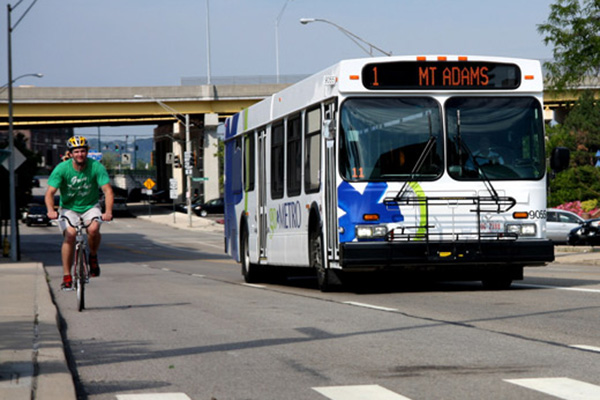
Metro blazes new trails with green efforts

Metro has been "going green" for more than 25 years, but partnerships with progressive organizations have helped it broaden sustainability efforts.

City Council adopts form-base code

For five years, Vice Mayor Roxanne Qualls has been working with the City of Cincinnati to develop form-based code for the city. Last Wednesday, City Council officially approved the Cincinnati Form-Based Code.   “Cincinnati now joins hundreds of cities that are using form-based code to build and reinforce walkable places that create value and preserve character,” Qualls says.   Cincinnati’s neighborhoods originally developed so residents could easily walk to restaurants, shops and grocery stores in and around business districts. Form-based code will allow neighborhoods to return to that original ideal and reinforce or create places where residents can live, work and play, Qualls says.   Current zoning code makes creating mixed-use neighborhoods difficult—the new code will help streamline the development process. To start, form-based code will be applied to business districts and adjacent residential areas in four pilot neighborhoods that volunteered for the chance—College Hill, Madisonville, Walnut Hills and Westwood.   The code is a result of six Neighborhood Summit training sessions; five years of neighborhood working group meetings, neighborhood walks and training sessions; five delegations to learn about Nashville’s form-based code; a five-day citywide urban design workshop; a four-day neighborhood urban design workshop; and more than 600 public comments on the draft from residents, stakeholders, neighborhood groups and city departments.   By Caitlin Koenig Follow Caitlin on Twitter

Cincinnati’s first tuition-free charter school to open in August

Just in time for the new school year, Carpe Diem Learning Systems will open its first Ohio school at Aiken High School Aug. 21 in College Hill. Carpe Diem is Cincinnati’s first tuition-free public charter school for the general district population, and is sponsored by Cincinnati Public Schools.   Carpe Diem-Aiken will offer a blended learning model of digital curriculum with blended learning experiences, says Rick Ogston, founder of CDLS.   Twelve years ago, Ogston’s wife, Sharon, encouraged him to go back to school and get a Masters' degree in education. After that, he started to learn about charter schools and the difference they can make in communities. From there, Carpe Diem was born.   “Carpe Diem is about personalizing education to the nth degree,” Ogston says. “It brings the uncommon combination of personalized education and high academics with a career focus on achievement to the table. We prepare students academically for the 21st century, but we also allow students to progress at a pace more comfortable to them.”   The curriculum at Carpe Diem is tailored to meet the needs of a spectrum of students, from those who are lost in large schools or traditional classrooms, to gifted students who want to work at an accelerated pace.   Tyree Gaines is the new principal of Carpe Diem-Aiken, and she hopes to contribute instructional leadership that opens the door for students and teachers to maximize their potential.   “I want Carpe Diem-Aiken to empower students to be learners, thinkers, doers, believers and achievers,” she says.   Carpe Diem-Aiken will bring an innovative new educational model to the area, but it will also be debuting Aiken New Tech, which infuses technology into curriculum while incorporating project-based learning and real-world experiences, says Janet Walsh, director of public affairs for CPS.   “We love that the Carpe Diem model incorporates ‘blended learning’—a combination of technology-driven and teacher-led instruction, which is very much a wave of the future,” Walsh says.   CDLS is North Central Association-accredited and includes Edgenuity’s instructional content, uBoost’s online recognition and reward system, and a secure online portal to provide parents with real-time student data. Carpe Diem also offers opportunities for career concentrations in Information Technology, Science and Engineering, Business Innovation and Entrepreneurship, Digital Arts and Entertainment, and Health Sciences.   Carpe Diem-Aiken joins CDLS’s first school, Carpe Diem Collegiate High School in Yuma, Ariz., and Carpe Diem Meridian, which opened in August in Indianapolis. Carpe Diem Summit in Fort Wayne is scheduled to open this August as well.    Parents and students who are interested in meeting with Gaines and learning more about Carpe Diem-Aiken can email her at TGaines@CarpeDiemAiken.com or call her at 513-612-0153.   If you’re a Cincinnati student who is interested in attending Carpe Diem-Aiken and is 12-16 years old, you can enroll in Carpe Diem here.   By Caitlin Koenig Follow Caitlin on Twitter

Library garners national attention, celebrates with Amnesty Day

The Public Library of Cincinnati and Hamilton County is one of 10 recipients out of 140,000 libraries and museums across the country to receive this year’s National Medal for Museum and Library Service.  The award recognizes outstanding service to communities. So, in appreciation of library users and as a way to celebrate, the PLCHC will offer a Fine Amnesty Day May 15.  “We really wanted something to express our appreciation to the community, and we started thinking about what is it that people hate most about the libraries—we all know that—the fines,” says Kim Fender, Eva Jane Romaine Coombe director. “I’ve been here 25 years, and we haven’t done this in my time here at all, but our hope is that people who have not used the library because of their fines come in and have those fines removed and come back to the library and get their cards started up again.”  Fender says the library most likely wouldn’t have received the award without the support of the community, because the library’s heavy usage was one reason the Institute of Museum and Library Services was so impressed.  With more than 17.6 million items borrowed in 2011, the PLCHC is considered the eighth-busiest library in the nation, and its commitment to providing academic assistance and encouragement to both children and adults is evident through the variety of programs it offers and successfully implements through its partnerships with other community-based organizations.  Last summer, for example, the library partnered with Cincinnati Public Schools and the Freestore Foodbank to serve about 7,000 meals to children.  “That’s something people don’t normally think of libraries doing,” Fender says. “But when they were in there eating, they could sign up for summer reading or programs.”  Fender says the library staff also goes out of its way to make sure children are learning by actually attending school.  “If we see kids in the building during school hours and we think they might be truant, we check up and say, ‘What school do you go to?’ and look at the school calendar, and we call someone from the school to let them know because they have to be in school to learn,” Fender says.  Fender will travel to Washington, D.C. with Amina Tuki, a local resident who came to Cincinnati from a small village in Ethiopia who was not fluent in her native language, but who learned English by picking up a small book called Coming to America at the PLCHC.   “She says it took her all day, but she made her way through it, and she took it home and read it to her husband and children, and her older son started crying,” Fender says.  Fender and Tuki will accept the award May 8. Library users can celebrate Amnesty Day May 15 by taking their library card to any local branch.  Do Good:  • Go to your local branch and have fines removed May 15 so that you can begin to use the library's resources.  • Sign up for a library card if you don't already have one. • Support the library. By Brittany York Brittany York is a professor of English composition at the University of Cincinnati and a teacher at the Regional Institute of Torah and Secular Studies. She also edits the For Good section of SoapboxMedia. 
BOOST partners with Dress for Success Cincinnati to inspire women’s confidence

Jenny White, owner of BOOST, says she’s always loved giving back, and now that she’s a business owner, she has a platform to better serve others.  BOOST, an offsite meeting space, was intended to boost productivity and creativity. After contemplating what nonprofit would best fit the BOOST business model, White decided to partner with Dress for Success Cincinnati to inspire confidence in women who are searching for jobs, but may not have the needed professional attire they need for job interviews. “It’s rewarding to give back in any way, but when I think of specifically working with Dress For Success Cincinnati, it means even more because it’s woman-to-woman,” White says. “It’s very empowering to me as a woman to know that I’m helping empower other women to move in a positive direction.”  Both the downtown and Mason locations of BOOST now have collection areas, and meeting attendees are encouraged to bring in any unneeded professional attire that could benefit DFS Cincinnati’s clients.  “I just found it to be a simple and convenient way for our meeting attendees, as well as BOOST, to make a significant difference in women’s lives,” White says. “Even our male attendees can get involved, talk to their wives, see what they don’t want anymore and bring it in.”  White says the new collection sites should be particularly helpful because DFS Cincinnati’s only drop-off locations are downtown and in College Hill. With a location in the northern suburbs, more clothes will start to come in.  In addition to providing women with business attire, DFS hosts self-esteem workshops to further encourage women to succeed. As a result of the new partnership, White says she’s getting ideas about how to successfully run selfesteem workshops of her own.  Enabling women to feel better about themselves is a mission White can get behind and one she understands personally. White says she was picked on as a child, and it kept her from doing things that she otherwise would have done. By the end of the year, White says she’s determined to host a workshop for young girls to "boost" their confidence as well. With the new DFS and BOOST collaboration, the ultimate goal for White is that women no longer have obstacles that hold them back from moving with their lives.  “I firmly believe that if you’re looking good, then you’re feeling good, and you’re dedicating more of your whole self to that interview,” White says. “I hope the clothes they put on will give them the boost of confidence that they need to acquire a job.”  Do Good: • Donate women's business attire and accessories to Dress for Success Cincinnati at one of their drop-off locations, or at the downtown or Mason BOOST meeting space. • Support Dress for Success Cincinnati by making a financial contribution, volunteering or hosting your own clothing drive. • Like Dress for Success Cincinnati and BOOST on Facebook. By Brittany York Brittany York is a professor of English composition at the University of Cincinnati and a teacher at the Regional Institute of Torah and Secular Studies. She also edits the For Good section of SoapboxMedia. 

College Hill Gardeners partners with Historical Society for bicentennial event

This year is the 200th anniversary of the founding of College Hill, and to celebrate, the College Hill Historical Society and College Hill Gardeners are partnering for History in Bloom. The event includes a lecture by Ed Loyd, CHHS president, on May 14, and a tour of five College Hill gardens on June 15.   The lecture will include past and present photos of the gardens at the five homes, along with images of a few gardens that used to be in College Hill, Loyd says.   “College Hill is a natural fit to put history and gardens together,” he says.   College Hill got its name from Farmers’ College, which was founded in 1846. It was one of the first schools for agriculture in the United States, and was around almost a generation before other land-grant colleges were established. It was a research center for all types of scientific agricultural education, and predated the U.S. Department of Agriculture, Loyd says.   This year is the eighth year for the CHG garden tour, but the first year for the event to have a co-presenter.   “The agricultural significance in College Hill is noteworthy, and it provides a great backdrop for the gardens,” says Beth McLean, founder of CHG.   The gardens included on the tour are those of Twin Towers, Tanglewood, The Upson House, The Oaks and Laurel Court. All of the houses are along Hamilton Avenue, Belmont Avenue and Hillcrest Road (Old College Hill). The gardens feature beautiful landscaping and ornamental structures, plus a Japanese garden and parterre, which can be found at Laurel Court.   Tickets for the tour go on sale May 4 for $10. Tickets will be available at CHG’s plant sale May 4, at the College Hill Coffee Company and at the lecture. Day-of tickets are $12.   The lecture will be at the Campus Center at Llanfair Retirement Community; seating is limited. Please contact CHG at 513-681-1326 to reserve your seat.   By Caitlin Koenig Follow Caitlin on Twitter

Cincinnati Montessori Society celebrates 50 years

Fifty years ago, a group of parents who were passionate about Maria Montessori’s philosophy of education developed the first Montessori preschool in the area.  And following the preschool’s inauguration, the group formed the Cincinnati Montessori Society, a nonprofit whose focus is to promote Montessori education while serving as a resource to countless schools, teachers, parents and students in the community. “One of my favorite quotes is, ‘Follow the child,’” says Heather Gerker, vice president of CMS. “We meet the child where they are developmentally.”  Montessori classrooms, which are both child-centered and composed of mixed age groups, are set up so that children can learn through a multisensory approach that allows them to figure things out at their own speed—and the philosophy works, Gerker says.  At CMS’s Annual Spring Conference and celebration of 50 years of success, neuroscientist Dee Coulter delivered the keynote address.  “This work that Maria Montessori did over 100 years ago is now being proven through neurological work happening now,” Gerker says. “[Coulter’s address] was really affirming and validating to the teachers there.”  Not only were teachers excited to go back to work on Monday after hearing Coulter’s presentation, Gerker says, but they also had the opportunity to participate in breakout sessions that were aimed at providing strategies and insight that lead to better education. Topics ranged from promoting mindfulness through music to strategizing ways of better assisting children with ADD and autism.  Gerker says she’s particularly passionate about the resources that CMS provides because they’re based on a philosophy that’s now scientifically proven, and she’s seen it work in the lives of her own children.  “It gives them a solid sense of self, that they’re so independent and happy, which I think is the ultimate goal,” Gerker says. “I just want to make sure it’s available to all children.”  Do Good:  • Become a member of CMS. • Check out the resources offered by CMS. • Connect with CMS on Facebook. By Brittany York Brittany York is a professor of English composition at the University of Cincinnati and a teacher at the Regional Institute of Torah and Secular Studies. She also edits the For Good section of SoapboxMedia. 

Everybody Rides Metro Foundation ensures available transportation to all

The Everybody Rides Metro Foundation, which is the first program of its kind, provides affordable transportation to about 30,000 low-income individuals each year.  Metro subsidizes rides at $1 and has partnered with about 70 different social service agencies to cover the remaining 75 cents of fares for riders in need of medical or work-related transportation.  “Many of our riders feel like this is the only way they can try and succeed—it’s somebody giving them a lift when they need it the most,” says Joe Curry, executive director of ERM. “The greatest outcome of this is that you’re getting people toward self-sufficiency. It’s something that stays with them forever—it helps them out until they earn money and start budgeting once they have a job; and self esteem is a large part of that overall package.”  According to Curry, many of ERM’s riders are paroled into the Talbert House and have anywhere from $0 to $20 to their name after coming out of prison. Once they’ve been rehabilitated and have participated in job counseling, they may need to interview at up to 20 different businesses before they find work.  “Once they land a job, the worst thing that can happen is not to show up during the first week of employment, so we give them additional money, if needed, to subsidize their rides during the first few weeks,” Curry says. “It’s to help them out temporarily so they can establish a budget—it’s not a lifetime pass.”  In addition to helping riders get to job interviews and places of employment, ERM provides rides to medical-related destinations so individuals can receive preventive care.  “Society of St. Vincent De Paul runs a free pharmacy on Bank Street in the West End, and if you can’t afford your meds, they’ll give you a 30-day supply for free so long as it’s not a narcotic, but you have to get to the location,” Curry says. “If you’re diabetic or are undergoing cancer treatment, meds are absolutely essential, but if you can’t get to a place where you can get your meds, you may get sicker. You may be one of those people who take that $1,500 ambulance ride, and that’s one of the things we’re trying to prevent.”  Beginning in January 2014, 40,000 more individuals in the Cincinnati area will be eligible for Medicaid, and according to Curry, anywhere from 50 to 70 percent of those people will need public transportation to get to a healthcare provider or pharmacy. “Those are the people we’re worried about," Curry says. "If public transit isn’t available to them because of the cost, how are they going to get treated? More than 30 percent of our population lives in federally defined poverty—that tells you we really need to do something and think outside the box about how to solve some of these public transit issues.” Do Good:  • Donate to the Everybody Rides Metro Foundation. • Like Cincinnati Metro on Facebook.  • Follow the Cincinnati Metro on Twitter. By Brittany York Brittany York is a professor of English composition at the University of Cincinnati and a teacher at the Regional Institute of Torah and Secular Studies. She also edits the For Good section of SoapboxMedia. 

Our Partners

Taft Museum of Art

Don't miss out!

Everything Cincinnati, in your inbox every week.

Close the CTA

Already a subscriber? Enter your email to hide this popup in the future.