Clifton / CUF

Resting on a hill overlooking the north side of Cincinnati, Clifton offers a wide range of experiences from a college atmosphere with the city's largest school, the University of Cincinnati, to an international center for cutting-edge medicine featuring University, Children's and Good Samaritan hospitals. Clifton's history has been preserved in historical buildings and homes — from modest to millionaire. Trendy shops and restaurants can be found on Ludlow Avenue in the Gaslight District, along with the Esquire Theatre, yoga studios, Clifton Market and a newly renovated branch of the Cincinnati Public Library. Even though Clifton is tightly compacted with large buildings and interesting architecture, green space does exist at Burnet Woods

Homeless, but not hopeless at the Cincinnati Zoo

  Antonio lingers at the elephant house, taking pictures and marveling at the size - and the smell - of the creatures before him. UC undergraduate Zach Koons laughs as he watches his 10-year-old charge snap photo after photo before the two move on to the Reptile House, where snakes hold the charm for the wide-eyed Bond Hill Academy student. The elephants and snakes have a serious if invisible advantage over Antonio, though. They have permanent night-time addresses. Antonio is homeless. Koon meets with Antonio every week as part of Zoo-Mates, a partnership between Project Connect, the University of Cincinnati's Center for Community Engagement and the Cincinnati Zoo and Botanical Garden. "Zoo-Mates enables UC students to bridge the gap between childhood and adulthood," says Koons, 21, who changed his major from Business to Middle Childhood Education as a result of his work with the program. "We can touch the lives of inner-city youth, and they can remind us of what is truly important in life." When it began, Zoo-Mates was a once-a-month program, with UC students meeting their young partners at the zoo, where they toured and talked. Now in its sixth year, Zoo-Mates pairs meet weekly, including regular visits to UC's Clifton campus. The success of the program has exceeded its organizers' expectations, according to Center for Community Engagement Director Kathy Dick. "The a-ha moment for me was when two families decided to keep their children in their home school so that they could continue to be a part of Zoo-Mates," she says. For families without homes, maintaining stability at school is a major challenge that can lead to academic problems for kids. Koons started volunteering because he needed to log community service hours to maintain a scholarship. But that's not why he stays. "Time can be worth more than any amount of money you can spend on someone," he says. For Antonio, any time he can spend away from worry is particularly sweet, even when it's laced with the smell of elephant. Do Good: • Donate: Make a financial contribution to the non-profit Faces without Places, which provides local homeless children with a wide range of services. Specify that you want your donation to support Zoo-Mates. • Cast your vote: Visit True Hero and vote for Zoo-Mates to receive additional funding. • Follow the blog: Find out the latest program activities at the Zoo-Mates' blog.

West MLK Drive improvements include enhancements for pedestrians, cyclists

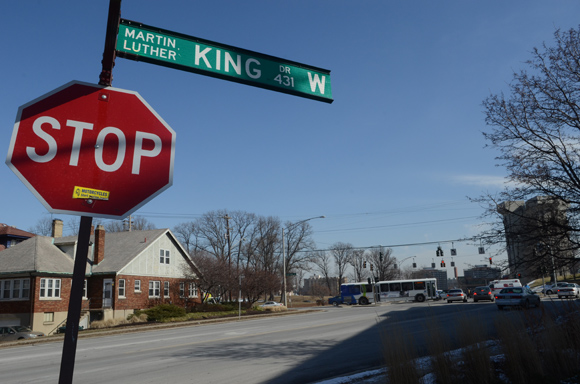
Plans to reconstruct a stretch of Martin Luther King Jr. Drive between Camp Washington and Clifton will drastically change the landscape there while improving safety for motorists and access for pedestrians and bicyclists.Thirty buildings on the north side of MLK between McMicken Ave. and Dixmyth Ave. will be razed to make way for wider lanes and a bike path. The on-street parking currently available in front of the homes, which cause numerous accidents every year, will be removed. Construction is expected to begin in the summer of 2014.The MLK West improvements, which run from McMicken to Clifton Ave., will include a new median, sidewalks and wider lanes in areas. A 12-ft-wide off-street "multi-use" path will run the complete length of the project, and will connect with a path planned as a part of ODOT improvements near the I-75 Hopple Street interchange at the bottom of the hill. When both projects are completed, bicyclists and pedestrians will be able to travel from Clifton to Camp Washington on a path separated from the road by several feet of grass. The intersection of MLK and Clifton will be reconstructed to improve pedestrian safety and traffic congestion there.The plans were selected from several different options that had been floated to the community in past public forums. At a recent public comment meeting on the project, the public left no comments. Project manager Andrea Henderson from the City's Department of Transportation and Engineering took that as a sign that the right option was chosen, she said."This was the most cost effective and actually the most desired option, so we were very happy we didn't have to force this alternative on anyone," she said.Between Dixmyth and Clifton avenues - the eastern portion of the project - property on both sides of MLK is owned by the park system and Henderson said a median and lane expansion were not planned for that area, just the bike path.Residents of the buildings who must be relocated by the City of Cincinnati include University of Cincinnati Students and elderly residents, Henderson said. The process of relocation could prove difficult for some, she said."I suspect that UC students renting there will have no problem finding another place, but it's the older people, or people with some sort of issues, that might need a lot of help and its our obligation to help them," she said.Writer: Henry SweetsPhotography by Scott Beseler.

UC prof, former J&J exec says innovative thinking can be learned

Innovative thinking isn't something a privileged few are born with, it's something that can be taught, said Drew Boyd assistant professor of Marketing and Innovation at the University of Cincinnati."Innovation is a skill, not a gift. It is something you can be trained to do like learning a new sport or new hobby," Boyd said.He should know. Boyd is a recently retired Johnson & Johnson executive who spent 17 years in marketing, mergers and acquisitions and international development. He's now the Executive Director of the MS-Marketing program, and teaches a class on innovating thinking that's quickly becoming popular at UC.The graduate level course, Systematic Innovation Tools, teaches five techniques that foster innovative thinking.  "There are five patterns that help you take a product or service and morph it into something innovative," Boud said. "These patterns have a structure that allows us to be more creative."For instance, one technique Boyd teaches involves tying together two aspects of a product. One feature of the product changes as another feature of the product or the environment changes. A recent example from his class involved using this technique (called attribute dependency) to innovate in the athletic shoe arena. A student invented to COLOR EX, where the user's exertion is tied to the color of the shoe. With this innovation the fabric color of the shoe changes based on how hard the athlete works. For example, as an athlete's heart rate rises, the shoe may turn red. As it lowers, blue.You can see the COLOR EX, and several other athletic shoe innovation in a blog entry Boyd wrote  here. About 45 students take his class each semester, and though its designed for business students, students outside the business world find it useful xx. Students innovate around a set of categories including xx.Though the athletic shoe and other innovations are academic, the Boyd's class will be partnering with international well known companies including P&G, GE and L'Oreal to develop innovative product ideas."All the ideas are turned over to the companies, and they are meant to be used. They are meant to be real ideas," Boyd said.In the past several class ideas have been put to use by local businesses and organizations, including the Cincinnati Art Museum," he said.Writer: Feoshia HendersonSource: Drew Boyd, Drew Boyd assistant professor of Marketing and Innovation at the University of CincinnatiYou can follow Feoshia on twitter @feoshiawrites


A toast to history: 500 years of wine-drinking cups mark social shifts in ancient Greece

How commonly used items - like wine drinking cups - change through time can tell us a lot about those times, according to research presented by Kathleen Lynch, UC associate professor of classics, at the annual meeting of the Archaeological Institute of America.Read the full story here.

Famed designer says DAAP one of few design schools not failing their students

Famed designer,Gadi Amit, questions if design schools are failing their students. As Amit reviewed candidate's portfolios to join his growing team, he noticed the lack of quality in student's work. According to Amit, fortunately the one U.S. exception is the University of Cincinnati with "an excellent program and very solid graduates." Read the full story here.

Children’s Hospital part of mother’s crusade against rare form of muscular dystrophy

Children's Hospital part of mother's crusade against rare form of muscular dystrophy. A mother of two sons with Duhenne Muscular Dystrophy in Middletown, Ohio is an activist for research for a cure. She also helped lobby congress to pass legislation in order to fund research and founded the organization Parent Project Muscular Dystrophy. Cincinnati's Children's Hospital is the leading clinical treatment center for Duhenne in the country. Read the full story here.

‘Bearcat Bubble’ adds practice space and energy savings on UC campus

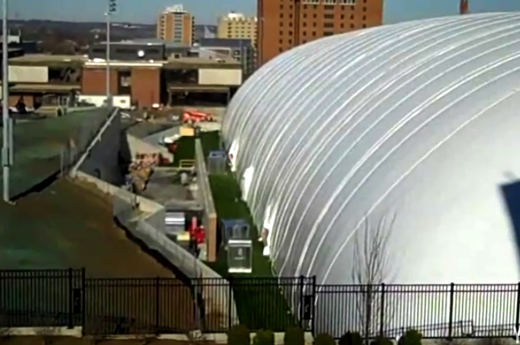
The University of Cincinnati gained its very own 24/7 practice field with the addition of an air-supported "Bearcat bubble" for the cold winter months. Athletes now have the ability to practice year-round in the new 75-foot-high and 370-foot-long bubble covering the new Sheakley Athletic Complex."The football players are excited and grateful to have the opportunity to use it. It gives us the ability to practice all year round with consistent conditions every time you are in there," according to UC Athletic Director Coslen. The field also benefits other varsity sports such as soccer, baseball, lacrosse, and eventually track and fieldBefore the addition of the practice field and bubble, athletes had limited conditioning and practice space. During the winter months they only had the ability to condition inside with the weight-room facility and indoor track. "The football team couldn't get out until the spring. During the winter months, they practiced outside when they could, " Coslon added. The Bubble and field provides 72,200 square feet of usable indoor space for athletic programs but also allowed the school to build a chilled water thermal storage tank underneath the short field to assist the air conditioning systems throughout campus. The addition provides the University $750,000 to $1 million in energy savings a year and adds to the "greening" of campus.According to the University project manager of the complex, Barrett Bamberger, the bubble is energy efficient and less expensive than a permanent structure. The dome consists of two layers that trap air between the two layers, which results in a 40 percent energy savings. Natural daylight also passes through the translucent outer layer, allowing the limited use of electric lights during practices. Because the bubble is transportable, it will only be inflated from November through February, and will return to a normal open-air practice field in the spring. Writer: Lisa EnsmingerPhotography provided by UC

The Year In Photos

Managing photographer Scott Beseler takes a look back at the photos from our top stories of 2010, showcasing some of the people, places and things that define our region.

Future e-readers could be made of paper

With E-books' popularity over hardcover books increasing this past year, engineers at the University of Cincinnati have revealed that paper could be used as a flexible backing for an electronic display. Using paper is a convenient, renewable, flexible, and cheap material that could be used as a platform for electrowetting. Researchers experimented with all sorts of papers, hoping to develop a future device that rolls and feels like paper yet delivers books, news, and video. Read the full story here.

UC brain pathways research finds food, sex reduce stress

Researchers at the University of Cincinnati found that food, sex, and other pleasurable activities reduce stress by inhibiting anxiety and producing pathways in the brain. Researchers conducted testing on rats, giving them a sugar solution twice a day. Stress responses lowered with lower stress hormones and heart rate. These results could help provide potential strategies to prevent obesity and other metabolic disorders. Read the full story here.

Our Partners

Solutions journalism takes time, trust, and your support.

Close
Psst. We could use your help today!

Don't miss out!

Everything Cincinnati, in your inbox every week.

Close the CTA

Already a subscriber? Enter your email to hide this popup in the future.