Northside

For those seeking an urban environment with a funky blend of Victorian homes, eclectic and traditional businesses, a long tradition of community activism and one of the most diverse neighborhoods in Cincinnati, you can't go wrong with Northside. Home to the legendary 4th of July parade, the Northside Farmer's Market, Shake It Records, the Gay and Lesbian Community Center of Cincinnati, popular watering holes like the Comet and Northside Tavern and an active community council, Northside is all about preserving its strong grassroots heritage. One of Cincinnati's most walkable neighborhoods, Northside also features multiple green spaces, including Hoffner Park, the central site of numerous festivals.

Spohr appointed to direct SW Ohio workforce development

Jennifer Spohr has been appointed as the regional workforce director of the Ohio Department of Development's (ODOD) Southwest Ohio office.In her new role, Spohr will serve as a liaison to state government, local business leaders, elected officials, and economic and workforce development entities to meet the training and talent development needs of businesses throughout Hamilton, Butler, Warren, and Clermont counties.Spohr joined ODOD in 2005 as coordinator for the Ohio Investment in Training Program and is currently on the Greater Cincinnati Workforce Network's Hard-2-Hire Workforce subcommittee.This year, she received from Cincinnati mayor Mark Mallory the 2009 Super Award from the Workforce One Investment Board of Southwest Ohio in recognition for her work with the SuperJobs Center.Read the full release here.

Cincinnati earns its ‘Queen City’ nickname

Yes, Cincinnati has a sometimes shaky reputation.  But let's forget about that for a second.  (Or forever.)Laura DeMarco, a writer for the Newhouse News Service whose story was picked up by the Minneapolis Star-Tribune, sees in Cincinnati a cultural revival, a city that boasts "world-class museums, a vibrant nightlife and dining scene, and a rich look at the state's history".For sights, DeMarco recommends Fountain Square, the Lois & Richard Rosenthal Center for Contemporary Art, the National Underground Railroad Freedom Center, and the "forward-thinking" architecture at the University of Cincinnati.The writer also recommends catching a show at the Southgate House, taking a trip off the beaten path to the Comet in Northside to dine on a giant burrito, or experiencing the fine dining, fantastic views, and charming streets of Mount Adams.Read the full article here.

Mallory highlights economic growth in State of the City address

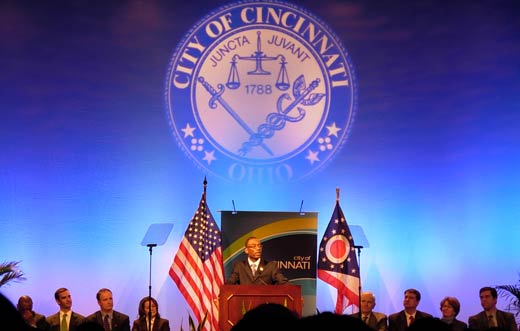
In his fourth State of the City address, delivered last Wednesday at the Duke Energy Center, Cincinnati Mayor Mark Mallory said that the city is weathering the poor economy much better than most."At a time when other cities are seeing businesses move out, we are seeing businesses expand and new businesses move in," he said.He credited the "aggressive and strategic" approach of City Manager Milton Dohoney and Economic Development Director Holly Childs for bringing 2,500 new jobs to Cincinnati last year, including commitments from such major players as Medpace, Humana, dunnhumbyUSA, and US Bank.Mallory also spoke of the need to empower small and minority-owned businesses, saying that four more Shop52 seminars will be held this year to link entrepreneurs with business experts, non-profit service providers, and lending professionals."We must also ensure that individuals have the opportunity to realize their dreams," he said.  "Shop52 is all about small business growth and strengthening our neighborhoods."In addition to job creation, Mallory noted that construction is underway on two major building projects – Great American Tower at Queen City Square, a 41-story, $340 million office tower and The Banks, a 2.8-million-square-foot mixed-use development on the city's riverfront.But Mallory said that the most crucial component of Cincinnati's development plans is the streetcar system that would connect Downtown, Over-the-Rhine, and the Uptown neighborhoods."Now, we have done our homework and the benefits of a streetcar system are clear," Mallory said.  "When a city puts rails in the ground, economic growth follows."Mallory said that $1.4 billion in economic impact would result from the project's first phase, giving the city additional resources that it can use in neighborhoods throughout the city."The benefits of the streetcar system are too significant to allow the naysayers to derail our efforts," he said.  "Streetcars must be a part of Cincinnati's future and we will fight to make it happen."According to Mallory, the key to Cincinnati's future success is strong local, national, and global partnerships.To achieve these partnerships, the city and its residents must be their own advocates."We have a great city and we must make it our priority to promote it here at home, across the nation and around the world," Mallory said.Writer: Kevin LeMasterSource: 2009 Cincinnati State of the City address Photography by Kevin LeMaster

Take the Cake opens Northside café
Spaces remain for 10-week government academy

Several spaces remain for the spring session of the Cincinnati Citizens Government Academy, a 10-week course designed to give an in-depth look at how city government is organized and how services are funded and delivered.Beginning March 2nd and held Mondays between 6 PM and 9 PM, the Academy features field trips to numerous city departments to learn about their services and programs.The goal of the program is to not only improve citizen understanding of how local government works, but also to encourage citizen involvement in strengthening and improving the quality of life throughout the city's neighborhoods."As City government continues to engage citizens, it's important that citizens have a broad understanding of how their government works," says Cincinnati city manager Milton Dohoney.  "We believe that informed citizens are involved citizens and that makes for better government.  The Academy may also bring forth some new ideas from the public that we may need to consider."Since 2007, the Academy has graduated 45 participants from its two sessions.Participation is free, and citizens can enroll by calling Trina Porter at (513) 352-5335 or by e-mailing citizensgovernmentacademy@cincinnati-oh.gov.Applications are also available online at or by visiting Suite 104 at Cincinnati City Hall.Writer: Kevin LeMasterSource: Tiffaney Hardy, senior communications specialist, City of Cincinnati Photography by Scott Beseler Milton Dohoney

Mayor Mallory gets assurances from President Obama

Following a meeting with President Obama and Vice President Joe Biden at the White House, Cincinnati Mayor Mark Mallory says that he's assured that Cincinnati will receive its fair share of the $787 billion federal economic stimulus bill.According to Mallory, the president told the 80 mayors in attendance that stimulus money will be on the streets within six months and is expected to be spent on projects within 18 months.He was also pleased that $7 billion of the $12 billion set aside for transit projects would go directly to cities, instead of being funnelled through state governments."The president stressed several things, that he understands the importance of cities as it relates to stimulating the economy," Mallory tells the Enquirer.Read the full article here.

Ohio’s 10 best-kept secrets

Following a year and a half of talking to Ohio's business leaders and executives, the Ohio Business Development Coalition has compiled a list of the ten best-kept secrets about doing business in Ohio.Everybody knows about the relatively low cost of living and the advantageous location, but what other advantages does Ohio have?I'm not going to give it all away here!You'll have to read the full article here.

A glimpse of Paris in Northside

From grass roots efforts to top designer in the world of bridal wear, Debra Moreland, owner of Paris in Northside is constantly designing and pushing the spectrum of bridal wear innovations—all with the help of her family.

Cincinnati approves $50,000 to advance form-based codes

Cincinnati City Council has approved $50,000 in funding for the development of neighborhood-based form-based codes.The funding will allow the city to hire a consultant team to review city regulations, study best practices, and develop options for implementation that can be condensed into a strategic guidebook that can be used as a blueprint for planning efforts in several Cincinnati neighborhoods.The city will issue a request for proposals for consultants on February 17, with a preferred candidate selected on April 6.Form-based codes are different from conventional zoning methods because they emphasize a building's form, massing, and relationship to the street and other buildings, instead of focusing on land uses.They also offer certainty to developers through a set of clear visual standards that streamline the approval process, decreasing development time and increasing the developer's design flexibility.The result is smart, compact development that creates a unique sense of place."These standards give neighborhoods a way to ensure that new development has a look and feel that's consistent with traditional neighborhood patterns – instead of the sprawl that conventional zoning has produced," says Councilmember Roxanne Qualls, recently appointed chair of council's Vibrant Neighborhoods Committee.  "This approach promotes walkable communities that support a range of transportation options."Since the 2008 Cincinnati Neighborhood Summit, Qualls has led a working group of neighborhood leaders, city staff, developers, and other stakeholders that led to a two-day conference at the Duke Energy Center last October.They also saw the successful implementation of form-based codes in Nashville, where taxable value in those districts grew 75 percent from 2003-2008, compared to overall growth of 28 percent throughout Davidson County, according to Nashville Metro Planning Department executive director Rick Bernhardt.College Hill, Madisonville, Pleasant Ridge and Westwood have been working closely with the monthly working group, and expect to begin holding intensive, community-wide charrettes this summer.Representatives of Avondale, Clifton, East Price Hill, Kennedy Heights, Mount Adams, Northside, and Walnut Hills have also participated in the working group, and are exploring the idea for their neighborhoods.Writer: Kevin LeMasterSource: Jennifer O'Donnell, aide to Councilmember Roxanne Qualls Photography by Scott Beseler


$35,000 GCF grant helps fund Mill Creek Greenway Trail

The Greater Cincinnati Foundation award is for planning and design costs associated with the first phase of the City of Cincinnati's Queen City-South Mill Creek Greenway Trail.

Our Partners

Taft Museum of Art
Warsaw Federal

Don't miss out!

Everything Cincinnati, in your inbox every week.

Close the CTA

Already a subscriber? Enter your email to hide this popup in the future.