Cincinnati

Video The Boys of Summer

Walk the Moon has had a pretty good start to their summer. The local band is percolating on the national music scene with a new album, an opening gig with indie rock icons Weezer, and slots at Bonnaroo and Lollapalooza. Fitting then that the video for the band's single "Anna Sun" has been ordained by Esquire Magazine as their "official song of summer." 

Latest in Cincinnati
Couple puts life on the line to find expert care at Ronald McDonald House

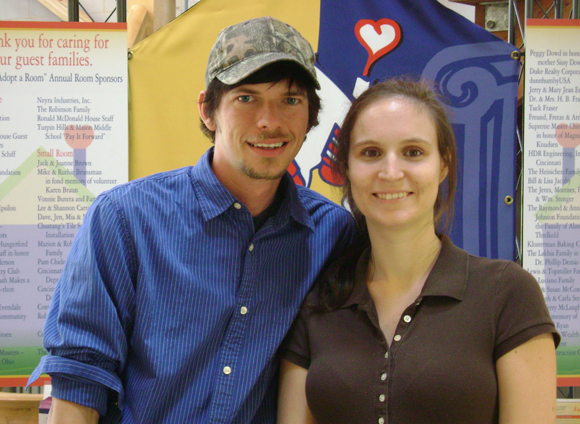
Angeline is still weeks away from being born, but she is already a miracle for her mother, LaDonna Thompson, and her father, Jared Litke. The young couple from Biloxi learned in April that their daughter-to-be had spina bifida - her spinal cord was literally growing outside of her back. They researched, consulted with experts and weighed heavy options.They could wait until her birth, then face a dangerous operation and growing odds that she might need to have a shunt inserted into her brain or spine to help drain spinal fluid. Or, they could try a risky but promising procedure available at only a handful of hospitals in the country. Fetal surgery to enclose their baby daughter's spinal cord before her birth offered the best chance that she might live a more normal life. "Only four hospitals in the country do it," says Litke, 24. "Vanderbilt and Cincinnati Children's are the top two."So Litke and Thompson, 19, who met while working at Petsmart in Mississippi, made plans to travel north. "We lost our jobs, we lost our home coming up here," Litke says. Though engaged, they don't qualify for the Family Medical Leave Act. They relied on family and friends to do what they could to help.They had three weeks to clear out their belongings and head north. It was a daunting task, but Litke and Thompson didn't hesitate. "Kids always come first," Litke says.Their stay at the Ronald McDonald House in Avondale started this spring. Thompson underwent a three-hour surgery in May to close Angeline's spine. Results looks promising so far, but because of the risks, the parents-to-be will stay in Cincinnati until Angeline's birth in September. The couple settled on the name Angeline early on, Litke explains. The word for "angel" has strong Irish and Italian roots, as do the parents.The Ronald McDonald House never withholds treatment because families can't afford it, but Thompson and Litke wanted to contribute something to offset the cost of treatment. In 2010, the facility housed more than 1,200 families from 49 states and 28 countries. Providing a room costs the agency $90 per day, but the suggested donation amount for families is just $25. Thompson and Litke could scarcely afford any additional expenses, so they decided to start a non-profit, Angeline's Hope, to raise funds for other families in similar conditions. They started collecting pull tabs from canned drinks, mostly via Facebook and friends in Mississippi, to donate to the Ronald McDonald House as well as to raise awareness of the organization's never-ending needs.Just 13 percent of its annual budget actually comes from McDonald's, explains ?Colleen Weinkam, communications manager of the Ronald McDonald House Charities of Greater Cincinnati. Cincinnati Children's Hospital Medical Center contributes 1 percent of the annual budget. But the lion's share of the funding, 84 percent, comes from donations and contributions. Last year, the organization raised more than $16,000 by cashing in hundreds of thousands of pull-tabs. Though it takes more than 300,000 pull-tabs to support a single night's stay in the house, Litke and Thompson were inspired by the House's existing pull-tab donation program. Plus, they wanted to give something back to show their appreciation and support of the people who became their family away from home. So far, they have collected more than 100,000 pull tabs. Their goal is to hit 400,000 before Angeline's birth. "It really does feel great knowing there is that there is all that support there," says Litke. "It's important to know that we are giving our little girl a better shot at living more of a normal life." Do Good:• Become a friend. Get the latest news on Angeline and fundraising on Facebook.• Sponsor a family. Pay for as little as one night for $25 or three months for $2,325 to cover costs for a family that is fighting for its life.• Be a Hero. Pick from more than a dozen options that package donations into categories including a "Basic Baker's" pack, a "Comfort" pack and a "Kitchen" pack.By Elissa YanceyPhoto courtesy Ronald McDonald House Charities of Greater Cincinnati


Father of the Year takes Talbert House project to heart

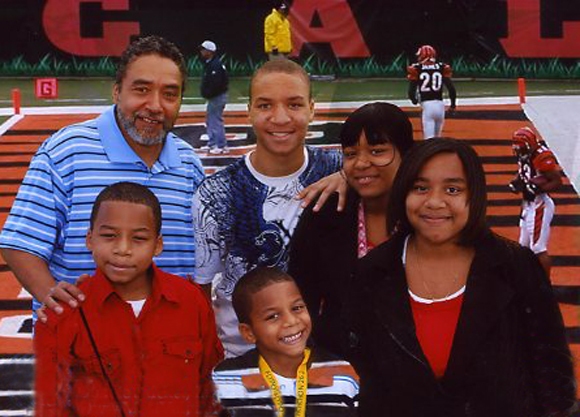
When Ronald Smith-Yisrael first enrolled in the Talbert House Fatherhood Project in May 2008, he was essentially homeless and trying to find food and shelter for his five children. This month, he'll be honored as Father of the Year and help lead a new celebration of nurturing and loving fathers at Sawyer Point June 19.Smith-Yisrael had just obtained physical custody of his children when he started 10 weeks of free classes called Nurturing Fathers. Sessions cover everything from how to process unmet needs from your own childhood to fathering without violence or fear. There are lessons on playing and listening, on problem-solving and discipline."It offers support for fathers and it's open to anyone who wants to be a better dad," says Kathleen Rause, Talbert House's community relations specialist. "Some folks didn't have the best models."Smith-Yisrael, a star student during his 10 weeks of classes, found permanent housing while part of the program. After graduating, he filed for, and was granted, full legal custody of his minor children in 2009. He still lives on a fixed income, but is now majoring in information technology in college."We are here, and we are making it," Smith-Yisrael says. He says he and his children rely on strong moral values, faith, and love to keep close. "My children are a blessing." Smith-Yisrael will be part of Talbert House's first ever Fatherhood Celebration, a free family outing Sunday, June 19, from 11 a.m. until 4 p.m.Do Good:• Celebrate Fathers! This year, put a twist on Father's Day traditions by visiting the first ever Fatherhood Celebration at Sawyer Point, June 19.• Make a donation to Talbert House. • Make a new friend. On Facebook!By Elissa YanceyPhoto courtesy of Talbert House 

Covington youth find meaning in the BLOCK

When Jenni Miller-Francis first talks with fourth and fifth graders who go to school in Covington, she asks them what they like about the city. A common initial response? "Nothing."After 10 weeks of Born Leaders of Covington Kentucky (BLOCK), she notices a transformation. Students have spent weekly sessions learning about their community, interviewing current leaders and analyzing ways they could do their part to help, from making "thank-you" soup jars filled with ingredients and instructions to conducing a neighborhood-wide lead-poisoning awareness campaign. "There are a lot of great things happening here," says Miller-Francis, the director of youth and family initiatives at the Center for Great Neighborhoods in Covington. "The coolest part is watching kids who either don't know anything about their community or don't have anything that they like about it really see the assets and start to have pride in it."While the Center for Great Neighborhoods of Covington has offered youth leadership training since 1976, BLOCK has only been around since 2007. Miller-Francis says partnering with Covington Independent Partner Schools and Covington Partners in Prevention has helped solidify the program in the Northern Kentucky city's 19 elementary schools. Teachers recommend students to participate in the program, which lasts for 20 weeks in all. Teachers and School Resource Center coordinators offer the additional 10 weeks of instruction. "The schools encourage kids to get involved in the community," Miller-Francis says. "We try to help them understand city and local government and how to be involved."Some graduates of the BLOCK and other youth leadership programs created by the Great Neighborhood nonprofit have remained in leadership roles in their community. Some have joined the Covington Youth Commission, where they can gain experience as grant makers, supporting projects developed by other young people aimed at bettering their city. "The kids learn how to be leaders," Miller-Francis says.Do Good:• Get a new Mac. And give your hand-me-down laptop to the Center for Great Neighborhoods of Covington.• Help a Born Leader. Volunteer to spend a session or two as a part of BLOCK.• Make nice on Facebook. Friend the Great Neighborhoods of Covington Facebook page to keep up on the latest news. By Elissa YanceyPhoto courtesy of BLOCK

Students get in StEP with market economy

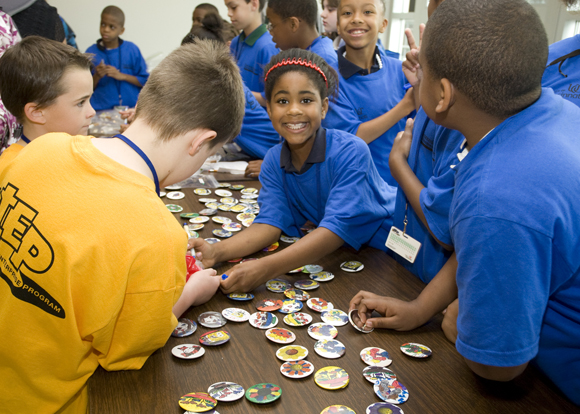
Third through fifth-graders survey a table of opportunities- silly bands, basketballs, notebooks, Frisbees. Which will they choose? That depends, of course, on how much they have to spend. It's part of the Student Enterprise Program (StEP), an initiative of the nonprofit Economics Center, located at the University of Cincinnati.The more than 4,000 Cincinnati elementary students who participate in StEP earn a maximum of $15 per day for attendance, homework completion and behavior. Their hypothetical money is logged in a ledger and spent via checks that students fill out themselves. Students get practical financial education and skills as classrooms are converted to small businesses and students as hold jobs, save, spend and invest school currency. Through saving and spending their money, students learn about supply and demand, opportunity cost and the value of their work.From Western Hills to Bond Hill and more than three dozen points in between, StEP offers more than a simple addition and subtraction lesson, says marketing manager Jaclyn Smith. Experiencing the impact of thoughtful financial decision-making - should I buy a notebook now or save for a basketball? - empowers students. Students learn what it feels like to delay gratification, and even have an opportunity to develop and market their own products in preparation for StEP's annual Market Madness event in the spring, Smith says. More than 700 students travel to UC in the spring to showcase their business ventures, which range from flowerpot shops to bakeries. During the event, students also tour UC's campus. The results impact students long after their market days are over. From better grades and more interest in their classwork to improved attendance, StEP participants prove that innovative incentives can make a real difference in learning.Do Good:• Mind the shop. Spend some time as a volunteer at a StEP school store near you. Email StEP Director Dr. Val Krugh for details.• Help a start-up. Interview students for management roles for their business ventures or make a direct donation to the program.• Give a tweet. Follow the Economics Center on Twitter. By Elissa YanceyPhoto courtesy Economics Center

Building a Green Legacy in OTR

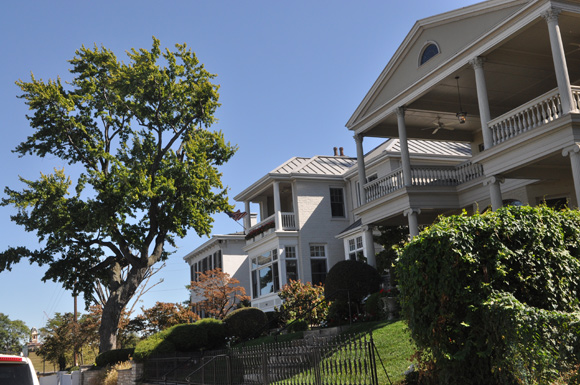
The US Green Building Council's Legacy Project partners with preservationists and affordable housing advocates in Over-the-Rhine for a first-of-its-kind green historic housing development. 

UC’s DAAP, Hughes High School team for TREAD Project

Three University of Cincinnati Industrial Design students are empowering and educating students at Hughes High School through a footwear design studio as part of their senior thesis, the TREAD Project.Charley Hudak, Vanessa Melendez, and Jince Kuruvilla, are fifth-year industrial design students in the College of Design, Architecture, Art and Planning and have been networking for nearly five years to bring TREAD Project to life.The design studio was somewhat inspired by a program at Carnegie Mellon University, Sneakerology Course, which focuses on the culture and history of sneakers, not design.In its first year as a footwear design studio, the TREAD Project became part of UC's ID curriculum thanks to the support of Dale Murray, associate professor and coordinator of Industrial Design, and Phyllis Borcherding, associate professor and coordinator of Fashion Design and Development. After the success of its initial year, the design team decided to share the project at the high school across the street from UC's Uptown campus. The TREAD Project is a seven-week design student for 25 Hughes students who meet for three sessions per week. The last session each week features a footwear industry professional, including representatives from Nike, Reebok, Adidas, Jordan, Toms Shoes, Vans and more. In classes, students learn how to design with markets in mind, solve design problems and creatively sketch their concepts of the perfect shoes, which they will present to a panel of experts on the last day of the studio, May 25."It gives them a different opportunity to realize their skill sets can be applied to any problem," Melendez says. "They're using different thinking skills to solve problems instead of memorization or standardized tests."The project has particular significance at Hughes, where the dress code allows only black or white shoes. The students' shoe brands become a way for them to express their personalities.While the studio teaches students about footwear design, it also inspires them to take more active roles in their lives, including getting to school every day, applying to college or landing a job after graduation. "There are opportunities that not all of these students are aware of," Hudak says "Creative problem-solving goes beyond the education and design process." "Their skill sets can be applied to any problem," Melendez says. "They're using different thinking skills to solve problems instead of memorization or standardized tests."Hudak and his partners, all of whom are graduating this June, hope to expand the curriculum into a working non-profit model that could be replicated nationwide. Do Good:• Support the Tread Project. Donate money or supplies so tread can continue to teach inner-city students. • 'Like' Tread Project on Facebook. • Get informed. Visit the Tread Project online to learn more about the progress and see cool pictures, too!By Jayna BarkerFollow Jayna on Twitter @jaynabarker.http://www.jaynabarker.comPhoto courtesy Tread Project

Chamber’s GrowthForce program aims to accelerate regional business growth

The Cincinnati USA Regional Chamber is ramping up its efforts to retain and grow the region's existing businesses through a revamped program called GrowthForceGrowthForce is building and expanding on the successful 20-year old Regional Business Retention Committee (RBRC), a volunteer group of 30 business leaders who mentor local business owners through growth periods."GrowthForce is a collaboration of business sector volunteers, local economic development professionals, and regional Workforce Investment Boards, a vastly expanded team of experts to address business needs," said Julia Muntel, the Director of Investor Relations and Business Retention with the Chamber. "The coordinated approach allows us to maximize resources by working in a regional, aligned fashion. This gives us the most bang for our buck. GrowthForce leverages powerful, existing resources and applies the same methods and tools of business attraction to help local companies stay strong and grow jobs in the economy. Focusing on local, established business growth isn't a small piece of Cincinnati's economic pie. In 2010, nearly three-fourths of the region's total business investment came from existing businesses, according to the Chamber.The free program is open to companies in the 15-county tri-state region of SW Ohio, Northern Kentucky and SE Indiana. The program's goals are to grow the its number of business outreach volunteers by 25 percent, and to increase the number of participating businesses to 450, a 10 percent jump from last year. "In this era of elevated competition and economic uncertainty, we have recently chosen to focus on companies that may be rapidly expanding, within targeted industries, or those experiencing a variety of changes in their business cycle. These high potential companies, large and small, may be well positioned for growth," explained Muntel. GrowthForce's expansion is largely being supported with a $250,000 grant to increase business retention efforts that the Ohio Department of Development awarded the Chamber last December.To support the program, the Chamber will publish the Cincinnati USA Regional Business Resource Guide, and provide training and orientation to partners. The resource guide and other supporting materials can be found online on the GrowthForce website.Writer: Feoshia HendersonSource: Chris Kemper, Cincinnati USA Regional ChamberYou can follow Feoshia on Twitter @feoshiawrites

What Makes Riverfront Developments Work?

With Cincinnati's Banks Project rising on the riverfront, we take a look at other regional waterfronts to see what works and why these developments are making cities reexamine their relationships with rivers.

High-school leaders bond, learn at Xavier this summer

More than 100 Cincinnati inner-city high-school students get a taste of college living for four weeks each summer through an educational effort with roots in the heart of Over-the-Rhine. Leadership Scholars, a four-year-old nonprofit focused on providing support for students with academic potential but few avenues of support, began after Cincinnati lawyer Harry Santen saw the challenges faced by talented students enrolled at St. Francis Seraph School downtown. Today, Leadership Scholars provides year-round programming and support for area youth, including a no-cost summer program based at Xavier University that will include 125 students this year, the biggest class ever.They span four grades and more than 15 schools. They are veterans of the school-year program, which includes team mentoring and leadership development sessions at Xavier. During the summer session, they take academic as well as arts-focused classes. They take field trips and have a picnic with their extended "family" of scholars. They walk away with much more than solidified academic skills. "The best part each summer is watching the students make new friends," says Tara Bonistall Noland, Leadership Scholars' associate director. "One student told me last week that while she has a lot of friends at her high school, she considers her Leadership Scholars friends to be her real friends."Bonistall Noland is preparing for her second summer program, which means hiring 12 professional teachers and 16 veteran high-school Leaders as staff members, and buying 200 water bottles, 120 flash drives, 160 t-shirts, more than 500 books and thousands of sheets of paper. She can't wait for the program to begin."We see tremendous growth in the students each summer - especially with the 8th graders, who are participating for the first time," Bonistall Noland says. "They become more mature, their communication skills improve, and they begin to embrace leadership in a new way. All of a sudden, holding the door for someone else becomes the norm, and speaking up in class is cool."Do Good:• Make a donation. Your contribution can help purchase supplies for this summer's session at Xavier!• Be a coach. Volunteer to mentor or speak to a group of young Leaders and Scholars about your career and path to success.• Keep in touch. Like the Leadership Scholars Facebook page to find out the latest news. By Elissa YanceyPhoto courtesy Leadership Scholars

Our Partners

Taft Museum of Art

Common Ground Is Brewing

Support local stories and receive our signature roast straight to your door when you join at the Standard level (or above).

Drink Better, Read Local

Close the CTA

Don't miss out!

Everything Cincinnati, in your inbox every week.

Close the CTA

Already a subscriber? Enter your email to hide this popup in the future.