
Kennedy Heights Art Center exhibition offers grief a place to surface and process
58 local artists approach loss as an environment, in spaces people learn to live inside.
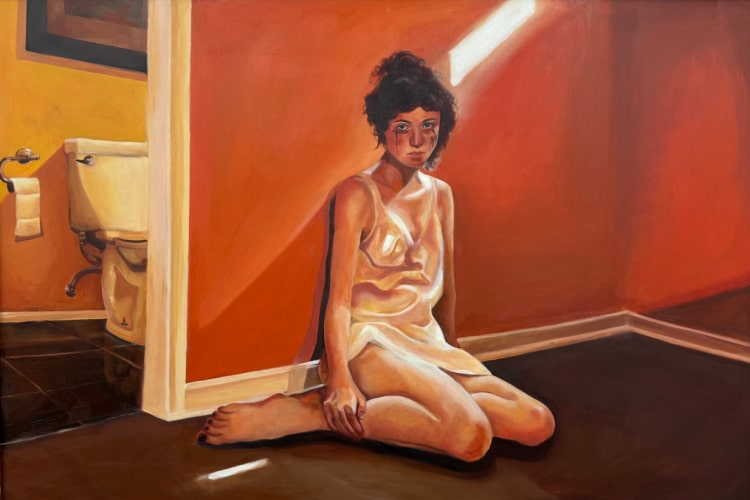
Grief does not arrive cleanly. It alters how time behaves. It changes how the body navigates space. And when it has nowhere to go, it looks for a way out, a means of expression. These artists have found that outlet. Through form, material, and restraint, they give shape to what is often held silently, offering grief a place to surface, a place to process.
That quiet reordering of the world is what Rooms of Grief, opening January 17 at Kennedy Heights Arts Center, attempts to hold. The multidisciplinary exhibition brings together 58 local artists whose work approaches loss not as a moment to be resolved, but as an environment people learn to live inside.
Rather than organizing around medium or theme, the exhibition is structured conceptually. Each room operates as a metaphorical space shaped by grief. Some are sparse. Others feel crowded. Together, they reflect how loss fragments experience and resists linear narrative. There is no single emotional arc offered here, no implied destination of healing or closure.
The exhibition is co-curated by Ena Nearon, founder of Ten Talents Network, a cultural platform focused on community-based art and underrepresented narratives, in collaboration with Kennedy Heights Arts Center exhibitions director Mallory Feltz. Their curatorial approach is deliberately restrained. The works do not explain themselves. They do not instruct viewers how to feel. Instead, they create conditions for recognition.
Nearon describes Rooms of Grief as “an invitational experience rather than an instructional one,” rooted in the understanding that grief is non-linear and revisited over time. “Each room offers permission,” she writes, “to feel, to remember, to rest, or simply to be witnessed.” Her hope, she adds, is that visitors leave with the sense that their grief belongs, without needing to fix it, explain it, or carry it alone.
Feltz emphasizes that the exhibition’s framing grew out of the varied and layered ways people experience grief. “Navigating the processing of grief is where we found the correlation with ‘rooms,’” she explains, noting how physical, mental, and emotional space all shape how loss is held. Moving through the gallery, she adds, allows visitors to see how artwork can make grief visible, creating opportunities for connection, empathy, and compassion rather than isolation.
That refusal to simplify grief feels especially relevant now, as conversations about loss are often flattened into slogans about resilience or recovery. Complex survival strategies are repackaged as “trends,” frequently by people who have never had to live inside that kind of pain. In contrast, Rooms of Grief acknowledges something more uncomfortable and more honest: grief does not stay in the past. It reappears. It loops. It reshapes perception long after the event itself has ended.

This understanding aligns closely with what trauma research has documented over the last several decades. As therapist Pete Walker outlines in Complex PTSD: From Surviving to Thriving, trauma does not merely affect emotions or memory. Prolonged exposure to loss, instability, or harm can alter the nervous system itself, rewiring how the brain interprets safety, threat, and connection.
Walker has argued that insight alone is never enough to resolve complex trauma. He describes grieving as an irreplaceable process for metabolizing what he calls emotional flashbacks, moments when the body is pulled back into fear, shame, or abandonment long after the original harm has passed. Grief, in this framework, is not indulgence or rumination, but a necessary release that allows the nervous system to move out of survival mode. Without it, trauma remains lodged in the body, unresolved and recurrent.
Seen through that lens, Rooms of Grief functions less like a traditional exhibition and more like an embodied experience. The gallery becomes a sequence of nervous-system states. Some rooms invite stillness. Others confront viewers with unresolved residue. There is no singular tone because trauma itself is non-linear. It fragments attention. It distorts chronology.
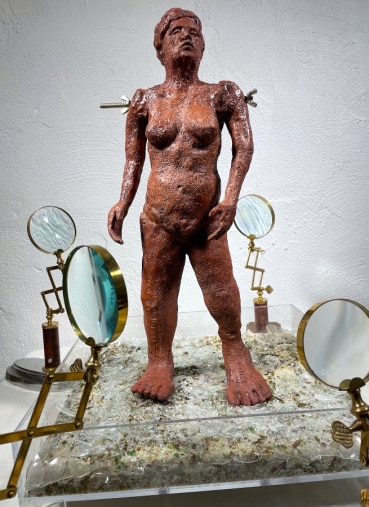
ground glass, glass shards, 2012. Provided.
The range of work on display reinforces this complexity. With pieces created more than a decade ago shown alongside new works completed within the last year, the exhibition invites reflection on how grief collapses time. Loss does not obey calendars. It returns unexpectedly, sometimes altered, sometimes unchanged.
What unites the artists is not subject matter but posture. These works resist spectacle. They ask viewers to slow down rather than consume. To remain present rather than extract meaning quickly. In that sense, the exhibition offers something increasingly rare: permission to linger without explanation.
That ethos extends beyond the gallery walls. In addition to the opening reception on January 17, the exhibition includes a public panel discussion on navigating grief in early February, as well as a facilitated art therapy workshop planned later in the run. The programming positions art not as decoration or distraction, but as a communal tool for reflection.
The exhibition does not offer answers. It does not promise healing. What it provides instead is something quieter and more honest: space. Space for grief to move, to speak, to be witnessed. Space to understand that what remains after loss is not always closure, but adaptation.
What: Rooms of Grief exhibition
Where: Kennedy Heights Arts Center, 6546 Montgomery Rd., Cincinnati, OH, 45213
When: The exhibition opens Jan. 17 with an opening reception from 6 – 8 p.m., and continues through March 14.
Tickets: The exhibition is free and open to the public during regular gallery hours, Tues. through Fri. from 10 a.m. to 5 p.m. and 11 a.m. to 4 p.m. on Sat.
Additional programming includes: A panel discussion on navigating grief on Feb. 7, plus a facilitated art therapy workshop to be held later. Check the website for programming times, locations, and updates.
Author

Related Articles

At the Taft Museum of Art, a 40-year legacy meets a living artist
The inspiration for the Duncanson program is literally painted on the walls inside.

Women do a world of good: How one woman transformed personal tragedy into triumph
106-year-old Junior League of Cincinnati focuses on strengthening women and children’s environments today.
WCC, a nonpartisan organization of feisty women, brings awareness to issues facing the average citizen
Women’s City Club hosts arts activist, Gina Belafonte, who uses music and art for social justice impact.