
Journalist Amanda Becker returns to “stand up” for Ohio
As a writer for the nonprofit newsroom The 19th, Becker focuses on educating the public about individual rights, highlighting those advancing the work and informing communities about local action.
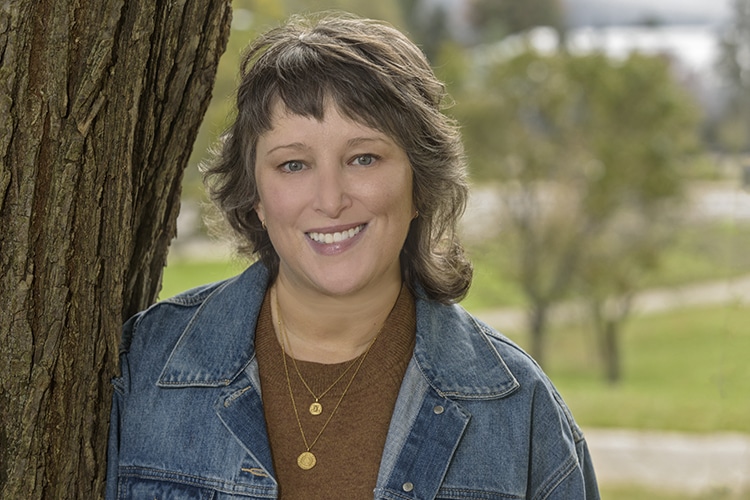
Amanda Becker grew up in the Midwest, shuttled between coasts for work and school, and currently writes for an Austin-based publication. Yet she credits her education at Loveland-based Children’s Meeting House, which practices the Montessori teaching method, for her independent spirit, adherence to her values, and her curiosity, to write about our political times. During attendance there, the school operated on a farm with 360 acres. “We could explore all we wanted as long as we could hear the bell,” Amanda recalls.
In March, Amanda heard a similar bell that rang loud enough to bring her back to Cincinnati, where she’s still practicing those same Montessori values. “I knew that as a country we would be going through a period of upheaval and uncertainty. I both wanted to be in my “home” state to cover the impact of policy coming out of Washington, but also there’s a tendency to want to be near your family and other loved ones during a time of uncertainty.”
Amanda attended Loveland Public Schools for middle school, Ursuline Academy for high school, and graduated with honors from Indiana University in political science with a certificate in journalism. She considered going into law, moved to New York City and worked for Simpson Thacher as a paralegal, then decided not to attend law school. Following a brief unpaid internship at a now-defunct luxury magazine, she set her sights on reporting, completing a master’s in journalism at University of Southern California while interning at American Lawyer magazine between her years of graduate school.
In 2008, Amanda says, “It was a terrible time for a generation to be graduating, especially in journalism,” where the LA Times laid off 400-500 in her last year of grad school and NPR closed NPR West for a time. Her understanding of this set Amanda off on a path she hadn’t planned.
Upon graduation, two job offers came her way. One for a community newspaper and the other for a legal newspaper covering law firm business. “I called up a woman I had met who worked at the Wall Street Journal,” Amanda says, and asked her mentor which internship she should take. Her mentor pointed out how local news stories would include parades and drunk people and the legal option would offer sources who could be relevant on other beats the rest of her career. “It was good advice, so I committed in my head I would work there for exactly one year.” And she did keep in touch with lawyers met through her work at the Los Angeles Daily Journal.
After receiving a fellowship in Washington, DC, she stayed there nearly seventeen years in a rent-controlled apartment, near where authorized military checkpoints had been set up in DC this past summer. “It was on 14th Street, which is a major thoroughfare, heavily populated with immigrants,” Amanda points out, like other areas targeted by the current administration’s law enforcement and ICE crackdowns.
Amanda started out at the Washington Post and moved on to Roll Call to cover Capitol Hill. For a year, she sat on an ethics panel that reported on the ethics committee of Congress. She loved being part of an investigative team. “That’s what I wanted to do but it’s just really hard to get those jobs because very few of them exist at this point.” “Anemic” was how she described Congressional enforcement capabilities. When her panel shut down, Amanda’s other option through Roll Call was to cover leadership in Congress. “It’s very inside baseball, and that wasn’t for me.”
The law called her back. At the time, Reuters had a separate unit that covered legal news. She filled their open slot to cover labor laws. Unfortunately, Reuters was very anti-union because employees there had a strong union. Most stories were behind a pay wall. But Reuters was covering the fight for $15 dollars an hour minimum wages at fast food stores and the first cases related to the gig economy through the National Labor Relations Board. “I didn’t want important stories behind a paywall, so I’d work on my paywall stories, get them done so I could write other ones too.” Labor was the trail that led into politics.
Amanda confesses, “I was a political science major, though I don’t really like politics. The way it’s covered as a game and who’s winning and who’s losing. These are peoples’ lives and livelihoods that we’re talking about in this country.” The traditional method of coverage in a place like Reuters, an international news wire, is focus more on things that move markets and policy.”
When another job offer came along, she noted if her boss didn’t want her to leave, would she put Amanda on the 2016 campaign? Her bureau chief agreed, which led to a five-year period of rotating between presidential campaigns and Congress. “I was on the team, but not assigned to cover Hillary Clinton until she got in her Scooby van to drive cross-country.” One reporter with equal experiences but of differing gender and background was scheduled to participate in the touring vans. That reporter didn’t know how to drive.” Amanda, posted at backup at the news bureau, got the spot.
“For the first time, every main reporter assigned to Hillary by every major news organization was a woman,” Amanda says with pride and disappointment, because “assigning editors thought ‘oh, we’ll send our lady reporters to cover the woman candidate’.”
She didn’t have to stray too far to determine if Hillary would win. The last few months of the campaign, she paid attention to what she saw and heard in Cincinnati, in Ohio, and from friends and relatives in her life after growing up here. “I’d come home and see who had signs up. Publicly, everyone knows who you’re voting for.” With a residue of surprise still today, Amanda says, “I radically underestimated the number of people who were willing to look past behavior they didn’t agree with, to get what they wanted.”
All over, newsrooms had made assignments on the assumption of Clinton’s win. “I didn’t want to be assigned to the White House press corps,” where one sits in a little phone booth-sized room. “I angled for Congressional coverage, was assigned financial regulations, and when Hillary lost, realized there would be no financial regulation.” Moving to cover general congressional news, she remained there throughout Trump’s first presidency.
Amanda found a news home as the 2020 Democratic primary wound down. She had become so frustrated by how the coverage of women who ran on the Democratic side was organized. “Editors and newsrooms pick winners and losers and that’s how they distribute resources.” It’s human nature in many aspects of life, but that kind of thinking was “always going to give minority candidates the short shrift. “I wanted to work in the way I believed news should be covered.”
Enter The 19th
About that time, Emily Ranshaw and Amanda Zamora, both former Texas Tribune staffers who served as editor-in-chief and chief audience officer, respectively, felt the same. They co-founded The 19th, according to their website, as “an independent, nonprofit newsroom reporting on gender, politics, policy and power.”
“Nonprofit news views each other as partners, and not competitors,” according to Amanda. “The problem in journalism and social media, is we’re trained to be competitors,” driven by profit motives. “Nonprofit news was the only place I wanted be.” Amanda found out about The 19th and started following the editors. Her target of flying to Austin for an interview with leadership hit a snag in March 2020, when Covid hit. Instead, she met potential workmates over Zoom. She joined the nonprofit news organization as the first non-managerial employee reporter and finished covering 2020 election for The 19th.
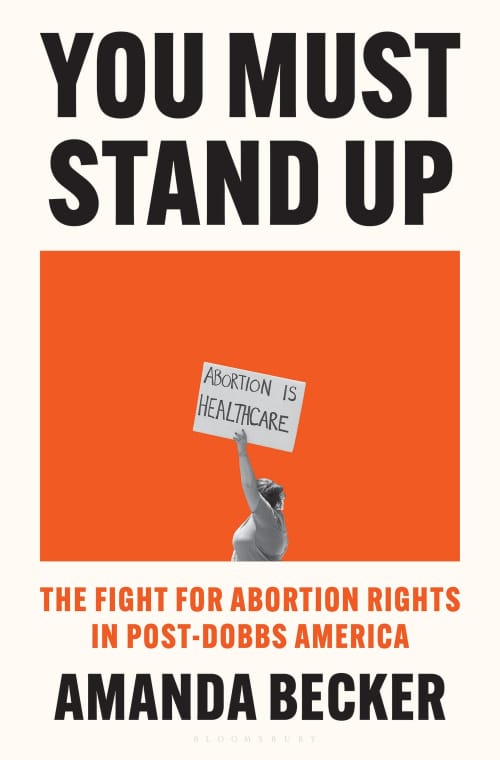
The seed for her book, You Must Stand Up: The Fight For Abortion Rights in Post-Dobbs America, grew from a variety of insights gleaned from those work experiences. She had covered Susan Collins, the Maine senator who planned to confirm a Supreme Court justice that would not uphold abortion rights. On the ground, Amanda sensed a lack of confidence in Collin’s opponent in the election. Collins would win. On Amanda’s last day in Maine, Ruth Bader Ginsburg died. “We knew with Trump it was a matter of time. I’m not sure the average person knew. When they argued the Dobbs case (the ruling that overturned Roe v. Wade) in December 2021, anyone who listened to the argument knew abortion rights would be scaled back even it not overturned.”
Amanda put the book proposal together and pitched it to editors. Before the decision leaked, editors wondered how she could be so sure. Newsrooms weren’t even covering it. Until after Dobbs, reporters weren’t covering reproductive health rights and related politics. “That’s why The 19th exists.”
“It’s hard to hold people responsible for not knowing how abortion would fall.” The Supreme Court ruling caused newsrooms to look at their coverage. There was plenty of intuitional blindness elsewhere too. “Older, male editors don’t see these rights in the same way as women.” It took an unprecedented overturning of a right that women have had for fifty years.
“While not everyone on the left votes based on abortion, there’s a not-insignificant-number who will never vote against it. That demographic can be a lightning rod.”
Amanda gave another example of how women’s issues are ignored. In her effort to find a local OB/GYN who better understood menopause as she turned 46, Amanda discovered research that showed only 31 percent of these specialized doctors receive training, which is lecture-based and not clinical. To that end, The 19th started a menopause newsletter. “Menopause, the biggest challenge to our health, impacts all we do.” Amanda is thankful for discovering a doctor at Tri-Health who will only see menopause patients, since her last primary care doctor told her she was too young for perimenopause. “I don’t want to spend ten years sorting this out,” she declares.
Amanda brought this drive to educate the public about our rights back to Ohio. Her role now, in continuing to write for The 19th and news organizations which pick up her stories, is to shine the spotlight on those doing the work, and educating communities on what we can do, “so we don’t despair.” The 19th implements an audience needs model. The nonprofit wants to help readers engage and offer examples of what’s working, what can make them feel better, like in her story about USDA cuts.
“My goal now is to cover how the Trump administration is affecting Ohioans, whether it’s the small local farms I wrote about in May who had a key USDA grant canceled, or upcoming stories I have in the works about the Haitian migrants who settled in Springfield and are now facing a deadline to leave the country.”
From The 19th: Their small farms helped stock food pantries. That program is going away.
From Loveland Magazine: Farmers pivot after USDA ends Local Food Purchase Assistance program
People might not feel these losses in their everyday lives until it’s too late. “They don’t realize the short and long-term implications come from a place that is governed without their regard.” A lot like menopause in medicine.
In other recent news stories, Amanda wrote about the Free DC movement led by four women on the front lines of responding to the president’s takeover of the Capitol this summer. In a city of 700,000, “they’re trained in organizing in other societies who have resisted authoritarianism, looking at it clear-eyed.” In DC, women began a banging of the pots and pans like in Chile, in Myanmar. “All very gendered, can be done in home, can’t tell who’s doing it,” Amanda smiles. “Besides, they’re cooking.”
“Mothers and grandmothers are learning to tie their work to democracy. Women are experiencing this political climate, queer people too, very differently. Our rights are affected first.” She sees this in her own circles. “We cannot separate democracy from racial and gender identities.”
Amanda urges local (and all) citizens to understand voting is not enough. “You wouldn’t plant a garden in two years and expect it to be doing well without watering or tending to it.” Even her book covers the ancillary providers and people protecting their rights. Thus, providing examples of other ways to champion democracy. “You can’t expect things you care about to do well if you don’t fight for them.” She admits the challenges look different for everyone. Community groups have had funding taken away. Shelters and health providers are deciding their priorities of whether they can accept transgender youth for care. Local NPR stations and universities have lost dollars.
Given that she has no thoughts about running for office, Amanda still believes in the power of possible. “Being intentional can make a really big difference right now. Look what happened to Target when they capitulated on DEI policy. It’s difficult but possible.”
A small part of Amanda wanted to move back because she “likes big change.” She’s advocating that for us too.
Follow her work through The 19th and on Bluesky Social.
Author

Related Articles
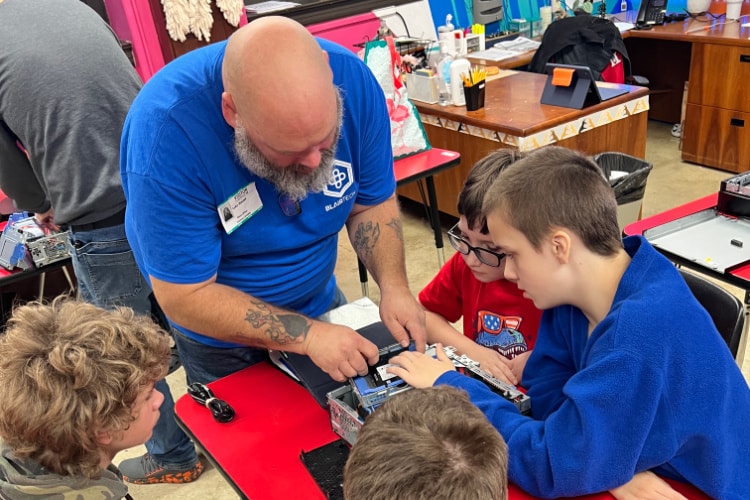
Adopt A Class introduces elementary school students to careers at leading Northern Kentucky life sciences, IT companies
Program initiates pipeline for future employees in advanced manufacturing, information technology, supply chain and biosciences.
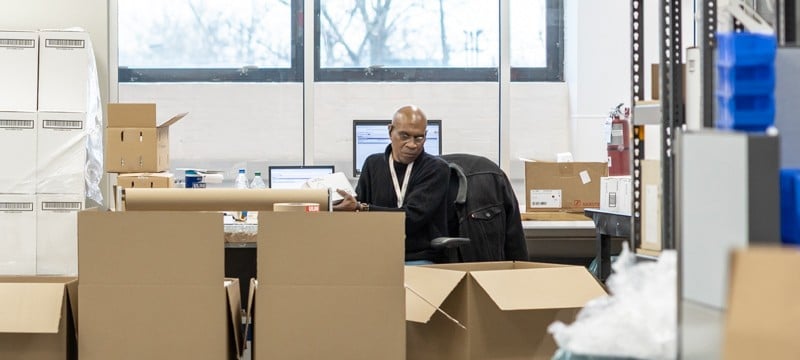
A labor shortage is hitting Cincinnati. These nonprofit groups are responding with inclusion.
Three organizations demonstrate the lesson that employment that lasts does not begin at the moment of hire. It begins earlier with time, structure and intention.

Middletown Community Foundation celebrates fifty years at the forefront facing challenges, incubating positive outcomes
While MCF reflects on role in the community’s revitalization, they continue to meet the complex challenges that await all communities in the 21st century.