
Health equity, representation drive Detroit dentist’s mission
Once inspired by a high school mentor, Dr. Michele Bloxson now advances health equity through public dentistry and trauma-informed care.
This story is part of a series on the challenges and solutions related to oral health in Michigan, Indiana, and Ohio. It is made possible with funding support from the Delta Dental Foundation.
Dentist Dr. Michele Bloxson might have followed a dramatically different career path if it weren’t for a mentor.
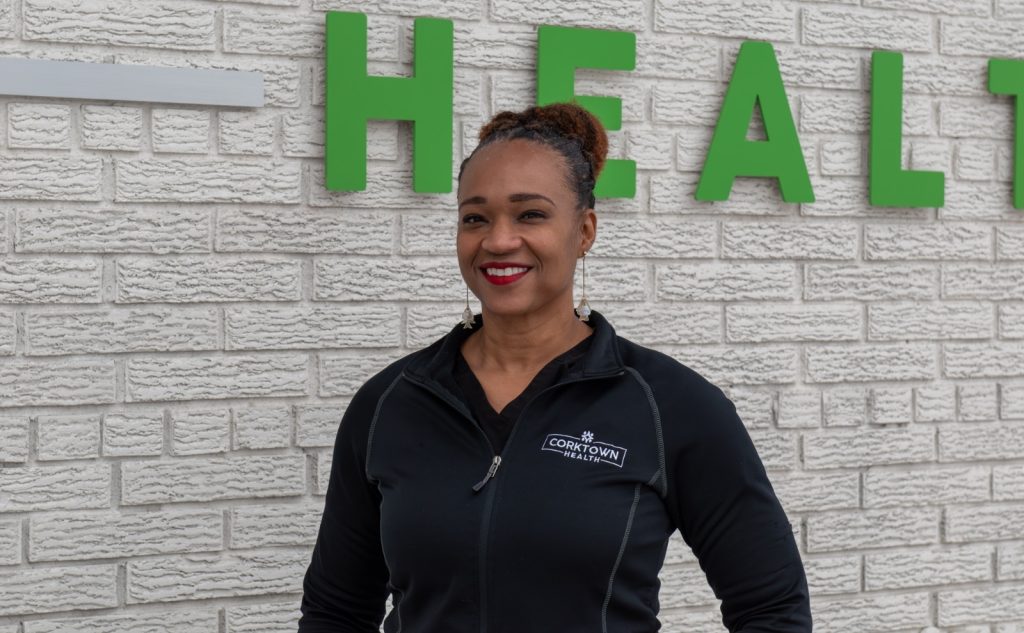
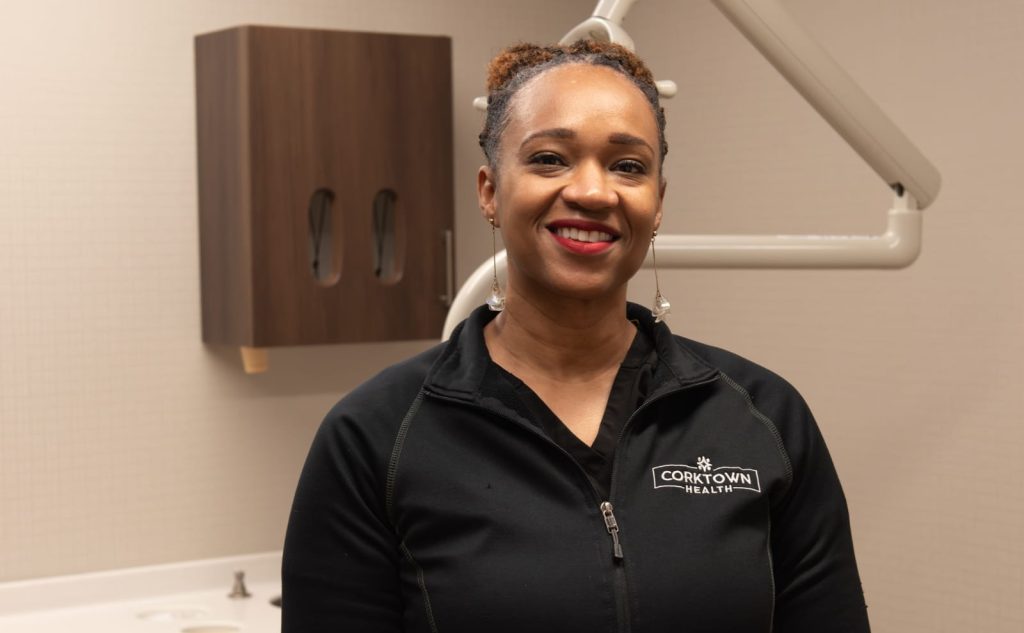
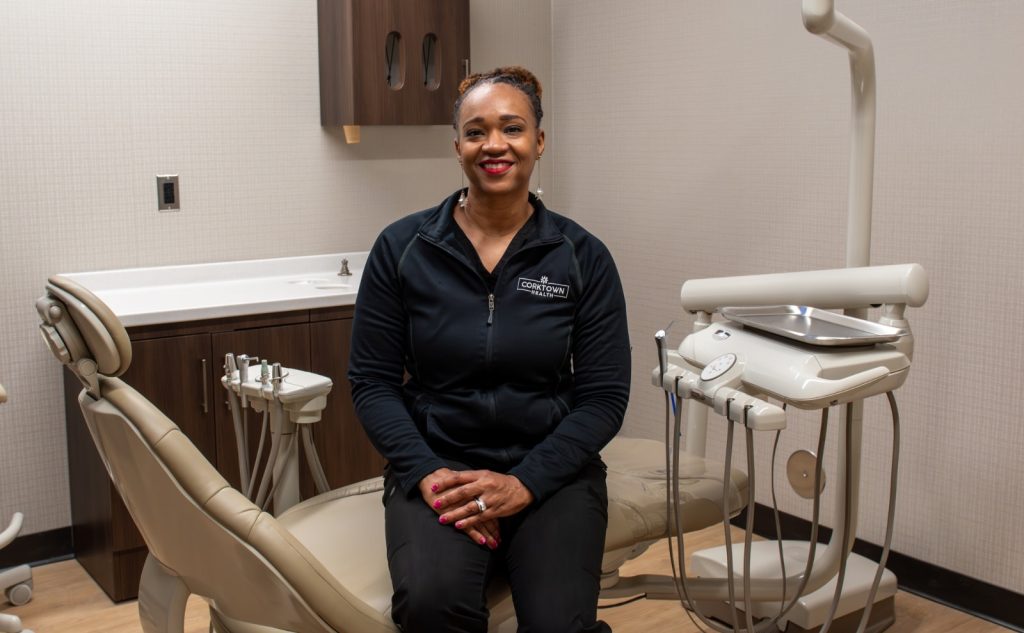
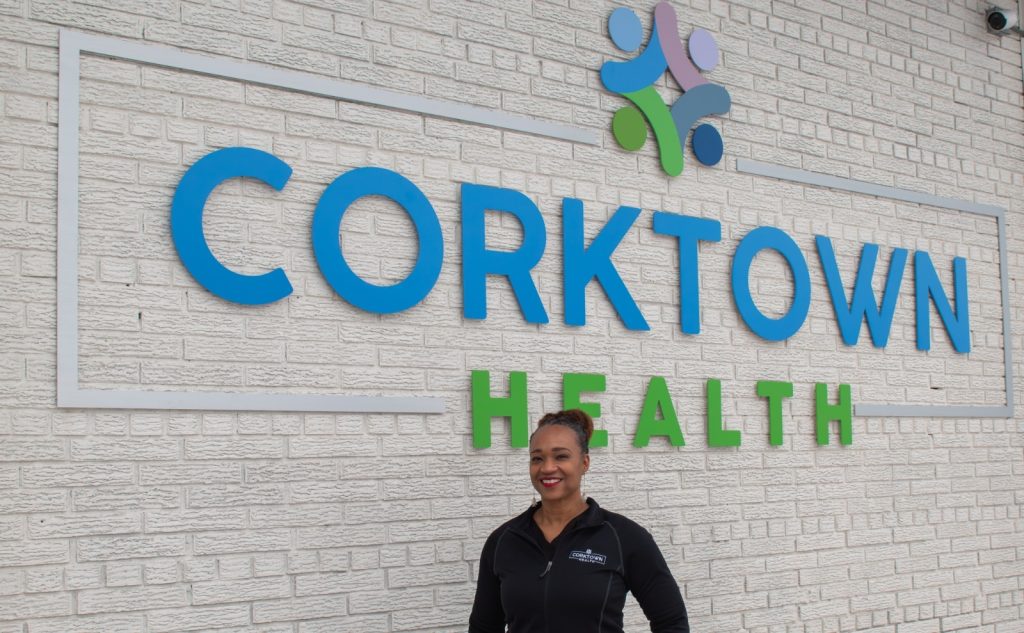
Decades later, she is paying that investment forward. Bloxson is the dental director at Corktown Health, a Detroit-based health center focused on equity, with an emphasis on LGBTQ and those living with HIV.
As a teenager growing up in Detroit, Bloxson wanted to be a pediatrician. She attended a city high school that offered vocational training, and when it came time to select a track, the medical courses were already full. School administrators suggested dental assisting as an alternative.
“I was like, OK,” Bloxson says. “They told me once medical opened up, I could always transition.”
That never happened. Dental assisting introduced Bloxson to a profession, and a mentor guided her down a path to her career.
She was paired with Dr. Patricia Lucas, a Black dentist practicing in downtown Detroit.
“She showed me a lot of things,” Bloxson says. “That exposure allowed me to start liking the field.”
By 11th grade, Bloxson was working as a dental assistant. She went on to attend the University of Detroit Mercy for college and dental school. She now has a rewarding career that spans more than two decades.
Welcoming marginalized patients
Bloxson is among the relatively few Black dentists in this country. Less than 4% of dentists in the United States identify as Black, according to the American Dental Association. According to the U.S. Census, Black or African American people make up more than 12% of the population.
“When patients see providers who look like them and understand their lived experiences, it builds trust, improves communication, and enhances health outcomes,” Bloxson says.
The clinic focuses on patients who often experience discrimination in traditional medical settings.
“When you have patients that are in the LGBTQ community, they face a lot of discrimination and judgment based simply on bias,” Bloxson says. “It’s important for them to have an opportunity and an avenue for care where they won’t be judged, they won’t be discriminated against, and they feel free and welcome to come as they are.”
Bloxson says some patients travel up to two hours to receive care at Corktown Health, driven by past experiences of judgment or outright refusal elsewhere.
“If they are HIV positive, sometimes they’ve been refused care,” she says. “We supply a great need to the community.”
Addressing patients’ past traumas
Bloxson says specialized training made available through the Delta Dental Foundation has helped her trauma-informed approach to care. She and several members of her staff completed courses focused on treating patients with trauma histories and disabilities, emphasizing consent, communication, and flexibility in clinical settings.
“It teaches you to slow down and really see the patient in front of you,” Bloxson says.
Education is central to that care, especially for HIV. Even with decades of medical advances, fear and misinformation remain.
“You treat all patients the same,” Bloxson says. “A provider should always be using universal precautions.”
Modern HIV medications have transformed outcomes so that many patients reach undetectable viral levels.
“That means the disease is non-transmittable at that point,” she says. “It is a great triumph in how far medicine has come.”
Bloxson also emphasizes a concept widely used in the HIV community known as U = U, which stands for Undetectable = Untransmittable. It means that when patients are diagnosed with HIV and stay in care — regularly seeing providers and taking prescribed medications — they can reach undetectable viral levels and are unable to transmit the virus to others.
Patients may be seen every three, six, nine, or 12 months depending on their individual care needs, but staying committed to treatment is key to reaching and maintaining those levels.
The trauma-informed care at Corktown Health’s dental practice is an approach Bloxson says is essential in public health.
“When you work in a health center, it’s not just a job,” she says. “Sometimes I’m a doctor, sometimes I’m a counselor, sometimes I’m a cheerleader.”
Patients often arrive carrying layers of trauma, she says, ranging from past abuse to negative medical experiences.
“If a patient says they’re in pain and the provider ignores that, that’s abuse to a certain level,” Bloxson says. “Some patients will take years and years away from receiving treatment because of that fear.”
The practice’s approach prioritizes consent, communication, and compassion.
“No one has ever taken the time to explain things to me,” Bloxson says, recounting what patients often tell her. “No one has ever taken the time to help me calm down.”
Those small accommodations can be transformative, she says, restoring trust and encouraging patients to return for preventive care.
Creating the Corktown program
Bloxson joined Corktown Health just over two years ago, tasked with building its dental program from the ground up. She had worked in public health for the previous 12 years after starting her career in private practice.
“When I came on board, there were no dental services,” she says. “I was brought on board to create the dental care for the patients.”
The clinic, which opened 18 months ago, recently launched a second location in Hazel Park to meet the growing need for care.
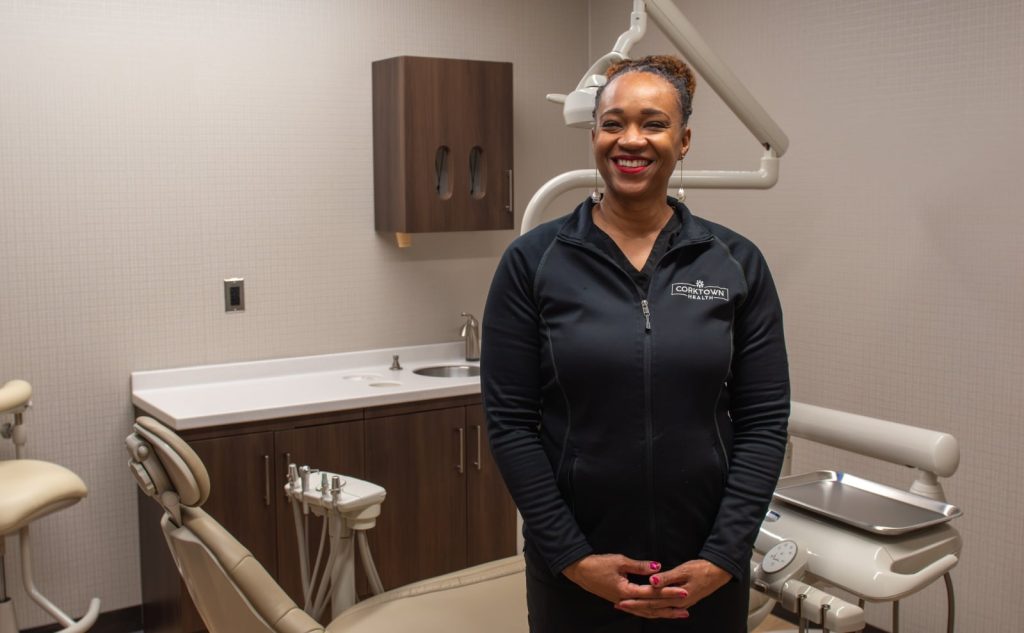
Bloxson’s commitment to her field goes beyond her clinic work. She is one of nine African American women dentists in Metro Detroit who serve as dental directors or lead dentists in public health centers. Together, they form what she describes as a sisterhood.
“We’re all committed to working in the community and serving patients who may not have access to care,” she says. “Oral health shouldn’t be a privilege reserved for the insured or the affluent. It’s a fundamental necessity that everyone deserves.”
The group shares resources and attends continuing education courses together. They also support each other in their leadership roles.
Bloxson also mentors students as well as younger dentists.
“It’s a lot of passing on knowledge and continuing that growth,” she says.
Photos courtesy of Jen Anderson
Author

Related Articles
Nonprofit organization provides for adults experiencing homelessness who are discharged after illness or surgery with nowhere to recover.
Center for Respite Care secures permanent home with purchase of former Uptown Arts Building.

The Davies Project expands care by connecting families to oral health
With Delta Dental Foundation’s support, The Davies Project, based in Lansing, removes transportation barriers, helping families access dental care as well as critical medical appointments for seriously and chronically ill children and expectant women.
How one school system bridges the care gap with innovative Health Hubs
Detroit’s Health Hubs embed medical, behavioral, and dental care inside schools, ensuring students receive essential services and thrive in class.