Development News

Latest Banks designs seek to create ‘great streets’

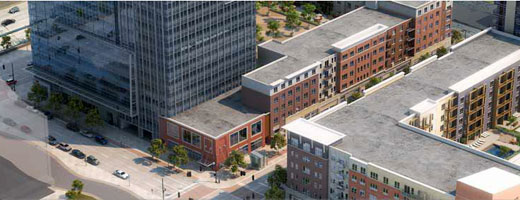
Representatives from the development team of Carter Real Estate and Dawson Company presented their latest designs for The Banks project to Cincinnati's Urban Design Review Board on Thursday evening.In its meeting on March 25, the board had asked designers to address issues they had with some of the building façades, architectural styles, and massing of the buildings that will house the 300 apartments and 70,000 square feet of retail of the project's first phase."There are several things that came out of the last discussion," says Trent Germano, executive vice president for Carter.  "We went back and we looked at what we could do in keeping with our visualization of the project that would address those concerns and comments."Bailey Pope, vice president of design and construction for Dawson, says that the residential buildings are intended to be "contributing"—or background – buildings that can provide the sort of ambience that will be marketable to prospective renters.A 14-story office building and a proposed 12- to 14-story boutique hotel would likely serve as the landmarks of the first phase."We're intentionally deferring to let those be the landmark structures," Pope says.  "I think that all of this [residential buildings] is good quality, and that it's handsome, attractive architecture that people will want to live in."Germano agrees."When we took on this challenge, we knew that we weren't going to be doing architectural icons up and down the street," he says.  "We've tried to create great streets.  That's what's going to attract people down here.  So we've focused on the connectivity of the street and how the street feels when you're on it."Pope says that this can be achieved authentically by allowing tenants the opportunity to create their own storefronts."So we'll have, as you go along here, a lot of variation and variety along the street, which I think goes a long way to create that dynamic pedestrian scale that we're trying to achieve along Freedom Way," he says.The office building is currently being marketed to tenants and there has been no further development on its design, Pope says."Until we have something concrete, it's not prudent to spend any more time to develop the design," he says.  "But I think that it is something that we'll revisit as we come in with additional work."Germano says that the project remains on schedule, with final designs heading to the City Planning Commission in mid-May and construction of the buildings beginning in mid-June.Another review session will be held Thursday at 2 p.m.Writer: Kevin LeMaster
Latest in Development News
ALLY event to showcase CPS leadership in green and healthy schools

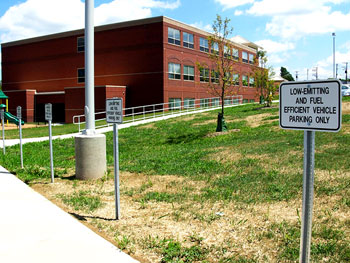
The Alliance for Leadership and Interconnection (ALLY), a citizens' group formed to advocate for Cincinnati Public Schools' (CPS) Green and Healthy Schools Program, will host a reception, program, and tour at the Pleasant Ridge Montessori School and Community Learning Center, Ohio's first LEED certified public school."Green & Healthy Schools as Learning Tools", to be held April 23 from 5 p.m. to 7:30 p.m., will introduce the concept of how a school's physical environment can be integrated into its curriculum and will highlight the ways in which CPS is leading the country in sustainable design.LEED for Schools national chair and Sustainaissance International president Robert Kobet will be the featured speaker."Robert Kobet identifies three systems of ecology:  natural, human, and builecologies," says Tevis Foreman, a consultant for ALLY.  "In order to offer the best outcomes for using the schools as learning tools, Kobet suggests that we explore the relationship between these systems of ecology.  The necessity of integrating environmental education empowers learners to think about ecological patterns, systems of causation, and to ultimately recognize and make informed decisions about their relationship with the natural world."Ohio Lt. Governor Lee Fisher and Robert Knight, project manager at GBBN Architects and sustainable design coordinator for CPS, are expected to attend."ALLY led introductions to partners throughout the community with shared missions to provide critical momentum for CPS going green," Knight says.  "Ultimately, this saved CPS significant time and effort."Students of the school will lead visitors on a tour of the building, following their participation in a Leaders-in-Training program in which ALLY volunteer educators and architects from SHP Leading Design and GBBN Architects will instruct them on the building's sustainable features.All proceeds from the event will go toward the development of educational resources that further ALLY's mission.Admission is $20 for non-ALLY members and $15 for ALLY and PTO members.  A $5 discount is available to those who register by April 21.  Children and CPS faculty can attend for free.Registration is available by calling (513) 541-4607 or by e-mailing info@allyohio.org.Writer: Kevin LeMasterSources: Ginny Frazier, executive director, ALLY; Tevis Foreman, consultant, ALLY

Covington’s Greenup Café getting greener

In an effort to integrate itself deeper into the local community, Greenup Café, at 308 Greenup Street in Covington, is beginning to incorporate several green and sustainable business practices."We're basically gradually going green," says Janna Williams, Greenup Café's new general manager.  "It's a change that's being made to be more locally inclusive."On the menu, the café will be incorporating more locally-grown meats and producfrom Findlay Market, and is offering fair trade, organic coffee from Cincinnati's own Coffee Break Roasting Company.The café's on-site herb garden will be fed by a compost pile."That will give us more carrots, tomatoes, et cetera that we can use here in our space," Williams says.Williams says that they're trying to be more energy conscious by leaving lights off during the day, and are exploring ways in which they can cut down on their use of chemicals."We function on the lowest level of light that we can," she says.  "If we can turn a light out, we do.  Any lighting needed will be from energy efficient bulbs.  As far as chemicals, we're going to have a green alternative to all of our cleaning products."Williams adds that they plan to use low-flow faucets and hand dryers in the restrooms to cut down on water and paper towel waste.On its website, Greenup Café is soliciting additional ideas on how it can operate in a more sustainable, neighborhood-focused way.So far, Williams has heard nothing but positive feedback from customers."In this economic climate, it's difficult to be green," she says.  "It's an expensive endeavor.  But why not pay a couple of extra dollars when you know that the quality will be amazing?"Williams says that the café is working on several community events, including a "doggy happy hour", a community movie night that could feature films from local filmmakers, and fundraisers for various area organizations.She also says that they're considering commissioning works from local sculptors to decorate the outdoor dining space."The goal is for Greenup Café to be not just a coffee shop, or a café, but a true community center," Williams says.  "It's about shrinking the global level down to the community."Writer: Kevin LeMasterSource: Janna Williams, general manager, Greenup CaféPhotography: Scott Beseler

CDC Association to administer nearly $500K for community projects

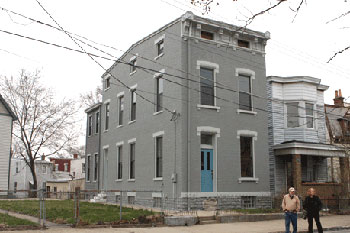
The City of Cincinnati has contracted with Community Development Corporations Association of Greater Cincinnati  (CDCAGC) to manage the 2009 operating support program for Community Development Block Grant and HOME funding CDCAGC has increased the number of community development corporations (CDCs) and community housing development organizations (CDHOs) receiving program funding from four to 13, with a total funding of just under $500,000.All CDCs and CDHOs within the city limits were eligible for funding, with a maximum available award of $75,000." We just signed contracts with the CDCs end of February and are holding capacity building meetings with each CDC, where we're walking with them around all their projects and talking about their specific plans," says Patricia Garry, executive director of CDCAGC.Funded projects include the development of affordable housing, single-family rehabilitation, infill housing, business district improvements, and community capacity building in the neighborhoods of Camp Washington, Carthage, College Hill, Mount Auburn, Northside, Over-the-Rhine, Roselawn, South Cumminsville, Spring Grove Village, Walnut Hills, Westwood, and the West End.All projects are planned to begin construction within the next two years."It's amazing to me how much everyone is doing," Garry says.  "It's really going to make a difference – most of them haven't had operating support for many years, and this is really going to speed up community development in the city."Writer: Kevin LeMasterSource: Patricia Garry, executive director, Community Development Corporations Association of Greater Cincinnati

Neyer Properties to celebrate Earth Day with Evanston workshops, fair

In honor of Earth Day, Neyer Properties will host "It's Easy to Be Green", a series of workshops to be held April 22 at its company headquarters at Keystone Parke in EvanstonChad Edwards, secretary of the Cincinnati chapter of the U.S. Green Building Counciland an architect at emersion DESIGN, plans to focus on the April 27 launch of LEED version 3."LEED version 3 will raise the bar for not only buildings, but also professionals," Edwards says.  "For instance, some existing credits have moved to become prerequisites, and LEED APs will need to prove working experience on LEED projects.  These modifications help push us to a more sustainable future with qualified individuals."He also plans to address two of his firm's projects – the April 17 groundbreaking for the new American Red Cross headquarters, and his work in achieving  LEED Platinum for commercial interiors for emersion DESIGN's Norwood headquarters."emersion DESIGN’s office was designed as an experiment in getting the best for low cost," Edwards says.  "At under $27 per square foot, we were able to achieve a design-award winning LEED Platinum office.  We're the first architecture and engineering firm in the world to have LEED Platinum office.  The feat was achieved through careful planning and close collaboration with all the stakeholders."Michael Chapman, regional director of landscape architecture for CDP Engineers, will address the question of whether or not rain gardens are a fad or the future, and how the recent popularity of rain gardens can be encouraged and fostered.He also will speak briefly about his work with theGreater Cincinnati Rain Garden Alliance (GCRGA)."My experience as the technical chair for the GCRGA has shown me that rain gardens on a small scale can make a difference," Chapman says.  "I think that municipalities should capitalize on this by doing what they can to encourage the widespread use of rain gardens.  Although small in scale if viewed lawn-by-lawn, the conglomeration of many individual rain gardens has real potential for reducing the damaging effects of storm water overflow problems that many cities are facing."Workshops begin at 1 p.m., and will be followed by a community fair from 4:30 p.m. to 6:30 p.m.Admission to the workshops and community fair is free, but registration is required for the workshops.Writer: Kevin LeMasterSources: Chad Edwards, secretary, Cincinnati chapter U.S. Green Building Council; Michael Chapman, regional director of landscape architecture, CDP Engineers; Susan Chapin, marketing director, Neyer PropertiesPhotography: Amber Kersley

Mariemont Inn’s multi-million dollar renovation puts new face on MM landmark

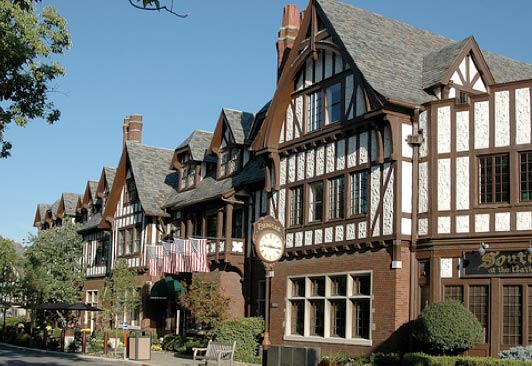
The Mariemont icon that is the old tudor Inn in the heart of Cincinnati's oldest planned community has completed a milestone renovation that may very well put the building on the road to receiving "luxury status.""We redid everything from top to bottom, every wire, pipe and wall was replaced and relocated, as discreetly as possible. We started by building a prototype, then went out across the country to find everything we needed," says proprietor, Dan SpinnenweberRenovations were substantial as the owners took the structure down to its s brick walls and foundation. The number of rooms dropped from 60 to 45, allowing the area of each space to expand by one-third. The new décor was meticulously designed with custom furniture, fixtures, moldings, and warm-glow fireplaces.That meticulous design manifests itself in the form of exquisitely decorated rooms, each with its own fireplace, a desk complete with a Herman Miller chair, and a a roll-up tapestry picturing a historic Mariemont scene that hides the large screen television set. "Our goal was to cater to the businessman and the businesswoman, the corporate traveler, primarily, while also making this just a great place for people to come in, relax, unwind and enjoy themselves," said the second-generation of Spinnenweber owner/operators, Spinnenweber's son Bill, now the general manager. "What that guest wants is plenty of room, peace and quiet, and a place to stay that's near the action. We've got it all." Throughout the renovation, the Spinnenwebers were determined to maintain the original character of the building.  "In the final analysis, what we're selling is a great place to come and stay, sleep, and have a comfortable, quite experience," Bill Spinnenweber said. "Everything that's been placed in the rooms is geared to accomplish this. That's why we exist. That's what are guests are paying for."Writer: Jeff Syroney

NKU College of Informatics expands into brave new world

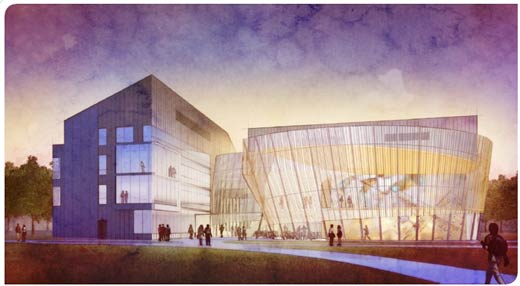
In speaking with Dr. Douglas Perry, the Dean of the College of Informatics, it only takes a matter of time before one begins to share his excitement for Northern Kentucky University's new $50.8 million Center for Informatics.  Drawings show a state-of-the-art facility that will serve as both a new home for the College of Informatics as well as a gateway to the campus' West Quad.The 110,000-square-foot facility, designed by lead architect Goody Clancy and local architecture firm McGill Smith Punshon Inc., is made up of a central Informatics Common and "digitorium," flanked on two sides by four-story loft-style academic buildings.One enters the structure through the Informatics Common, designed to serve as an intersection between the social and digital worlds contained within the center. This space will house a "genius bar", complete with a multi-discipline technology help desk, research flex space, and a café.Within the Informatics Common sits the impressive two-story glass digitorium, the fully reconfigurable technological heart of the center equipped with audio/visual technology using high-quality LED, digital projection, and intelligent digital displays that allow users to watch, interact with, create and share information. The digitorium's transparent skin is designed to reflect the center's purpose by allowing those outside to witness human interaction, the most basic – yet most complex – of information sharing systems."With the digitorium we are going to be able to create or recreate anything digital including simulations of war rooms, gaming contests, 3D film festivals, mercantile trading houses or even a performance space," says Dr. Perry.What does the College of Informatics need with a performance space? Dr. Perry is happy to explain that his vision for informatics goes well beyond the "hardcore bit-level computer science." Although that research is important, Dr. Perry wants to reach much further… "all the way to a whole human-affected domain – including writing, communication, music, performance, even dance."Preliminary conversations have taken place with area arts leaders including Cincinnati Ballet CEO and Artistic Director, Victoria Morgan about using the College's resources in new and different ways."The digitorium will be saturated with high definition cameras that can take images of a performance, synthesize, render into a new image, and project onto the digitorium wall, all in real time. The artistic possibilities are endless," says Dr. Perry.Opening things we take for granted into a realm of endless possibility is at the very heart of the study of informatics. Dr. Perry continues, "We want to transcend the college to offer something so unique that it will draw in as many people as possible. I want people to walk in and understand immediately what informatics could mean to them."Lining the Informatics Common sits a pair of glass and metal lofts housing classrooms and labs arranged on the lower two floors, administrative functions stacked on the third floor, and faculty offices on the fourth floor.Construction of the Center for Informatics is expected to begin within the next two months, with completion occurring by July 2010.The Kentucky legislature has approved $35.5 million for the new center, with the remainder being funded by a mix of grants and private, government, and corporate funding."Currently there are very few colleges of informatics in the country," says Dr. Perry.  In fact NKU can boast it has one of less than a dozen like it around the nation."The University conducted a study five years ago where they looked at the surrounding economy and area and said, 'where can we go from here?'"The study showed that NKU was already graduating a number of students in the informatics field even without a program dedicated to it."The real reason we got the program started was because of the surrounding business community," says Perry.It turns out Northern Kentucky's industries and businesses possess a very real and practical need for talent honed in programs such as these. "85 percent of our graduates stay right here," says Perry who believes the new facility will help supply the skilled workforce needed for the region's information economy by attracting and retaining artists, musicians, entrepreneurs, and scientists.Currently a leader in Kentucky's e-health network through the modernization of the delivery of health care through technology, the college is looking to expand its study of electronic information to other disciplines. A $2 million investment into a virtual "cave" will open doors to a number of area companies wanting to perform simulated market research. "Most companies, even the larger ones, can’t make that kind of investment into that kind of technology," says Dr. Perry. "We'll be the only facility in the region that will be able to offer this kind of space to a wide array of companies."Writer: Kevin LeMaster and Jeff SyroneySource: Northern Kentucky University College of InformaticsRendering provided

Fernald work earns Megen second Build America Award in four years

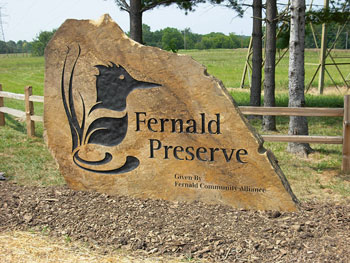
Megen Construction Company has won the Aon Build America Award for its work on the Fernald Preserve Visitors Center in Crosby Township.Considered the construction industry's top honor, the Build America Award recognizes projects for their complexity, innovation, success, and significance to the construction industry and the country at large.Megen Construction president Evans Nwankwo accepted the award during the Associated General Contractors of America annual convention in San Diego."Our work on the Fernald Preserve Visitors Center exemplifies our team's expertise in green building practices," Nwankwo says.  "To also have our work honored once again by our peers as being one of the best in the industry demonstrates the Megen commitment to delivering encore construction experiences."This is the latest in a string of awards garnered for the 10,800-square-foot visitors center, part of a 1,050-acre nature preserve reclaimed from a Cold War-era uranium processing facility.In 2008, Megen Construction won a Build Ohio Award from the Associated General Contractors of Ohio, and, later that year, Megen and project architect glaserworksearned the first LEED Platinum certification in the state of Ohio.This is the second time the company has won the Build America Award in four years, making it one of only three Ohio firms to win more than once.In 2005, the company received the award for its work on the National Underground Railroad Freedom Center.Founded by Nwankwo in 1993, Megen Construction employs more than 50 out of offices in Cincinnati and Cleveland.The company has also worked on the Fountain Square revitalization, renovation of theMacy's corporate offices, and Great American Ball Park.Writer: Kevin LeMasterSource: Sandi Straetker, Priority Public RelationsPhotography: Kevin LeMaster

Quality of life survey to identify Northern Kentucky’s strengths, weaknesses
Focus on environment garners planning award for Green Cincinnati plan

Our Partners

Taft Museum of Art
Warsaw Federal

Don't miss out!

Everything Cincinnati, in your inbox every week.

Close the CTA

Already a subscriber? Enter your email to hide this popup in the future.