‘Big Beautiful Bill’ could mean cuts to cornerstone food program counted on by tens of thousands here
States will need to take on hundreds of millions in new expenses, which could mean massive cuts or the elimination of the SNAP program.
Across the region, there’s a big disparity in how long people live. Nearly 90 years, on average, in Indian Hill and Mason, but barely over 60 in Arlington Heights and Adams County. That’s nearly 30 years of life, love, children, grandchildren, and memories that are lost. Why? Community health experts are looking at the larger forces that shape health and wellness. The places where we grow up, live, work, and age shape our lives and opportunities to thrive. This is the tenth story in the series, Health Justice in Action, a year-long deep dive into the factors that people and neighborhoods need for long, healthful lives. You can read other stories in the series here.
Tucked inside the signature legislation of President Trump and the 119th Congress is a time bomb scheduled to explode in 2027. When it does, it could have a crippling impact on a 60-year-old program that millions of people here and around the country depend on for basic nutrition and sustenance.
SNAP, the Supplemental Nutrition Assistance Program, is a key link in the safety net that keeps people from being consumed by poverty, hunger and illness. It also supports local farmers, businesses and economies. Once known as “food stamps,” SNAP is the nation’s largest food assistance program, counted on by 42 million Americans, including more than 100,000 in Hamilton County.
But the passage this summer of H.R. 1, nicknamed the “One Big Beautiful Bill Act,” will mean seismic changes to this cornerstone program. Chief among them is the shifting of much the costs of the benefits to the states, meaning they will, almost overnight, need to take on hundreds of millions in new expenses, a transfer likely to cause havoc with state budgets. That, in turn, could mean massive cuts or even the elimination of the SNAP program in some states.
This legislative overhaul of the SNAP program is separate from the pending pause in benefits threatened by the government shutdown. While it’s hoped that the shutdown will eventually be resolved, the cost shift to the states is now embedded in legislation passed by the Republican-controlled Congress and signed into law by President Trump.
Currently, SNAP benefits are 100% funded by the federal government. The cost of administering the program is shared equally by the states and the feds. But the new law will transfer much of the burden to already-fragile state budgets. States will be forced to share the benefit costs for the first time. And their share of the admin costs will rise to 75%.
“States (will) face impossibly high costs — forcing them to cut other programs, raise taxes, reduce SNAP access, or end their SNAP programs altogether,” concludes a study released in September by Georgetown University.
The researchers analyzed SNAP data and state budget data to map the impact of the pending OBBBA changes to SNAP on all 50 state budgets. “The findings are staggering,” they reported.
In Ohio, the state’s share of the costs will more than triple, from $145.9 million to $536.7 million, the research found. Similar increases are forecast in Kentucky, where SNAP costs will surge 157% to $276.4 million, and in Indiana, which will see its SNAP expenses explode by 202% to $285.5 million.
Unlike the federal government, states are required to balance their budgets every year. Taking on such big expenses all at once is likely to create budget chaos in state capitols. “States are left with no good options,” the Georgetown study says. “They will have to shift funding away from other priorities — like education and health care — to preserve SNAP, raise new revenues, reduce SNAP enrollments by adding red tape, or end their SNAP programs entirely.”
A Congressional Budget Office assessment done in May before the bill passed supports this. The nonpartisan office said states will likely respond differently, and some may leave the program entirely.
Figures provided by the Ohio Department of Jobs and Family Services, which supervises the program in the state, agree with the Georgetown study. “We are aware of impact of the changes on Ohio’s SNAP program,” spokesman Bill Teets says.
The changes are still two years away, giving legislators time to rethink them and states and counties, which handle the day-to-day administration, time to plan for them. But if they take place as currently written, the impact would fall on the most vulnerable members of our communities, namely children, seniors, and the poor. Forty percent of SNAP participants are under the age of 18, and 20% of U.S. children receive SNAP benefits.
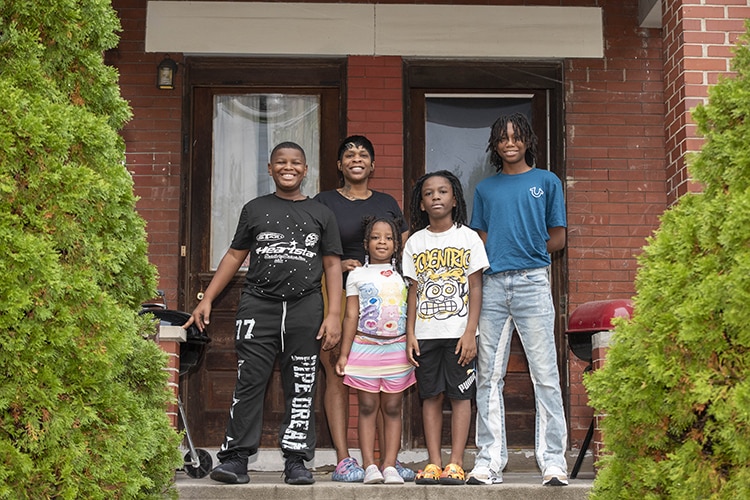
They are families like Bianca Foster’s. She’s a single mother of four children, who range in age from 5 to 13. She receives $1,176 a month in SNAP benefits, less than $8 a day per person, to help feed her household of five. With four growing youths, including boys age 9, 11 and 13, the refrigerator and the pantry at their East Price Hill home need frequent restocking.
“The boys, they are growing and they eat a lot,” Foster says. “They’re playing football too. And they come home and they’re hungry.”
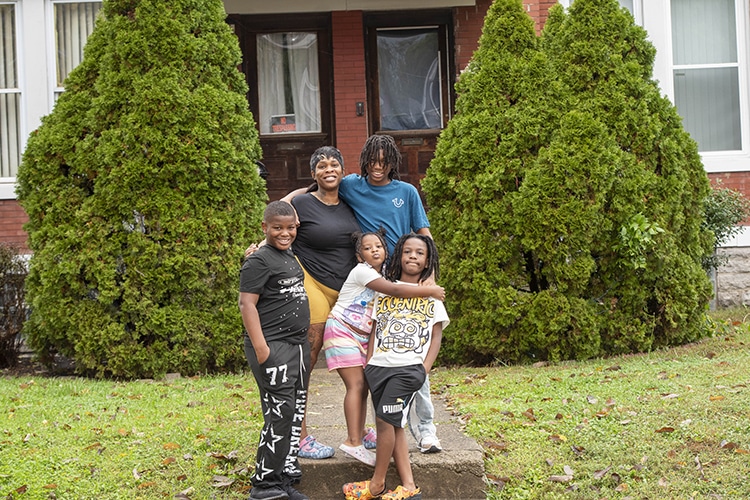
She’s unemployed, with her sole source of income a Social Security check for her disabled 11-year-old. He takes several medications that need to be taken on a full stomach. She tries to portion out meals in baggies to make the food last. If the SNAP program were to be cut or ended, “I’d be stuck and messed up, for real,” she says.
She’s not alone. More than 100,000 SNAP recipients live in Hamilton County alone, according to the county’s Job and Family Services office. In the tri-state metro region, about 160,000 households receive the benefit, says Matthew Randazzo, president of the Greater Cincinnati Foundation, the region’s leading philanthropy. That equates to more than a half million people in the metro region who receive food assistance from the program.
“Greater Cincinnati already has a higher rate of food insecurity than our Midwest peers,” Randazzo says. “There are more hungry families in this region than there are in Detroit and Indianapolis and Columbus. With the risk of losing or reducing SNAP benefits, we will see a huge crush.”
Food insecurity is linked to a variety of poor health issues, especially in a low-income population that is already under stress to pay for housing and other essentials. Children, in particular, are at greater risk of chronic health conditions including asthma and anemia, cognitive and behavioral problems, and anxiety and depression if they cannot depend on a stable,healthy source of sustenance.
With the price of groceries surging, and other costs, particularly for housing, going up, the demand for help from food pantries has risen at the same time. “We have seen significantly high and steady levels of need for a couple of years now,” says Joree Novotny, executive director of the Ohio Association of Food Banks. “It’s been month over month of inflationary pressure on families living paycheck to paycheck.”
Demand is rising just as the Trump Administration abruptly stopped funding a program that had supplied communities with fresh food. The Local Food Purchase Assistance Cooperative Agreement Program provided about $1 billion to food banks to buy from local farms and distribute it in their communities. Cincinnati’s Freestore Foodbank, which supplies about 600 food pantries in the region, lost about $750,000 in funding.
READ MORE: These food desert neighborhoods act to bring healthy fare to their communities
For low-income families struggling with escalating costs for rent, utilities, and health care, it’s often the food budget that gets cut to close the gap. “Food is the place we see people sacrifice first because they’re not going to have a bill collector come,” Novotny says. “That’s the place where they can shortchange themselves.”
The SNAP program helps close the gap, but with a benefit of about $5.60 per person a day on average, it doesn’t pay for all of a family’s nutritional needs. “It’s not meeting their entire month’s needs of groceries by any stretch of the imagination” Novotny says. “We’re talking about something that can help make sure that there’s a meal or two that families can access.”
The program has been shown to improve childhood health over the long-term, particularly reducing the rates of obesity, high blood pressure and diabetes. It has been shown to improve academic performance, especially in the first four years of school. It lifts families out of poverty.
“Nothing could be more valuable than investing in nutrition for families,” Novotny says.
And in a benefit that is often overlooked in the policy debates, it helps boost local economies.
A 2019 government study found that $1 billion in SNAP benefits generates $1.5 billion in gross domestic product, supporting 13,560 new jobs, including $32 million in added income for farmers and others agricultural businesses.
“SNAP is one of the most effective tools we have to combat poverty and build stronger, more resilient communities,” concludes the Robert Wood Johnson Foundation.
With profound changes coming to such a bedrock element of the community landscape, what can be done?
The state job and family services agency says it is working on reducing error rates in its administration of the program. The new law links the amount of the cost shift to each state’s error rate. Ohio’s last error rate was 9.13%. But errors can mean overpayments or underpayments. They don’t equate to fraud. And they are inevitable in a program of such magnitude. The department has “begun looking at what we can do as it relates to automation, processes and policies in order to increase payment accuracy,” Teets says.
GCF’s Randazzo called on businesses to step up their charitable giving to help offset the coming cuts in SNAP and in Medicaid, the health care program for the poor. “We will see a crush of need that’s coming to our health and human services partners around basic human needs of food and access to health care,” he says.
With two years before the law takes effect, the best option may be to re-examine the legislation. “I hope we can have real conversation and dialogue across state and federal government about the unintended consequences of what this change may lead to,” Novotny says. “Maybe there’s an opportunity to rethink this decision going forward.”
This series, Health Justice in Action, is made possible with support from Interact for Health. To learn more about Interact for Health’s commitment to working with communities to advance health justice, please visit here.
Author

Related Articles

From constitutional amendment to access
A conversation with journalist Amanda Becker and PPSWO ACT’s Nan Whaley about the forces influencing reproductive rights today.
How a sisterhood of dentists is expanding public health across Metro Detroit
A collective of African American women dentists delivers public health care, mentorship, and trust to underserved patients across Detroit, Wayne County and Macomb County.
What does the new childhood vaccine schedule actually mean for your family?
Officials say not much will change. Experts aren’t so sure.