
At the Taft Museum of Art, a 40-year legacy meets a living artist
The inspiration for the Duncanson program is literally painted on the walls inside.
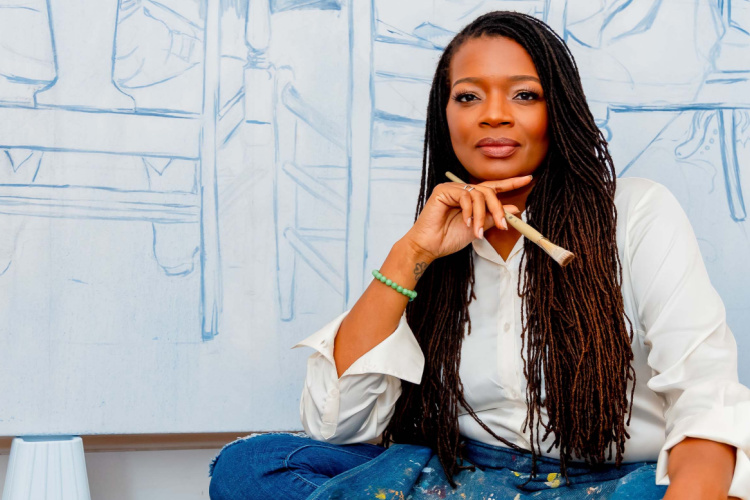
Photo by Carol Rose of Colurwrk Photography
In the museum’s historic Cincinnati house, visitors encounter sweeping landscape murals painted in the mid-1800s by Robert S. Duncanson, one of the most accomplished painters of the 19th century and a central figure in early Black American art. He worked during a time when Black artists were largely shut out of American cultural institutions, even as their work helped shape the country’s visual culture. Despite those barriers, Duncanson built a remarkable career and helped shape the tradition of American landscape painting.
His murals remain one of the clearest reminders that Black artists were shaping American visual culture even when their contributions were often overlooked. Today they anchor a program that continues to shape the museum’s relationship with the Cincinnati community.
For forty years, the Duncanson Artist-in-Residence program has invited contemporary Black artists to create new work in conversation with that legacy, keeping Duncanson’s story connected to the artists working today.
This year’s resident, painter Ayana Ross, is adding her voice to that dialogue.
“I was thrilled,” Ross said. “Anytime you can have your name mentioned with Robert S. Duncanson or Nikki Giovanni, that’s a big deal.”
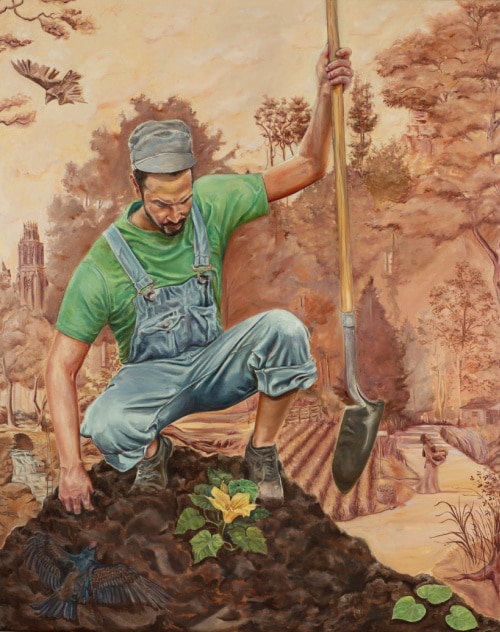
Ross’s paintings linger on everyday moments. A family gathered around a table. A person caught in quiet reflection. Scenes that feel familiar until the viewer begins to notice the story unfolding beneath them.
“I’m thinking about stories that are worth preserving,” Ross said. “Culture. Legacy. Continuity. Elevating people who have not always been esteemed in the way that they should.”
One of the works in the exhibition, “Seed for the Sower,” grew out of Ross’s own family history.
After her grandmother passed away, Ross found court documents describing how her great grandfather and his son, farmers in South Georgia, were sued by a fertilizer company after taking out a loan common among farmers at the time. Even after much of the loan had been repaid, the company won the case. The court ordered that the crops produced on the land be turned over.
Ross spent nearly two years developing the painting. “It was like living life and collecting tools over time,” she said. “Researching, reading, thinking about how a small moment might reveal a much larger truth.”
Stories like this were not unusual. Across the American South, legal and economic systems routinely stripped Black farmers of land and income, reshaping families, communities, and generational wealth.
The finished painting will hang in a significant location inside the museum. It will be installed in the Duncanson foyer, near the historic murals themselves.
For curator Angela Fuller, Ross’s work stood out immediately during the residency selection process.
Because the program’s 40th anniversary was approaching, the museum intentionally sought a painter to honor Duncanson’s legacy. “We were looking for someone who really loved painting,” Fuller said. “That excitement for the medium felt important.”
Ross’s portfolio demonstrated both technical skill and narrative depth. Fuller recalls two works that stayed with her long after reviewing Ross’s application: “Please Pass It On” which will appear in the exhibition, and “Pioneer Woman,” a portrait not included in the show but one that lingered in her mind.
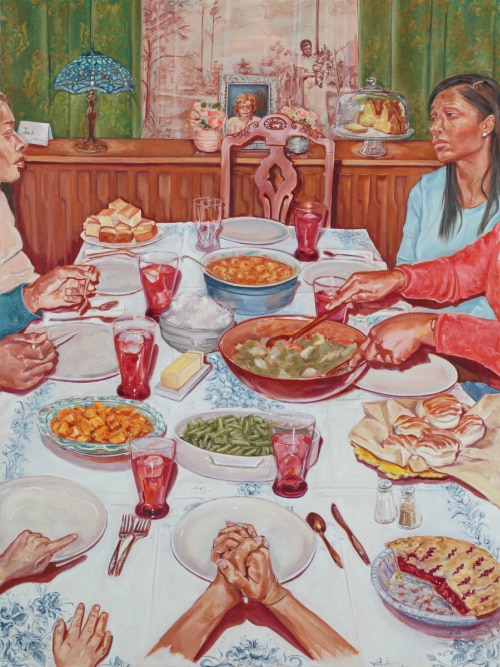
Both paintings connected to Fuller’s research into the layered history of the Taft house. Before becoming a museum, the building was a private residence, and Fuller has spent years studying the people who lived within its walls.
“The women. The children. The domestic workers,” she said. “They’re almost always left out of the story.”
Ross’s paintings offer a way to bring those lives back into view and into the historical record of the house itself. “They expand what we’re able to talk about here,” Fuller said.
Visitors will also encounter Ross’s voice directly in the gallery. She wrote the interpretive labels for her paintings herself, giving audiences a chance to hear the artist describe her work in her own words.
The residency program itself was created in 1986 as a way to keep Duncanson’s legacy active rather than frozen in the past.
According to Kareem Simpson, manager of the Taft’s Duncanson Program, that commitment extends beyond the gallery walls. “It’s about creating intentional platforms,” Simpson said. “Not just events for the sake of events. But real visibility.”
Ross will spend her residency working with students across the region, including Cincinnati Public Schools, Northern Kentucky University, the Art Academy of Cincinnati, and the Boys and Girls Club.
Young artists from grades K through 8 will study her work and create pieces of their own. For Simpson, those moments matter as much as the exhibition itself. “What we hope happens is conversation,” he said. “Honest conversation. And forward-looking conversation.”
Ross hopes visitors begin with something simple: Recognition.
“I hope people notice something familiar,” she said. “A scene or experience they recognize.” That familiarity often opens the door to deeper reflection.
“These experiences aren’t isolated to Georgia,” Ross said. “They’re not isolated to my family.” Stories travel. They move across generations and across geography.
“There is always a connection between the past and the present,” Ross said. “Everything has a historical context. The more we understand that history, the better we understand where we are and how we move forward.” That idea carries particular weight today.
Across the country, and especially in Washington, D.C., programs centered on Black history and cultural memory are facing growing political pressure. Museums and cultural institutions have seen funding debates intensify and public conversations about history grow more contentious. Even the Smithsonian’s National Museum of African American History and Culture has faced scrutiny from lawmakers over exhibits and educational materials addressing systemic racism and the legacy of slavery in the United States.
In that environment, spaces like the Taft’s Duncanson Artist-in-Residence program carries particular weight. They preserve stories that might otherwise fade from public memory while making space for new voices to enter the conversation.
For forty years, the residency has ensured that Robert S. Duncanson’s legacy remains part of a living conversation.
Inside the Taft Museum’s historic rooms, that conversation continues. The murals remain. The stories remain. And now another artist’s work joins them.
One day another resident will stand in those same rooms and say the same thing. That it is a big deal to stand in the presence of the names Duncanson, Giovanni, and Ross.
Ayana Ross’s residency exhibition opens April 11, 2026, at the Taft Museum of Art with a public reception. A closing celebration will take place April 26 and will feature several past Duncanson Artist-in-Residence participants.
Ross will also engage directly with visitors during a gallery conversation on April 12 from 1:30–2:30 p.m. as part of the museum’s family programming.
More information about the exhibition and related programming can be found at taftmuseum.org. The Taft Museum of Art is a supporter of Soapbox Cincinnati.
Author

Related Articles

Women do a world of good: How one woman transformed personal tragedy into triumph
106-year-old Junior League of Cincinnati focuses on strengthening women and children’s environments today.
WCC, a nonpartisan organization of feisty women, brings awareness to issues facing the average citizen
Women’s City Club hosts arts activist, Gina Belafonte, who uses music and art for social justice impact.
Gallery exhibition to foster conversation about the people and enterprises driving food systems
Studio Kroner presents “The Warriors, Builders & Weavers of Cincinnati’s Foodshed.”