
Making Musical Cities
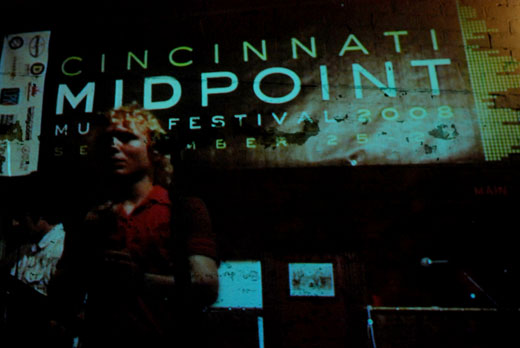
What makes a city a ‘music city’? Is it a homongenous, definable sound, or something more? Could it be an attitude, or is it simply how well we value ‘art’ amongst us? The 8th annual Midpoint Music Festival celebrates our ‘music city’, and questions where our place is amongst other musical cities.
 “We’re from Cincinnati.”
The words out of the usually soft spoken, diminutive lead singer of the Heartless Bastards, Erika Wennestrom, were said twice. What made it noticeable was she was correcting one of the most powerful men in television, who had just wrongingly referenced that the band was a product of the venerable Austin, Texas music scene.
The fact that is was the Heartless Bastards’ network television debut didn’t matter, nor the fact that the confusion arose because Wennestrom had in fact relocated to Austin, but she was very clear in letting Letterman know where the band’s real home town was.
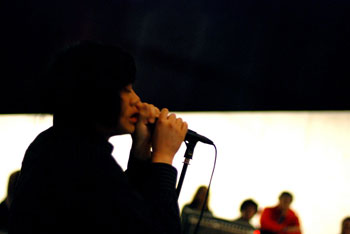 So when the band plays this Friday at the 8th Annual Midpoint Music Festival, it’s a homecoming gig for sure, and perhaps a testament to Cincinnati’s growing presence in the national music scene. In a year that has already seen the meteoric rise of Bad Veins signing to Dangerbird, and a four star Rolling Stone review for Wussy, or the continued electro musical exploits of artist Spencer Yeh’s who’s collaborations with Sonic Youth’s Thurston Moore, and visual artist Pete Coors garner mentions in the Village Voice and the New York Times.
If you want an analogy, Midpoint is the tip of a very large musical iceberg, exposing just a small part of what makes the Cincinnati music scene so strong, presenting the local crop of talented artists alongside well regarded national indie bands that play, create, survive, and sometimes, die, in the trenches of their local music scenes.
So what makes Cincinnati’s scene so special?
“Cincinnatians appreciate live music, and many of our great venues have built-in audiences. Plus, the quality of music coming from the musicians in this city continues to raise the bar for new acts, essentially perpetuating a cycle of evolved songwriting,” says Margarret Weiner, a three year veteran of Midpoint and member of the Seedy Seeds.
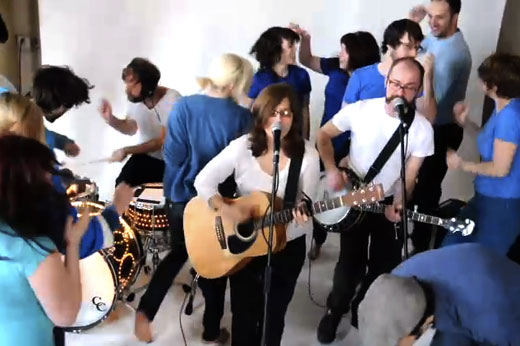 “Having been involved with MPMF for three years now, I can’t imagine living without it. The festival brings additional commerce to the city, boosts culture, and brings attention to some downtown neighborhoods that really need support”
Austin is the “live music capital of the world”™. Nashville’s rich heritage has it appropriately dubbed, ‘music city.’ The ‘A’ word always creeps up. Now in its 24th year, the granddaddy of music festivals and one of the most influential multi-media events in the world, South by Southwest generates close to $26 million annually for Austin.
But the measurable economic and fiscal impact of all music in Austin is significant: it’s estimated that $616 million in economic activity, 11,200 jobs, and over $11 million in city tax revenues can be attributed to the influence of music on the local economy.
While Midpoint’s numbers probably aren’t there yet, its annual impact is palatable, drawing thousands of music patrons to downtown, Over-the-Rhine and Northern Kentucky for three nights. And like Cincinnati’s ramped up conventioneer, it also brings tourists, in the form of musicians, fans, and media from all over the continental US and several countries. But more importantly, the festival, and music in general, creates a quality of life that’s attractive to talented and creative people – they seek it out, they relocate their businesses, and they set up residence in cities that literally and figuratively, ‘sing to them.’
 And city government should play a part. Austin recognizes the role of music in a variety of ways, providing music by local artists at the airport, funding a cable access channel devoted entirely to local music, and administering a loan program specifically for the music industry. Austin’s convention and visitor’s bureau even includes a ‘music marketing director’ to capitalize on homegrown talent and the omnipresence of live music in every conceivable space.
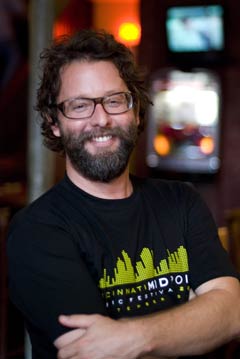
Midpoint Executive Producer Dan McCabe says as much in his welcome to this year’s out of town artists in his welcome message for this year’s Festival.
 Cincinnati already has the ‘bones’: offer is a low cost of living, and plentiful, cheap affordable rehearsal space. In retaining and attracting creative musical talent to stay here, much like McCabe’s call out: job opportunities for artists native to the area or who ultimately choose to work here.
So what are our strengths, and what do we need to work on to become the next big musical city? We asked a host of local artists, some who live here now, and others who have relocated away for career or personal reasons.
Michael Bond, relocated to Chicago in 2006 for a job and change of scenery. He still runs datawaslost records, and will return to Midpoint this week with his band Coltrane Motion. A web developer, he’s been working on Chicago’s 2016 Olympic bid, with Ogilvy & Mather.
“I find it interesting that the things that make Cincinnati a music destination, the things I hear my friends from Columbus, Louisville, and Indiana travelling to see – they’re not only things that those cities don’t have, they’re things that no one else has – Southgate House, Music Now. Not weak copies of things happening in NYC or LA, but rather events and places that are special to Cincinnati.”
Davis says”If business and government treated music with half the respect and support offered to losing sports teams, we’d be the New Austin,” he says. “We have the same star-breaking powers as Seattle, Austin, Detroit or Nashville. We’re just too insecure or too stubborn to see it.”
Another of Cincinnati’s strengths according to Davis is collaboration.
“Finally the range and diversity of artists here is extraordinary, as is the opportunity for businesses to connect with new customers through music. Not just musical artists, but filmmakers, photographers, writers – many who hang out together or even play in bands. It’s a small town in that sense – so you meet and re-meet people all the time. Put it all together and as a community we have a unique, expressive music for creative filmmakers, advertisers and web slingers. We bring music no one else in town is offering to the table, which by the way, comes complete with fans.”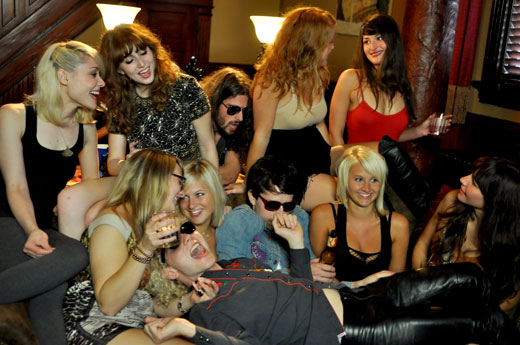
Lions Rampant, another local artist playing the festival, teamed up with Ragged Productions production team Ragged http://www.ragged.tv/ to produce a music video as stylized as anything out of NYC.
“At a business development level, the focus needs to be on supporting micro-businesses, creating the structures that allow creative folks to run galleries, labels or festivals in their spare time, or to start small businesses w/ risks and costs low enough to give them time to grow.. The key is not to get 5/3 or P& G to ‘support the arts’ but rather to have a thousand smaller systems supporting themselves. Larger metros tend to create these kinds of situations by accident, but smaller cities like Cincinnati need a little help to push things along.”
So will Cincinnati ever be a music industry city 24/7?
Perhaps. Its in our DNA, when talented mid century incubators like Herzog Studios downtown and Evanston’s King Records were overloaded with talent and innovative ideas – King pioneered the all-under-one-roof-label, recording, manufacturing and distributing its own records.
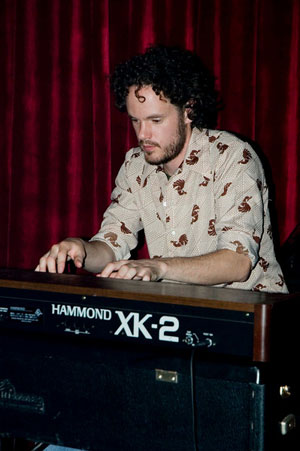 Andrew Higley recently moved to Nashville to sustain his career in music. A multi-instrumentalist who’s played in several Cincinnati bands including Pearlene and Chocolate Horse, Higley has toured nationally with Brendan Benson of Raconteur’s fame and Ben Folds, before relocating to Nashville this past summer.
“Unfortunately, as far as music goes, you’re always going to lose people to cities like Nashville that have built-in industries. Until Cincinnati gets its own Music Row, I don’t think that will ever change.” “There just simply isn’t the industry-the studios, the labels, the publishing companies, etc. There aren’t session and touring opportunities. And I don’t think it’s realistic to expect Cincinnati to get to a point where it attracts professional musicians like Nashville or LA.
He praises the scene for its abundance of talent,
“Events like MPMF, Taste of Cincinnati, and the Fountain Square summer concert series are all good examples of city-sponsored events that support local musicians. So I think Cincinnati is doing a lot of things really well.”
“But if there were some sort of organization to pull together bands, graphic artists, promoters, and small labels, to promote the city’s music as a whole, I think it could be pretty big.”
Dave Davis agrees, and has started his own innovative company with several local investors. A mastering engineer, Davis teaches Digital Design at DAAP and is a principal in All Night Party, a new envisioning of the locally based record label.
“We’re in the business of connecting bands to fans, on many levels. Fans like to support artists, and products are a great way to make do that. So we make cool, unique records (digitally or physically enhanced), and all manner of “musicated merch” – attaching music to stuff like t-shirts and trucker caps. We put music on Amazon and iTunes, by the method that makes the most sense for the band’s sales We work hard to create and present artists with clear options, and connect them to all the new web-based services to get the most bang for the buck and meet their goals.”
 The availability of commercial work, whether visual, production, or music, is another attractive option for local musicians.
A recent collaboration between the Cincinnati Ballet and local musician, Peter Adams, hints at the possibilities of finding synergy between the arts.
Adams, 26, was commissioned by the Ballet to compose a piece of music for their New Works. Already a successful solo artist with a national following and mentions in big rock rags, Adams, who plays violin with Matthew Shelton’s Picnic, embraced the collaboration and the chance to earn a living from his work in his own.
“It was a nice change of pace to be commissioned and have outside pressure and deadlines, not to mention the energy that comes from working with other talented artists.”
And he likes the ability to continue his work in Cincinnati.
“I think Rust Belt cities like Cincinnati are some of the best places for broke young artists to be, not only because expenses like rent and food are well below average, but because you get the perks of a big city with a more close-knit community feel. I can’t really imagine doing what I do in a city like New York or LA.”
And even hometown enterprise has got on the bandwagon.
Conversely, last summer, locally based chili-empire Gold Star commissioned local bands the Newbees and Buckra for an ad campaign, prominently featuring the artists performing their “Lost in the Taste” songs in 30 second spots.
And local music scene veteran Rob Fetters transitioned a career fronting critically acclaimed rock bands into commercial music composition work. Fetters clients have included ABC, Disney, Nickelodeon, PBS, Sea World, P&G, Crest , Cincinnati USA, Cincinnati Bell. His first commission, though: penning the infamous “347-1111” LaRosa’s jingle.
 Even while working for national clients, Fetters keeps it local, using “cream of the crop local talent 90% of the time.” He understands the bias towards more musical cities, but also thinks it works both ways.
“I’ve heard a guy actually say it looks “hipper” to work with somebody in Santa Monica or New York City, yet I’ve gotten a ton of work from distant locales like Burbank, CA.”
Monika Royal Roberts, an advertising and marketing professional for 12 years, sees a disconnect between local production work and local music.
“If a company wants to connect their product or service to Cincinnati, and wants a true hometown feel, the most authentic thing they can is use original local music in their productions.” “In my experience, very few ad projects that require music have ever incorporated original local music or musicians. I think the main reason lies in the fact that businesses don’t know how to necessarily find original local musicians, and therefore miss opportunities to use their music.
Davis agrees and hopes that’s what All Night Party is all about.
“To push it farther requires a little curation and a deeper connection with many artists. People outside the music scene, don’t really know who to call or even what music’s available.” we know whose doing work and get a lot of those calls already, and artists know we’re bringing opportunity and can be trusted. So we’re going to make every effort to make it regional music first choice.”
That seems so, for example when the Cincinnati Reds licensed New York based Hotcakes’ song, ‘Paint the Town Red’ for its promo spots.
Other complementary businesses could also flourish in a music economy.
Music Now is the brainchild of Bryce Dessner, guitarist with Brooklyn based the National – a band comprised of Cincinnati ex patriates. That Dessner headquarters his festival, now in its fourth year, at Memorial Hall in Over the Rhine, is testament to the infusion of talent.
“Music’s a great tool to move people in all kinds of ways.”
Photography by Scott Beseler
Midpoint 2009 at the Courtyard
Spencer Yeh
The Seedy Seeds
Jesse Ebaugh of the Heartless Bastards
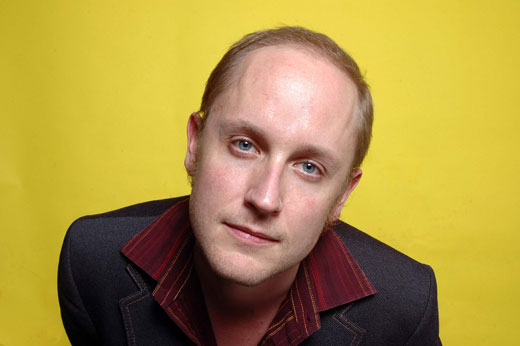
Dan McCabe
The Lions Rampant video shoot
Andrew Higley
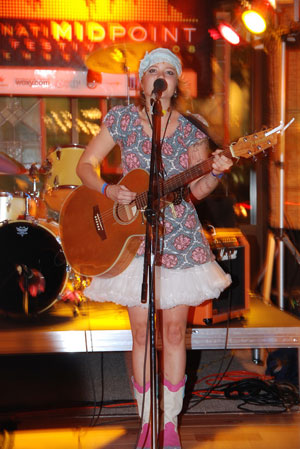
Jasmine Poole, Wonky Tonk at Midpoint 2009
The Chocolate Horse
Related Articles
Fewer options, fuller ERs: The behavioral health fallout of Medicaid cuts
MHA advocates for state funding that preserves behavioral health care and keeps rural hospitals open.

What does the new childhood vaccine schedule actually mean for your family?
Officials say not much will change. Experts aren’t so sure.

New platform to share ‘Common Ground’ from community ideas and solutions
Issue Media Group, a multilocal network of solutions-based, issues-focused digital publications, has launched a new national platform for increasing the reach and impact of its journalism.