
Nanotech in the ‘Nati
Small science is becoming big business for the Queen City. The University of Cincinnati has joined forces with a local innovate businesses to transfer some of today’s most cutting edge science in the nanotechnology field from lab to market.

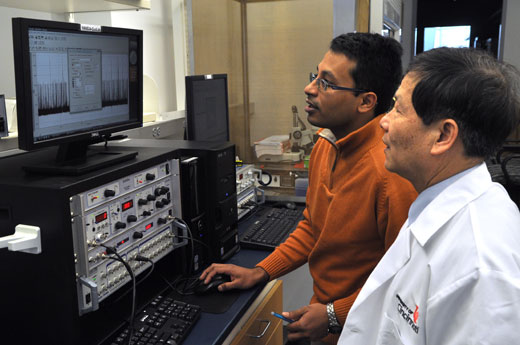 Nanotechnology proves that big things come in small structures. And vibrant collaboration between scientists at the University of Cincinnati (UC) and a few progressive local start-ups is giving Cincinnati a substantial piece of the nanotech pie.
Nanotechnology, or nanotech, is essentially the controlling of matter on the atomic and molecular scale. This means working with structures at least 100 nanometers or smaller in at least one dimension. For perspective, a nanometer is the metric unit of length equal to one-billionth of a meter. Although there are wild discrepancies amongst forecasts, the size of the nanotech market, broadly speaking, will safely reach into the hundreds of billions of dollars in the coming years.
Working with matter at this mind-bogglingly small level opens the door to revolutionary applications in myriad fields: medicine, industry, textiles, aerospace, defense, energy, electronics and, well, the possibilities are almost limitless. For this reason, nanotech has sparked intense debate over its boundaries in the moral and ethical spheres; the same as with any other technology that is yet to be properly understood and harnessed. But supporters say nanotech’s good outshines its potential for abuse.
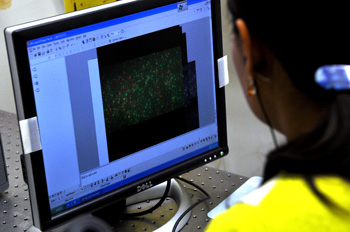 “Today’s manufacturing methods are very crude at the molecular level,” according to Dr. Ralph Merkle, Senior Research Fellow at the Institute for Molecular Manufacturing. “It’s like trying to make things out of LEGO blocks with boxing gloves on your hands…In the future, nanotechnology will let us take off the boxing gloves.”
At the University of Cincinnati (UC), a brilliant group of scientists have shed the gloves and are churning out a stream of groundbreaking nanotech applications. Peixuan Guo, Director of UC’s NIH Nanomedicine Development Center and an endowed chair of biomedical engineering at UC, explains that Cincinnati is particularly well-suited to nanotech development for a few fundamental reasons.
“One strength is that there is an engineering school where many people are working on nanomaterial production,” Guo says. “And the second one is that there is a medical school that can apply the materials to medical applications. The third strength is that Cincinnati is close to several universities.”
And UC has capitalized on these strategic advantages, sometimes to world-renowned effect.
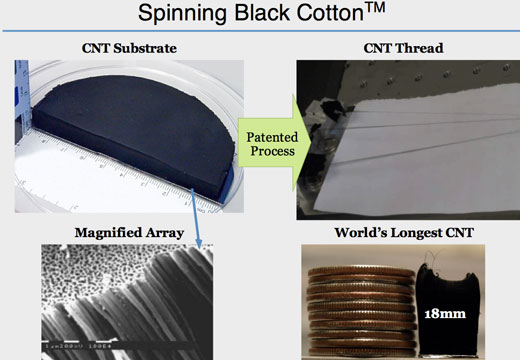
“The longest nanotubes ever grown in the world were grown at the University of Cincinnati,” says Joe Sprengard, of Cincinnati-based General Nano.
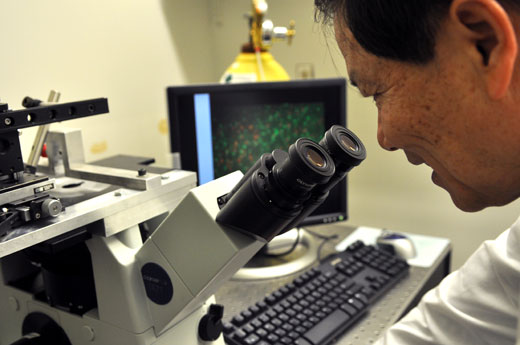 These record length nanotubes are 18 millimeters long, hardly a length for which one usually applies the word “long,” and less diameter than a single hair. With Sprengard at the helm, General Nano is transferring these world-record length carbon nanotubes to the market.
“We grow carbon nanotubes,” Sprengard says. “What we do different than others is we grow them very long. The long carbon nanotubes allow us to apply the technology in other applications that would not be possible if they were very short, which is what most people are doing today.”
Although many companies such as Bayer sell literally tons of nanotubes annually, these more common nanotubes are made of a composite of dust and a mixture of other materials. General Nano does not do composite. Instead, they grow nanotubes on a substrate. This substrate was developed by Vesselin Shanov and Mark Schulz, researchers in the UC College of Engineering NanoWorld Lab.
To explain this baffling process, Sprengard offers a simple metaphor: pizza.
 “It’s almost like the dough of the pizza, and then you put the secret sauce on the pizza, and then put it in the oven,” he says. After putting the pizza [wafer] in the oven [reactor], so to speak, the chemicals interact with the substrate [catalyst], and “these carbon structures grow vertically aligned like a forest, like trees.”
Thanks to a contract between General Nano and the U.S. Air Force, these extra-long nanotubes could yield big bucks in the fields of aerospace and defense.
“What really put General Nano in business was about two years ago the U.S. Air Force was interested in using these materials because, from a property standpoint, nanotubes are the highest performing materials on the planet,” Sprengard says.
Carbon nanotubes are the strongest material on the planet. More energy can be pushed through nanotubes than through copper with the use of less energy. It’s one hundred times stronger than steel, is lighter and more electrically conductive than copper, is bendable and is not brittle. Due to coppers weight and difficulties in extreme temperatures, the U.S. Air Force became interested in replacing copper wire with carbon nanotubes.
Unsure whether these sought after carbon nanotube threads were even possible, General Nano took the plunge and began to try. When General Nano agreed to take on the challenge of spinning carbon nanotube arrays into threads, as the ‘forests’ that grow from the substrate are called, into they were in business. Last summer, six months into the twelve month contract, General Nano was invited to compete for phase two. Only 42 percent of companies made the cut. Now, General Nano is in a two year contract with the Air Force to further refine the threads and applications for the threads.
Carbon nanotubes are not the only thing coming out of the labs at UC. Alongside nanotubes, UC scientists have also been delving into the biotech side of nanotech research.
As a testament to this, UC researchers Shanov and Schulz have coauthored what may be the first textbook on nanomedicine in the world. In biotech, for one example, carbon nanotubes can be used as the propulsion mechanisms for nanomotors to non-invasively deliver drugs into the body.
 “A nanomotor is a motor on the nanometer scale – very small,” Guo explains.
Using RNA-powered nanomotors, Guo and team have developed an artificial pore that enables double-stranded DNA to pass through a membrane. In a paper published in the September 27, 2009 edition of Nature Nanotechnology, Guo explained that this artificial pore could be useful in nano-sensing, gene delivery, drug loading and DNA sequencing. As past channels have only been capable of passing single-stranded genetic materials, this new innovation is significant.
“Since the genomic DNA of human, animals, plants, fungus and bacteria are double stranded, the development of single pore system that can sequence double-stranded DNA is very important,” Guo says.
These findings could be a piece of a much larger puzzle that may eventually lead to nanotech-based medical devices that are capable of delivering drugs to the body in a non-invasive way and detect and treat diseases.
“None of this is possible for Cincinnati if not for the university,” Sprengard says.
“The University of Cincinnati attracted to extremely talented individuals to the university. If those two individuals didn’t come to the university, it’s possible that this technology would not exist here.”
This kind of cutting edge tech transfer will be vital to the future economic development, job growth and competitiveness of the region. As such, nanotech, like clean tech, is something to watch.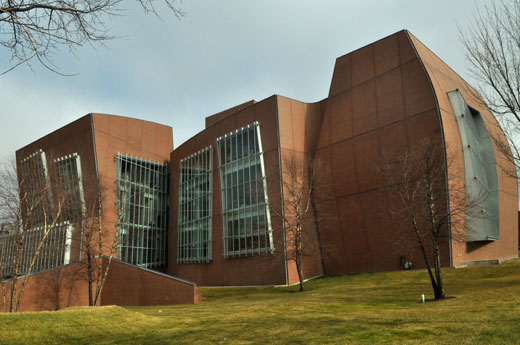
Related Articles
Coming Clean: 5 questions with fashion designer Allison Ross
A move back to Cincinnati after 15 years in NYC, combined with her growing interest in the upcycle movement, led to creation of her own brand, Rephrase.

From capital to community: SparkHaus is powering the growing entrepreneurial scene
A collaboration between Northern Kentucky public entities and the private sector made the project possible.

Triple Moon Coffee brews community spirit in the heart of Middie City
Entrepreneur Heather Gibson builds success with a community-first space where creativity, conversation, and caffeine keep customers coming back.