Transportation

New plan, old debate highlight streetcar special session

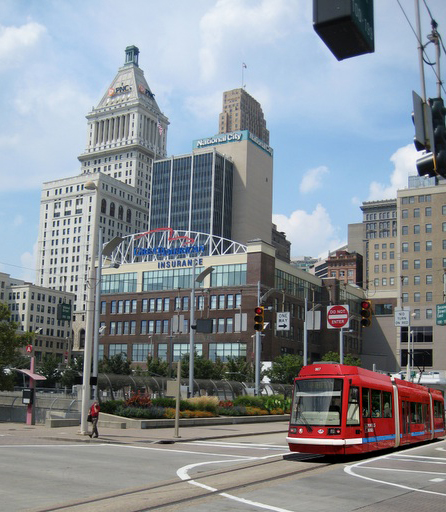
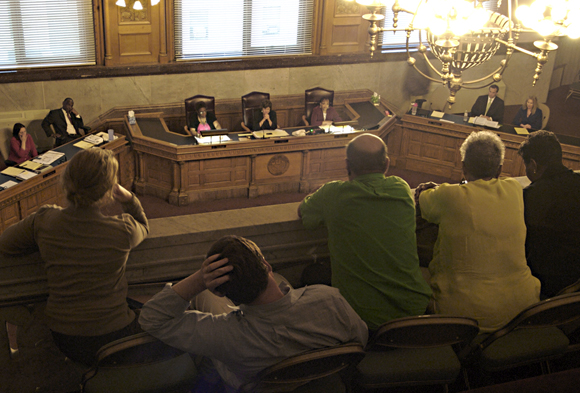
 Cincinnati City Council and more than 100 local residents gathered in Council chambers Wednesday for a special session on one of the city's hottest political footballs: The proposed Cincinnati Streetcar. On May 3, Mayor Mark Mallory and city manager Milton Dohoney released details on a revised streetcar plan, which adapts the original $128 million dollar plan to account for the loss of state funding earlier this year. The new plan breaks the Banks-to Uptown streetcar line into phases, and proposes a $99 million first phase that would run from Fountain Square to Findlay Market. As additional funds become available, the line would be extended to reach the Banks and Uptown via Vine Street and a to-be-planned circulator loop.The announcement prompted streetcar opponents on Council, Republicans Charlie Winburn, Amy Murray, Leslie Ghiz and Wayne Lippert, to call for Wednesday's special session. In a press release, Winburn called the meeting a chance to hold streetcar supporters accountable for the money spent on - and planned to be used for - the project.At the meeting's start, City Manager Dohoney presented details of the revised streetcar plan, including notes about case studies, peer reviews conducted and funding sources that would support the streetcar without touching the city's general fund. He mentioned multiple times that the original streetcar plan and route remain essentially unaltered, but have been broken into phases to adapt to the new funding situation. But funding, scope and city authority became focal points of several questions after Dohoney finished.Councilmember Murray started with questions about appropriation of Banks Tax increment Financing District funds for the project."The argument put forward to justify stealing from the Banks to fund the streetcar was that the streetcar would benefit the Banks," she said. "Now that it's not going to the Banks, how do you justify this?"Dohoney reiterated that the Banks-to-Uptown plan remains intact, but would now be built in phases. "The vision for where the streetcar's going has not changed at all," he said, adding that the initial route still comes within three blocks of the Banks, a distance research suggests would still wrap it in the streetcar's economic boost radius.Winburn raised an array of questions, ranging from details about funding to the administration's authority to pursue the project and its associated funds. While Dohoney referred financial questions to the city's finance office, he responded, again, that 12 council ordinances and one resolution had already uthorized the work to begin."These authorized the administration to plan, design and construct the streetcar," Dohoney said. "The direction we were given says to avoid the general fund, and we've managed to do that. The administration has authorized us to advance the project."Councilmember Lippert asked if council had considered 'worst-case scenarios' for a streetcar, noting Detroit's expensive and little-used People Mover system. Dohoney prompted some laughter with his response:"I'd admit Detroit is a worst-case scenario for a lot of things," he said, adding "I can't tell you every city that does a streetcar doesn't have downsides. But we're plugged into the streetcar community, and we have not found a city that says, 'this was not worth it; there were downsides.'" Council then opened the floor to more than two hours' worth of public comments. The vast majority of the 45 speakers expressed support for the streetcar, with many telling how they'd bought or launched businesses along the route in hopes of leveraging its projected economic boost to Over-the-Rhine. Jean-François Flechet, owner of Taste of Belgium waffle bakery and cafes, said that his decision to open a café at the National Underground Railroad Freedom Center, and his plans for a third location in the city are based on the streetcar route. "I love the idea of being able to take the streetcar to my businesses, and not have to drive," he said. Flechet also noted that the lack of parking at Findlay Market - a planned stop along the first-phase route - is a problem that could be directly solved by the streetcar. "You see people come in, who are frustrated because they've been waiting, they don't stay as long as they might," he said. Other streetcar proponents fired back at the Republican council members. "I'm amazed by the criticisms I hear," said resident Edward Osborne. "It's penny-wise and pound-foolish."Only about five speakers raised opposition to the project. Rev. Doc Foster called on council to use the funds for streets, police and fire services. "We need to put that money where it will support real jobs," he said. "We can't afford the streetcar, Mayor." Realtor Kathleen Norris suggested the City needs to consider the bigger, national picture where other cities are currently evaluating streetcar projects."If we're not as future-oriented and aggressive as the 80 other cities, we will watch our status erode," said Norris.At the end, Mallory thanked the attendees. "Every single speaker who commented here did so because they care about Cincinnati," he said. "In any public forum, that's the most you could ask for."Winburn said he'd likely retract his call for an additional special session after this meeting, and appeared to make comments to clarify his purpose for calling the meeting. "This was really about fiscal accountability," he said. "I just want to make sure we don't bankrupt the city."Writer: Matt Cunningham

Latest in Transportation
Amp delivers its first electric Mercedes-Benz ML conversion

 Amp Electric Vehicles, a Cincinnati company that removes the internal parts of combustion passenger cars and replaces them with electric powertrains, has delivered its first conversion of a Mercedes-Benz ML 350. The conversion is part of a five-year contract between Amp Electric Vehicles and Northern Lights Energy of Iceland that will produce 1,000 electric vehicles. Read the full story here.

Metro planning a transit center for Uptown

  The Uptown Consortium's plans to boost growth and investment in the area around UC and the hospital-heavy 'pill hill' could soon get a big boost, in the form of a cutting-edge transit hub. Cincinnati Metro announced it will begin planning this year for an uptown transit hub that could include everything from new express routes to bike storage and connections to hospital and university transit routes."We want to work with the community to determine what they want to see in the facility," said Colin Groth, Metro's government relations director. He explained that the motivation to create a transit hub comes both from Metro's experience with similar projects and a desire to make the most of what public transit can offer the city's commuters."Like many American cities, we have a traditional hub-and-spoke transit system," Groth said, "and we've long had the vision for a neighborhood hub network." That network, as envisioned by metro, would feature transit centers in many of Cincinnati's more populous neighborhoods and suburbs. Much like the large hub at Government Square, where 90 percent of Metro's routes converge in a few blocks, these smaller hubs would let users access much of the city and surrounding area without frequent bus changes or long waits at small stops along the way. Depending on demand, some of the hubs may offer new express routes (imagine a direct line connecting Cincinnati Children's Hospital's main and Liberty campuses, for example) and facilities such as bike lockers and showers. Metro is already developing two such hubs, in Anderson Township and Glenway Crossing in Western Hills, and Groth said the transit authority is actively seeking additional funding that could bring more such projects online in the future.But in the meantime, the Uptown hub is at a fresh, wide-open stage: Funding through the state and OKI has already been secured, and it's time for the real planning work to begin."It's important to note that we're moving from that conceptual phase to becoming a real project," said Groth. "We [Metro] don't want to define what it is, we want the community to be part of that process. We want to be sure we're creating value for the community." That's music to the ears of Beth Robinson, director of the Uptown Consortium. She said the project fits in well with the consortium's efforts to enhance and revitalize the neighborhood. "Any time you have a link with transit access, it brings in more people," she said. "And when you're trying to attract more development, this is the kind of thing they look for."Groth noted that Metro, the Uptown Consortium, the Corryville Revitalization Consortium and University of Cincinnati are all working together to identify what should be included in the transit hub, and where it should be located. And while those discussions are just getting started, he and Robinson both noted some tantalizing ideas that could well be part of the finished facility. "We like the idea of a mixed-use concept," said Robinson, referring to the possibility of integrating the facility in with retail or residential space in the densely packed neighborhood. "We're thinking a bit out of the box on this."And Groth noted that the combination of these features and multiple access routes could mean better, more affordable access for commuters and Uptown residents alike, giving better access to such community-building features as better housing and job choices."We want to do a project that really demonstrates the value of transit: these are the things we can do with a real transit project: make market rate housing a reality and develop retail in the area," he said.Evaluation and compliance studies for the transit hub are projected to begin this summer, with the possibility that groundbreaking could take place as early as 2012.Writer: Matt Cunningham

Awards Program names Cincinnati businesses and organizations “Bike Friendly Destinations”

 Nearly 40 Cincinnati area businesses, organizations, and institutions were awarded as "Bike Friendly Destinations." Developed by Queen City Bike, this program encourages more people to travel by bicycle, benefitting the individual, destination, community and all of Cincinnati.Read the full story here.

Video ARTeries

Imagine a series of public art 'links' that run the length of 12th Street in Over-the-Rhine's arts district. That's just what ARTeries proposes to do by using public art to link the new Washington Park, arts venues, and cultural clusters on Vine and Main Streets.

Cincinnati Streetcar Project gets an environmental assessment

 Despite the state removing $51.8 million intended for it, the Cincinnati Streetcar project is driving forward, thanks to anenvironmental assessment prepared by Parsons Brinckerhoff (PB) and HDR. Backed by the City of Cincinnati and the Federal Transit Administration (FTA), the downtown and Blue Ash firms, respectively, presented their study at public hearings held at Cincinnati City Hall last week. They're gathering public comments through April 21 in order to comply with federal laws, offering copies of the study via the city's website and public libraries and community centers. Councilman Cecil Thomas spoke at the 5:30 p.m. public hearing last Wednesday. He was one of two audience speakers, both of whom supported the study. "I truly believe that we should continue to march forward with the project," he said. "Unfortunately, the state has chosen to do what they did, but that shouldn't be disappointing … we need to continue on." After filing those comments, PB and HDR will submit the study to the FTA. Discussions of funding come later, says PB's streetcar project manager Fred Craig. "This is simply to quantify the environmental impact of the project so that the feds can actually put money into the project." The study began soon after the FTA awarded the city approximately $25 million through an Urban Circulator Grant. It reports that the streetcar system, encompassing the riverfront, Over-the-Rhine and the University of Cincinnati area ("Uptown"), would present minimal or no impacts to the air quality, water resources, noise and visuals of the aforementioned areas. The community impact, it reports, would be limited to the displacement of Volunteers of America's halfway house, located at 115. W. McMicken Ave, one proposed site for a streetcar maintenance and storage facility. "This is a critical turning point," Craig says, "because what it says is that the environmental impacts of the project are positive and that it shouldn't have an adverse impact on the community." The Cincinnati Streetcar Project timeline includes construction of a maintenance and storage facility and streetcar tracks beginning this Fall, 2011, with an opening in 2013.Writer: Rich Shivener

UC student ‘kickstarts’ local transit map to increase ridership, attract businesses

  A UC DAAP student has taken an innovative approach to making Cincinnati's bus system more usable and available to residents and visitors.The motivation started when Nathan Wessel realized his friends weren't using Metro's extensive bus system, partly because they claimed they didn't understand it. It was a common enough complaint that Wessel began to wonder why other residents struggled with using Metro when Cincinnati's transportation system had extensive routes and limited wait times. One reason, Wessel observed, was that current transit maps include too much information, leaving riders confused and perhaps unwilling to ride. So he designed a map to assuage rider concerns, allowing them to quickly and easily see which line they need to take, how to take it, and how long they will have to wait."I designed the map for people who don't ride transit a lot. My aim is to get more people on the bus, out of the cars, and to improve the quality of life for people who use the bus."By using an online donation site, Kickstarter, Wessel launched his project with the goal of receiving enough funding in one month, about $1,200, to publish and print a convenient map for the transit system. "I didn't know what to expect because my first thought was to go to major institutions and see if I could get a chunk of money from them," Wessel said. "I tried a few places like corporations and universities, but it didn't go anywhere fast."By using Kickstarter, Wessel has already received a great response and more money than his initial goal. To keep the project moving forward he issued the map under a Creative Commons attribution share-alike license, which allows anyone to distribute or modify the maps after initial printing.Dave Etienne, Metro's Marketing Director, has no problem with Wessel's DIY approach."I support anything that increases access to information on how to use transit. Especially during these budgetary times, it's great that citizens are actively involved with trying to improve and help the transit system," Etienne said.Although the economic recession slowed down enhancements for local transit, SORTA does plan to move forward with improvements for Metro including actively working to make information and maps suitable for Google, updating a system map, creating a new website, and implementing a new communications system on buses. In the meantime, Wessel believes his map will help businesses and homeowners identify neighborhoods where they want to settle. His map will show the most traveled places in Cincinnati, making it ideal for businesses to locate without doing a lot of research. "I would really like for this map to help businesses. A good transit system should structure the city around it. If there's a bus going 75 trips in each direction, that's probably a good place to look for a business or own a home. This is the first step into thinking how we can rebuild the city," Wessel said.Writer: Lisa Ensminger

Popular driver network offers freedom, independence to seniors

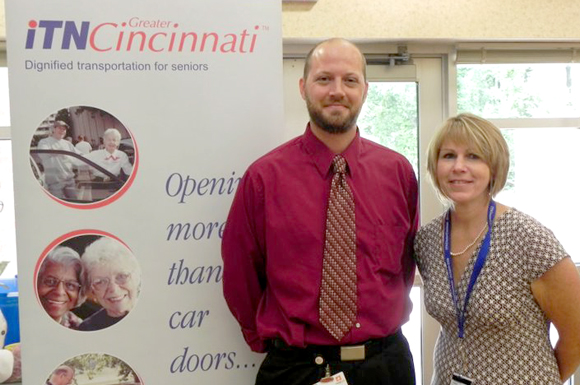
Nancy Schuster saw the painful confrontation first-hand. She watched her parents try to convince her grandmother to hand over her car keys. But in the end, it took an intervention by her family doctor to drive the point home. "She wouldn't listen to any of us," says Schuster, 46. "It gave me a much better appreciation for the challenges that are out there."When she learned of an opening to direct the new Independent Transportation Network of Greater Cincinnati, a program developed last year by the Deaconess Association's Foundation, she saw an important opportunity.The statistics are scary for every driver and any child with senior parents holding on tightly to their car keys as a path to freedom, independence and control of their lives. The National Highway Traffic Safety Administration reports that drivers 85 and over are nine times more likely to die behind the wheel as their counterparts aged 25 through 69.The ITN Greater Cincinnati serves seniors and people with visual impairments who live and travel within the I-275 loop. The process is as simple as it is powerful: riders join the network for a $75 annual fee, then pay a pick-up fee and a per-mileage rate to cover their transportation needs, which range from trips to the doctor to the grocery to the beauty parlor. The average cost for a round-trip service is about $10, depending on distance. "We offer all of our members door through door, arm through arm service," Schuster says.She is also a volunteer driver, and regularly takes a rider to the Sycamore Senior Center. While most trips are practical necessities, some are pure fun. One volunteer driver took a regular rider to a night out at Eddie Merlot's; December brought many Christmas shopping trips.Bonds develop quickly between drivers and riders. "It happens naturally," Schuster says. "Even when you are driving someone once or twice, you still form those relationships. We've become part of their families."Before the end of 2010, ITN Greater Cincinnati had given more than 1,000 rides with just a dozen drivers and fewer than 100 member riders. This year, demand has grown each month. "We've driven more than 30,000 miles," Schuster says. Volunteer drivers get more than good will in return for their efforts. They get automatic membership in the network, which they can donate to anyone they like. In one of the program's most innovative strategies, drivers can choose to be reimbursed directly for their mileage or bank their credits in their own Transportation Social Security Accounts. They can also give them to a friend or loved one, or to a rider in need. "You are doing a charitable act, but it's so much more," Schuster says.As the demand for rides continues to increase alongside gas prices, Schuster says the ITN Greater Cincinnati plans to be able to offer scholarships for low-income riders by this summer. Do Good: • Be a rider. Click to learn more about how to donate your services. • Make a donation. Click and make a tax-deductible donation to help seniors ride with pride. • Give a gift. Know someone who could benefit from ITN Greater Cincinnati's services? Gift a membership or sponsor regular visits to the mall. By Elissa Yancey Photo courtesy of ITN Greater Cincinnati

Bike, Mobility and Visitors Center gets Chicago based operator

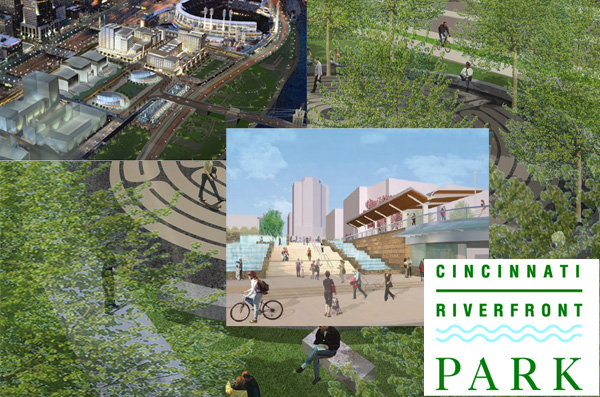
 Cincinnati residents have one more reason to park their cars and enjoy the developing outdoor-friendly spaces along the Ohio River. This month, the Cincinnati Park Board announced that Chicago-based Bike and Park will operate the new Bike, Mobility and Visitors Center in Cincinnati Riverfront Park, an urban recreational area over ten years in the making.In 1998, the Park Board created a master plan for a new park to be incorporated into the urban design plan for the riverfront. With the acceptance of that master plan, work began to find funding - federal, state, and local - to support the project and develop a park that would meet the needs of the Cincinnati community. Later plans for The Banks fully supported the Park Board's riverfront park as both a destination and a neighborhood park for future tenants and visitors. "As the plan evolved, we wanted to include a bike center as this seemed an ideal use for the park," recalls Steve Schuckman, Superintendent of Planning and Design for Cincinnati Parks. With the park located on the Ohio to Erie and Ohio River trail systems, the bike center would be well-positioned to serve recreational cycling. The Park Board envisioned a place that rented bikes to families and visitors and also offered storage space and services for commuters cycling to work. The McDonald's Cycle Center in Chicago's Millennium Park was a good model for what planners envisioned in Cincinnati. Located downtown, it encourages a greater acceptance of cycling to work among the business community by offering convenient services for commuters. Cincinnati Riverfront Park's Bike, Mobility and Visitor Center will offer many of the same services when it opens in the fall of 2011. Tucked beneath the Walnut Street steps of a new garage, the Bike Center will have showers, lockers, bike repair and supplies and secure storage space for around 150 bicycles. Most of that storage space will be available for bicycle commuters. 'Rental bikes typically get displayed outside, so we don't plan to take much of the commuter racks," says Josh Squire, owner of Bike and Park. "We will not sell new bikes at the facility; we want to work with local bike shops. We will offer guided bike and Segway tours along the riverfront and also through some neighborhoods."Like the McDonald's Cycle Center, which Bike and Park also staffs and operates, Squire plans for the riverfront Bike Center to be self-sustaining and generating revenue for the park from rentals, tours, and memberships. And the facilities aren't just for cyclists. "Whether you're commuting downtown or running at lunch, you can use those showers," clarifies Schuckman. "Trying to make the city more sustainable [and healthy] is what the parks are all about." Writer: Becky Johnson

Ten best cities for commuters

 Kiplinger selected its 10 Best Cities for Commuters, ranking Cincinnati at number seven. These cities have the easiest and most affordable commutes, while taking into consideration the population and low congestion costs.Read the full story here.

Our Partners

Don't miss out!

Everything Cincinnati, in your inbox every week.

Close the CTA

Already a subscriber? Enter your email to hide this popup in the future.