Author

Soapbox

Soapbox's Latest Articles

Established businesses moving into Main Street district

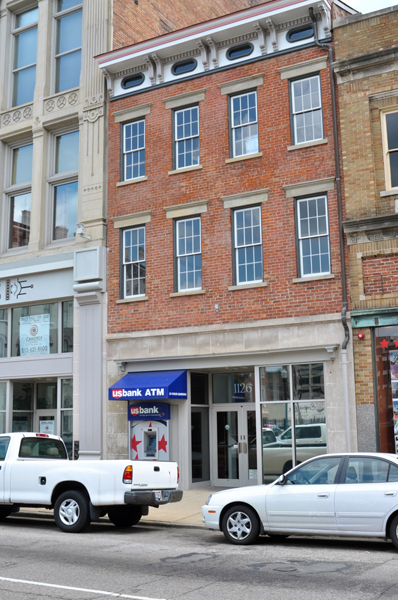
Two local businesses will soon be new neighbors in the 1100 block of Main Street in Over-the-Rhine. Lucy Blue Pizza is moving one block from its current location at 12th and Walnut Streets to 1126 Main Street. And the Cincinnati branch of strategic talent management agency Human Capital Institute (HCI) moved earlier this month two doors over from its temporary space to a newly-renovated office at 1110 Main Street. Lucy Blue Pizza has been a late-night restaurant fixture since 2002, offering thin-crust pizza both in-store and from a sidewalk take-out window. Taylor Thompson, owner Jim Thompson’s daughter, says the new store will be more of a full-service restaurant with larger, more open seating areas. Beer and wine service will be offered, along with more of a nightclub feel. “We would love to have live music,” Taylor Thompson says. She adds that Lucy Blue Pizza will open at the new location in a few months, once construction is finished. The restaurant plans to continue its current nighttime business hours from 10 p.m. to 3 a.m.  HCI is a branch office of a larger company headquartered in Washington, D.C. The two-year-old operation moved to Over-the-Rhine from West Chester and grew to nine employees at its temporary location. Aubrey Krekler Wiete, a research analyst with HCI, says their new location “…offers everything needed in an office space.” She says HCI has many Cincinnati natives on staff who like working downtown and contributing to business growth in Over-the-Rhine. The location, she says, puts them closer to their clients. Lucy Blue Pizza has three other stores, but Jim Thompson says the original in Over-the-Rhine remains his favorite. He says he is looking forward to expanding the business. Both buildings are owned by Hanke Associates, LLC. By Andy Dobson


Soapbox takes a holiday

The Soapbox staff is taking next week off to honor Memorial day with our families and friends, but we'll be back on Tuesday June 7th with a brand new issue.

Urban Harvest gets support from Xavier

Xavier University will offer a wealth of support to Brad Roger’s start-up company Urban Harvest. Rogers won the Xavier Launch-A-Business (X-LAB) Competition, sponsored by the university’s Williams College of Business and Sedler Center for Entrepreneurship and Innovation. Judges announce the complete list of winners 1:30 p.m. Tuesday, Aug. 30, in the Grand Atrium of Smith Hall. Winners, such as Rogers, will develop a business plan and receive consulting services, networking opportunities and a meeting with possible investors. The competition included a questionnaire submission, and 30- and 60-minute interviews with panels of experts. In a preview interview with Soapbox, Rogers, a project manager for a home remodeling company, explained that Urban Harvest aims to bring more fresh fish and produce, and employment, to area communities. He says the company plans to use an innovative, cost-effective system called aquaponics, a hybrid of aquafarming (fish raising) and hydroponics (growing plants without soil). In this system, when fish are fed, he says, fish waste provides nutrients that are circulated into the planting beds. The plants, in turn, filter the water for the fish. “It’s like a mini eco-system.” “Ideally, with the system I want to setup, ” he adds, “it will produce 10,000 heads of lettuce and some herbs every week, and produce about 10,000 pounds of fish a year.” Rogers was the local expert behind the development of an aquaponics system at H.J. Benken Florist & Garden Center in Blue Ash. Launched in November, it was treated as a beta test for an aquaponics system planned for a village outside Jos, Nigeria. The local, faith-based company Self-Sustaining Enterprises (SSE) helped install the system there in March. Pete West, a Procter & Gamble engineer, was among the locals who traveled to Nigeria. “The idea was twofold,” he says. “To provide gainful employment for people in the village area, and to provide food that village will eat.” Rogers and SSE hope to expand that idea in the Greater Cincinnati area, employing community members and engaging farmers. “The goal is to have a main campus, where I teach people about aquaponics, but then I want to establish other aquaponic centers in neighborhoods,” he says. “Some communities have to hop on three buses to get to a grocery store.” By Rich Shivener

Cincinnati USA Partnership: play to area strengths

A presentation Thursday by the state's top economic development officials gave participants more than just an overview of Ohio Gov. John Kasich's plan to create jobs; it provided both an ideal setting and a fitting big-picture perspective as the Cincinnati USA Regional Chamber presented a new strategic plan for its development arm, the Cincinnati USA Partnership. Cincinnati USA Regional Chamber Executive Director Dave Dougherty presented a series of goals that he says the Partnership will work toward: the creation of 200,000 net new jobs in the region by 2020, and securing the city a top-quartile ranking in the regional indicators measured by the Agenda-360 Vision 2015 Regional Indicators Report. Dougherty began the presentation by defining the Partnership as a local extension of JobsOhio's overall plan. And if he had a single theme to his presentation, it could be summed up with the concept of playing to one's strengths. While he noted the chamber will play a role in JobsOhio's efforts to bring more large-company investment to the state, a key part of the chamber's local efforts will focus on job creation within existing Cincinnati companies. Those businesses have historically counted for 80 percent of the region's new jobs. "I believe we should fish where the fish are," he says. Likewise, the chamber will reflect JobsOhio's focus on key 'industry clusters:' industries and related businesses that already have a strong foothold in the state. On the local level, Dougherty said that means the chamber - and through it the state - will be focusing on the industries for which Cincinnati is known, such as branding, consumer products and biomedical. The goal, says JobsOhio Interim CIO and President Mark Kvamme, is to build Ohio's reputation as a hotbed for its strongest industries. "What you have here is an amazing piece of resources," he says. Julie Janson, chair of the Cincinnati USA Partnership and president of Duke Energy of Ohio and Kentucky, calls the plan a step toward defining the city's - and state's - best attributes. "This plan delivers a solid infrastructure to support the high-growth potential of the region," she says via press release Thursday. "We believe this is the right plan at the right time to capture our region's rightful place as one of America's favorite business centers." By Matt Cunningham

True Joy Acoustics mixes ukeleles, philanthropy

Gone are the days when Tiny Tim strummed a ukulele and warbled his signature rendition of “Tiptoe Through the Tulips.” The tiny instrument is making a mighty comeback thanks to Israel “IZ” Kamakawiwo’ole’s poignant rendition of “Somewhere Over the Rainbow” and YouTube favorite Jake Shimabukuro’s inventive pop song adaptations on the instrument. Cincinnatian Greg Huntington understands the appeal. His company, True Joy Acoustics, has been selling ukuleles for the past year. Yet this is far more than an online business venture. Since the company’s launch, it has donated one ukulele for every nine sold to Cincinnati Children’s Hospital Medical Center’s Music Therapy program. And every ukulele kit is packaged by the Clovernook Center for the Blind, which pays visually-impaired workers through its Contract Packaging department.  “Unique is sort of an understatement; no one is doing what Greg is doing,” says Brian Schreck, Music Therapy Coordinator in the hospital’s Division of Child Life and Integrative Care. “He’s taking into account the business side of things and the community at large.” So far, True Joy Acoustics has donated seven ukuleles to the hospital, an instrument that Schreck finds very useful in his therapy. “It’s the perfect size for anyone from a toddler to an adult, and it’s easy to play in a hospital bed.” Huntington’s ukuleles, made by a Connecticut manufacturer, also have a flat bottom, so they stand up easily on a night stand. Because these ukuleles are professional-grade, “there is such a difference when someone gets to play a real musical instrument rather than a toy or a lower-quality instrument,” says Schreck. Including the instrument, picks, instruction books and a custom case made locally, ukulele kits called “Music Makers” offer “the basic skills for a lifetime of enjoyment of this instrument,” says Huntington. With increased efforts to accelerate the hospital’s donation program, Huntington hopes to put ukuleles in more people's hands. “It’s all about maximizing your success,” he says. By Becky Johnson

UC’s FETCH-LAB research helps pets, people

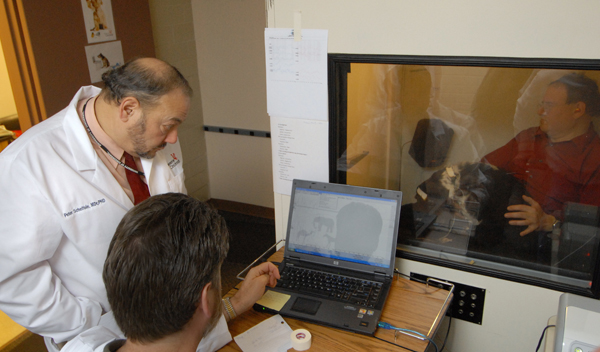
The idea of putting hearing aids on a dog may, to the uninitiated, seem like an extravagant splurge, the kind of move reserved for those with money to burn. But not to a team of researchers at the University of Cincinnati. It's one of several innovative projects designed to better understand how animals hear and communicate, with the hope of making the world more comfortable for both humans and our animal counterparts. "This research has been going on for some time," says Pete Scheifele, PhD, head of UC's Facility for the Education and Testing of Canine Hearing and Lab Animal Bioacoustics (FETCH-LAB). "However, the noise impacts on animals have not been on the forefront, especially on animals that are domestic or captive." Scheifele explains that, for years, vets and animal researchers paid little attention to hearing loss in animals such as domestic dogs. Owners who brought in their pets with concerns over hearing loss often saw vets use primitive tests, such as jingling keys or snapping and looking for reactions. When researchers started using pediatric hearing-test equipment to study dogs, however, an alarming trend surfaced: About 60 dog breeds showed a tendency toward congenital deafness, due in part to inbreeding. "The awareness kind of shot up, because everyone's worried about having a deaf dog," he says. "It's had a domino effect." Now, vets and researchers are working to identify causes of animal deafness, especially in service animals such as police and rescue dogs. "Your job, perhaps your life, may depend on your working partner," Scheifele says. FETCH-LAB scientists have also explored ways to combat excessive noise in places supposed to meet physical and mental needs. Kennels, for example, often have highly reflective walls and ceilings that bounce barks and yips into an annoying - and potentially harmful - cacophony. "Kennels are made to be washed, not for hearing safety," he says. The FETCH-LAB team recently installed sound-dampening panels at the League for Animal Welfare's kennel in Batavia, and is studying their effects on the sound levels and the health of both canine inhabitants and employees. And although Scheifele says testing is still underway, LFAW Director Mary Sue Bahr says that the panels are having a significant effect. "Our goal for all of the dogs in our care is to provide a clean, healthy, friendly, stress-free environment for them,” says Bahr in a UC press release. "Having these sound panels helps us to fulfill that goal—and it’s also nice for our staff and volunteers. In reducing the sound levels, it helps them have a more enjoyable time here.” Scieifele says FETCH-LAB also studies hearing and hearing loss in horses and marine animals, and is in the process of publishing a paper on optimizing aquarium design to provide stimulating - but not overwhelming - amounts of noise for captive inhabitants. The work, he explains, could both improve lives for animals, and could effect the way human hearing and noise control takes shape in the future. "We often come back with information that's useful and say, 'we never thought about this in humans,'" he says. "We help the animals, and they help us." By Matt Cunningham

Bad Girl Ventures graduates third class

Cincinnati-based micro-lending organization Bad Girl Ventures graduates its third class of entrepreneurs this week. On Aug. 31 at the Cincinnati Art Museum, it will send 10 women into the field with lots of start-up know-how, including business plans, marketing and financing. The classes include one-on-one consultations with accountants, lawyers and business experts and teach student business owners how to craft marking plans and financial projections among other business strategies. To date, 18 women-owned businesses have made use of the organization’s lending efforts, resulting in approximately 45 jobs created in Greater Cincinnati and a 100 percent repayment rate on loans, says BGV founder Candace Klein. “We’re very proud of what we and the women have accomplished,” she says. The graduates of Bad Girl Ventures third cycle of Cincinnati classes’ run the gamut from the food industry and farming to retail and construction. “This class has a good range of businesses that have yet to launch to businesses working for several years,” says Corey Drushal, strategic initiatives coordinator for Bad Girl Ventures. Business skills were not the only thing the classes taught, however, says Brinda Chatterjee, class member and founder of the retail cosmetics website MakeupHaulic.com. “For me it was two-fold, both the actual business skills imparted in the classes as well as the connections to real-world business people who are willing to give their time to help you,” Chatterjee says. “Literally, three months ago I had no idea any of these resources were available.” Chatterjee praises Klein for her work in starting Bad Girl Ventures and its contribution to local entrepreneurs. “Candace has done an amazing job of pulling all these things together to create a launching pad for business and innovation in Cincinnati … and now beyond,” Chatterjee says. Lu Anne Van Kleunen, founder and owner of Premium Sealcoat, an asphalt sealing and maintenance business, says she was drawn to the classes offered by Bad Girl Ventures through a television appearance by Klein. Van Kleunen and her husband decided to start their business in 2009 after both lost their jobs of 30-plus years. “Candace described what her vision was for BGV – helping women business owners with the challenging issues that prevent them or impeded them from being successful,” Van Kleunen says. “Specifically, Candace talked about women who used personal funds or credit cards to fund their business. That is me.” What Van Kleunen has learned through the classes will only strengthen her business, she says, and she plans on using the micro-loans to purchase a truck, tank and other required equipment to support Premium Sealcoat's growth. “Candace and BGV helped make my business acumen stronger, resulting in more opportunities for me and Premium Sealcoat,” Van Kleunen says. The classes helped illustrate to Toni Winston, founder and president of Tiburon Energy/Tiburon Construction – a construction company focusing on energy-efficiency, water usage and sustainability efforts – how important financial practices and marketing was to her company’s efforts. “Since the BGV classroom instruction, I review my projections and financial templates weekly,” Winston says. “I didn’t realize how important a web presence and participation was to growing a business. I now spend time on social media and am working on refining my message and my branding.” Winston also feels that the focus shouldn’t only be on the 10 finalists graduating from Bad Girl Ventures, but on everyone who took part. “I think there should be some recognition for the other 40-plus women-owned businesses that showed up weekly to take advantage of the classes and the mentoring,” she says. “We are all Bad Girls!” By James Sprague

Acutek celebrates 15 years of adapting to a changing industry

A Greater Cincinnati software company is celebrating its 15th birthday with a new vision of innovation. “For 15 years we successfully solved client needs with custom automation controls,” says Dave Tryling, co-managing partner at Acutek. But as the manufacturing businesses that used Acutek's products to help automate their processes, such as aerospace, automotive and pharmaceutical firms, evolved in those rapidly-changing markets, the company changed its offerings to stay current. “We now offer clients a more comprehensive solution to enhance any segment of their manufacturing process, or the entire line,” he says. The company has evolved to have a greater focus on custom solutions, Tryling says, and has grown its product line in step with its service offerings: the company that once focused on integrating mechanical and software processes grew to offer solutions for efficiency and productivity issues as well. “Rather than simply focusing on control, we have expanded our scope to offer clients an array of solution that enhances data monitoring, movement, sortation and traceability,” he says. The transition from specialist firm to a general service provider may seem to run counter to traditional business thought, specialization being a common path toward higher rates and less competition. But for a company whose products can have application in a wide range of industries - think of how many companies use robots or automated assembly lines - the move from narrow to broad makes a good deal of sense.

Digital Bookmobile highlights free library downloads

“Free and public” is not a term typically associated with digital downloads. But the long-standing motto of the Public Library of Cincinnati and Hamilton County holds true for any e-book or e-audiobook download that the library offers today.  A “Digital Bookmobile” recently rolled into two branches – Loveland and Grosbeck – to educate Hamilton County residents about the libraries' growing collection of downloadable material. Filled with a gadget gallery of mobile devices, visitors learned download basics from Overdrive, a downloadable materials vendor sponsoring the new-age bookmobile.  With a library card and an iPod, Android, NOOK, Sony Reader, Blackberry, WindowsPhone or other digital device, customers can freely access the library’s entire downloadable collection. Through the Ohio eBook Project, libraries around the state, including Cincinnati’s, have collectively purchased downloadable materials. So, when one participating library adds titles to its collection, customers from all OEP member libraries can borrow them.    E-books are usually offered for two weeks at a time, but music, part of the Sony Entertainment Catalog and the library’s newest digital service, can be downloaded for life.   “People often ask the question, ‘Are e-books going to put the library out of business?’” says Amy Banister, the library’s marketing and programming director. “But we haven’t found that at all.”  In fact, circulation and usage is up dramatically this year, and last year’s total of 16.4 million items loaned or downloaded was the highest number the library has ever seen. “We’re seeing increased circulation in borrowing, an increase in visitors and searching on-line, and an increase in program attendance.”  Cincinnati’s public library draws people with its ever-enlarging downloadable collection and then keeps them there to attend a program, visit an exhibit or even sit down with one of those old-fashioned hardcover books for a quiet read. By Becky Johnson

Social Innovation Fund charts course from cradle to career

As grade-schoolers play in the "Energy Zone" filled with bright-colored balls at the Duke Energy Children's Musuem, they learn about simple machines the fun way. Training teachers to guide students through field-trip science activities expands the reach, and impact, of every lesson. At Cincinnati's Social Innovation Fund, which supports a wide range of educational programs including teacher training, creating lasting learning makes for measurable successes.

Our Partners

Don't miss out!

Everything Cincinnati, in your inbox every week.

Close the CTA

Already a subscriber? Enter your email to hide this popup in the future.