
Author

Robin Donovan

Robin Donovan's Latest Articles

CCM Link coordinates patient care on the cloud

So, you’ve put on a few pounds.  At first it was a little extra chub here and there, and then a new pants size and now your annual physical always comes with a reminder that you could use to lose a few pounds.  You expect to walk away from the appointment with a slap on the wrist, at worst and, predictably, don’t lose weight. But what if your employer offered you an incentive to lose weight?  How much information would you be willing to share? Perhaps more than you think, according to Jerry Felix and Bill Nadler, co-founders of the Connected Care Management Link, or CCM Link. The duo developed this cloud-based program to cut costs and help patients manage chronic conditions, by, for example, tackling obesity or monitoring an elderly parent with dementia. “It seemed that everyone that we talked to who had struggled caring for an aging parent or a chronic patient agreed that communication and tracking was an issue,” Felix says. The product is timely, with Medicaid getting ready to cut reimbursements to hospitals for patients readmitted within 30 days. Frequent readmissions can be a symptom of poor follow-up or inadequate at-home care. CCM Link allows patients, medical practitioners and family members to maintain separate accounts and log-in from any computer to access and add information about medication schedules, physician orders, progress reports and even data tracking for, say, blood pressure readings. Each user can set up a notification schedule. For example, adult children might receive a message if a diabetic parent fails to log blood sugar levels, or if medications are changed. The company is currently focused on its business-to-business product, which is targeted to businesses looking to cut healthcare expenses by encouraging health lifestyles. A business-to-consumer model is set to launch in July. Our first customer group was a local hospital group. They’re working with a set of employees. They also provide insurance for other employers. They’ve identified their high-cost users. These might be employees or family of employees. They’ve put case managers working with these employees to try to impact their health care to cut down costs. CCM Link has already received funding from start-up accelerator Innov8 for Health and employs 10 people full time. Felix and Nadler have leveraged resources from their IT management company, EC Link, to get CCM Link running, and say they have spoken with approximately 500 potential clients to date. By Robin Donovan
Founder Profile: Amanda Voss, Constance Depler and Friends

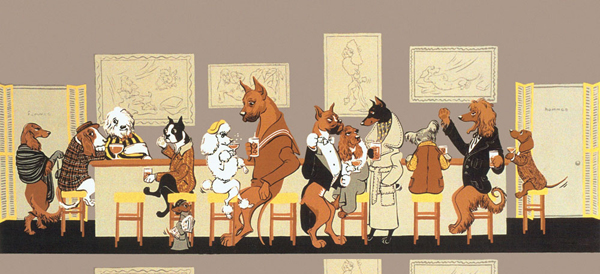
How did you start your business? The images I use are all my mother’s [Constance Depler’s] artwork. Her work had been reproduced in the past and I decided we could do it instead of just licensing it out. At first, I tried just starting a website, but I spent a lot of money, and it didn’t work great. Then, I took the Bad Girl Ventures classes and was a finalist. Ultimately, we decided to focus on my mother’s 1950s work, the bar hounds, reindeer and a lot more. Right now, we’re at the point of reconstructing the website and starting with web-based sales, with a plan of going into wholesale retail next year. How did you come up the idea for your business? It was a mutual decision between my mom and I; she’s thrilled and loved that I’m doing it. What resources here did you take advantage of and how did they help? Bad Girl Ventures helped me form connections with business people and mentors. It also forced me to to sit down and do the work I don’t like: financials, business plans, and just really studying what a business entails. Connections I made through Bad Girl have been great for finding people who would work with me on marketing and design; it helped me make my support team. Overall, I learned to go slower and really take the time so that things aren’t rushed and everything we put out looks great. That lesson helped me: slow down, think it out, you don’t have to do everything at once. What inspires you? When I tell people about the store and the artwork, they love it and they love the look of the pieces. Also, keeping a support system around me helps. My mother, who’s really interested, still lives on Milton Street here in Cincinnati. She’s 85, still painting, still working, and still doing the pet portraits she’s known for. Personally, I’m excited about getting more involved in the design aspect of what we’re producing, which is a part of myself I haven’t tapped into yet. What’s next for you and your company? We’ve switched our focus to the 1950s genre of my mother’s work. Our immediate next step is to have a new online store by April, and the next big goal is to have a new product line coming out. The first year we’re starting with products like purses and kindle covers – things with a flat image on them. Hopefully, by September, we’ll bring out barware and then develop into products like candlesticks, figurines, corkscrews and other items that we’d need to have molded. By 2013, we plan to have a full-fledged product line for the wholesale and retail market. By Robin Donovan

Founder profile: James Dickerson, Nick Cramer and Ryan Tinker, Leap

How did you start your business? I [James] first had an idea for a company called “Wellthy” based around corporate wellness challenges that I started about a year ago. I built the team and we took the company through the Brandery, which gave us some great resources to help us get going. What resources here did you take advantage of and how did they help? We built our first app and tested it with companies, but learned that people didn't want to do corporate wellness challenges. They wanted to compete with their friends around their goals and interests. So, with about a month before the Brandery demo day, we changed directions to Leap. Leap is the first mobile app for social group challenges. It lets users create challenges with their friends and compete by snapping photos from their phone. For example, you could create a challenge to see who could eat a healthy breakfast each day of the week, or meet the most people on a Friday night and prove your progress by posting pictures and earning points. What inspires you? The Brandery was a huge help to us. It helped us get connected to mentors that gave us some very valuable advice on topics from fundraising to product development. We were also one of five startups in the country invited to pitch at the 2011 Clinton Global Initiative in Chicago. We were able to validate what we were working on and it gave us a big confidence boost. Our vision is that challenges are the best way to push people to try new and interesting things in their lives and to capture fun experiences with the people that you care about. This has inspired our team to build Leap, and we hope people use our application in a really positive way. What’s next for your company? We launched our app on Leap day, Feb. 29. We're focused on gathering feedback from early adopters and using it to build the best possible product. We’re also talking to investors to raise a seed round for Leap. By Robin Donovan

Nurse offers compassion and clean-up to grieving families

Heidi Lamkin admits her work is “a job most people couldn't do.” She recently launched Absolute Bio-Recovery Service East, a small company that offers bio-recovery, or cleanup, of crime scenes and bio-hazards. “We do crime and trauma scenes like murders, and I've done some suicide cleanups," Lamkin says. "We also do hoarder houses and unattended deaths." By “do,” she means “clean-up after,” a job that can involve anything from carefully cleaning a car’s wiring to removing bloodstained floorboards. On the mundane side, she offers deodorizing services to families caring for a sick loved one at home or in a hospice setting. Because Lamkin is an ICU nurse, she’s not bothered by most jobs, many of which are no more stomach-turning than what she’s encountered in hospital settings. In addition, she and her husband have been trained through the American Bio-Recovery Association to safely clean up crime scenes, bio hazards and other waste that poses a health risk to the average person. They’re even certified in meth lab cleanup. Although some larger bio-recovery companies market and advertise heavily, Lamkin sees advantage in her experience. “They’re [some larger companies] not emotionally or technically trained to do the work,” she says. “To me, training in dealing with people, being compassionate and truly caring is huge. All of these situations are cases in which people have been devastated.”   Because a coroner would typically remove a deceased person before Lamkin arrives, she's not as directly exposed to death as she could be. However, she says that finding personal items -- glasses, a cane, dentures – is moving and saddening. Still, Lamkin takes comfort in knowing that she's sparing grieving families an unenviable task. She says her nursing background helps her relate to traumatized families. “I’m helping people achieve a new normal,” she says, “And I’m showing them that there are truly compassionate people out there.” By Robin Donovan

Profile: Rosalie Giesel of 346 Stanley

How did you come to be an entrepreneur?   It started with a project in one of our entrepreneurship classes at the University of Cincinnati’s College of Business. We had to come up with an idea for a new business, product, or service and build a business plan around it. Although the class ended in December 2011, we felt that we had a marketable product and decided to continue on with its development by founding 346 Stanley LLC. How did you come up the idea? Some of my favorite perfume leaked from the bottle and onto my cell phone. I found that I loved smelling it every time I used my phone and even continued to spray it on the case when it began to wear off. That’s where the idea was born. I should mention that our original name for the product was Tek-Tak but when our lawyer researched it, we found that the name was already in use. We have since changed the product name to “Akscentz.” What resources here did you take advantage of and how did they help? We’ve had some great help from professors in the College of Business; they are all very supportive of us going forward and taking our product to market. Also, we’ve consulted with lawyers and professionals with expertise in launching new products. What inspires you? The thought of coming up with our own idea and actually taking it to market and making it a success inspires us. Seeing the hard work and passion of other entrepreneurs who have taken their ideas and turned them into something real; that is truly inspiring. What’s next for you and your product? Right now we are consulting with some experts who have experience in launching new products. We want to learn the best way to produce and market Akscentz.   By Robin Donovan

Our Partners

Don't miss out!

Everything Cincinnati, in your inbox every week.

Close the CTA

Already a subscriber? Enter your email to hide this popup in the future.