
Get Down Moses
Baoku Moses, a native of Nigeria, moved to the Queen City in 2002. Since then the musician, composer, actor, and activist has been a one man cultural attache, spreading West African culture throughout his ‘adopted city’ via music, fashion, and education.
 Baoku Moses, a Yoruba native from Nigeria, West Africa came to the United States in 2002 with a band to play a festival in Florida. Following the show, with a two year work visa in hand, he wanted to take advantage of the opportunity to work and experience the United States, so the band relocated to New York City.
“To us it was paradise on earth,” he recalls. But his visions of what the US offered were countered with his first images of someone less fortunate picking through a garbage can on the streets of New York City.
 With the band dissolved and options limited, Moses connected with friend James Asokere in Cincinnati. A well regarded drummer, Asokere had come to the states several years before and had settled down in Cincinnati, but continued to tour to Chicago and Canada for shows. Asokere, who Moses considers “a master drummer”, suggested his friend come try out Cincinnati and he moved shortly thereafter. Moses got a job with Bi-Okoto Dance Company.
Prior to coming to the states, Moses had trained as an actor and dancer, working with various theatre groups. Now an accomplished African drummer, his discovery of native drumming came later.
“I was too tall to be a dancer, so I started playing drums.”
Moses moved onto Ivory Ambassadors, a top cultural touring group that performed cultural dances and drumming. He learned 25 different dances from different regions of Nigeria during his five years of training.
However, his true inspiration came when Afro beat pioneer, Fela Kuti passed away in 1997. Kuti, a musician, composer and ardent human rights activist, was known for his supercharged, politicized grooves that shaped the way generations of Africans viewed their own situation.
“When Fela was alive his music was banned – no radio or TV and I wasn’t rich enough to be able to go to his concerts. I was too poor to do that. But after his death they released the ban on his music,” Moses recalls. Kuti’s passing inspired a young Moses to start writing songs.
Largely ignored in the United States, Afro beat does have an audience in New York, Chicago and Atlanta. Moses likens it to as indigienous an artform as American jazz
 “Afro beat is a combination of big band jazz with African instruments but usually political in its lyrics. Back in Africa, music is the voice of the people and when Fela started Afro beat in the late 60’s he was that voice,” he says.
But Moses is grateful he found a home in Cincinnati to continue his art, noting the opportunity here.
“When I came to this country I was a newborn, and a newborn has to learn to crawl and walk before he can run. If you put me as a newborn in Los Angeles in 2002, I wouldn’t have made it!”
In 2003 Moses began recording his first CD with local rock star Rob Fetters. Moses had searched online and wrote Fetters. He was the only one who replied, but less than a month later they were recording. Fetters, a well known guitarist, songwriter and musical producer, helped make Moses’ disc, entitled “Koror Oro, The Realistic Reality”, a true reality.
 “Making Baoku’s album was hard working bliss from start to finish. Every musician played
as if the future of the universe depended on it; total heart, soul, and commitment to his
musical / spiritual vision.”
Fetters arranged for some of the city’s top session musicians to contribute, including fellow Bear/psychodot Chris Arduser, and jazz greats Randy Villars, and trumpeter Gary Winters.
Influenced now as much by Cincinnati’s music scene as he has brought his culture to it, Moses hopes to collaborate with musicians of every style including, rap, r&b, country, bluegrass, blues. Recently he’s jammed with local jazz trumpeter, Wade Baker. How does he fit African drumming into truly American art form?
“When music starts I feel where it’s coming from and I find my spot,” he says.
With an album of original music under his belt, Moses set out to start a new band here in Cincinnati. He placed an initial ad in CityBeat seeking participants in a drumming group. Surprisingly, his ad drew 12 like minded (and not so like minded) drummers, horn players, and guitarists. Once they began jamming together, the players took note of Moses’ CD and suggested a full-on Afro beat group might be the best medium for the musician. But Moses was hesitant to become the band leader for such a large ensemble given his previous ‘big band’ experiences.
“Back in Nigeria to put a band together you have to be ready to pay them every time they show up for practice, every time they go to the studio or show whether you get paid or not. I’m not sure I’d be able to afford it,” he said.
But the musicians, mostly white, with influences as diverse as rock, blues, and soul, formed a core unit that Moses says exists to this day – eight founding members still exist. Playing frequently at the Blue Wisp Jazz Club, and at the Northside Tavern, the ensemble has grown to a 12 piece unit with several players coming and going depending on availability.
 “We’ve come to describe my band as a church or mosque, the structure remains but people come and go.”
When not focusing on his own music, he founded the upcoming Cincinnati Unity Jam III this September. Moses held the first last December, gathering artists with disparate backgrounds to come together for a show. Moses said its founding serves a dual purpose.
“I realized that just like in Nigeria you either have connections or lots of money to make it in the music industry. So if no one will give me a show, I have to create my own.” But he also realized how segregated local music communities were, and wanted to find a way to bring different genres, audiences, together.
“I was working with a non-profit, Unity Corps – they promote unity among all regardless of our differences. Create a path to peace through unity. If you bring all this music together, their crowd will follow. That’s the idea, unity through music,” he says.
A one year anniversary festival will be held in December and feature music, art, food, and fashion.
In the interim, Moses has taken up residence in the Pendleton Arts Center in Over-the-Rhine, housing his cultural efforts under the umbrella of “Baoku’s African Village.”
“A lot of people are ignorant about things that come from Africa. When you check the National Geographic channel what it shows are bad things like hunger and war. Since I’ve been here part of what I wanted to do was have a gallery to showcase everything that comes from Africa that is good as well,” he says.
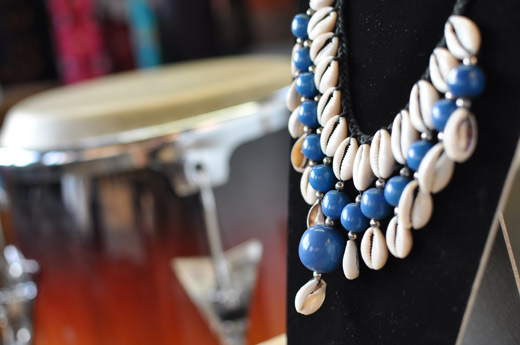
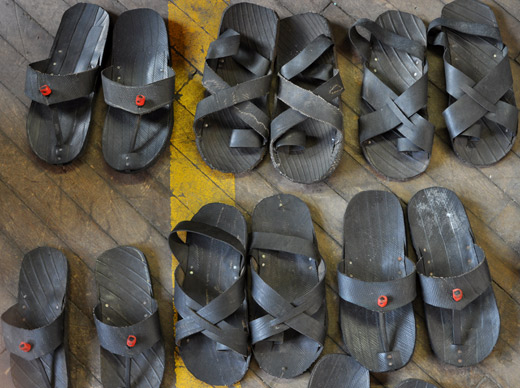 Moses’ space includes African fashion, fabric jewelry, instruments and art imported from Nigeria, Ghana, and Senegal. And while it’s mostly traditional crafted goods, Moses points to a pair of traditional Nigerian shoes made of rubber tire and tube pieces as a model of sustainability.
“When they talk about recycle, recycle, recycle – Africans have been recycling for thousands of year. These shoes are what poor people wear at home, but here its work of art. And these shoes last forever,” he laughs.
Moses’ ultimate goal is to have his own space and arts center where everything he does is under one space, including a dance and drum studio, workshop space, and performance and recording.
Moses lives in Northside, a far cry from his family who still lives in Nigeria. He’s eligible to apply to become a US citizen this year and will probably apply for dual citizenship.
“I’m adopting Cincinnati as my US home.”
His newest musical venture is Baoku’s Song for peace, abbreviated as B4Peace will focus solely on African folk music. Two practices in, he envisions it as a multicultural, drumming ensemble that reflects his consistent message of peace for all. With both a Nigerian African and American African in the ensemble,
“Nigeria has 512 languages, yes we are the same color but we are totally different. When they’re speaking I have no idea what they’re saying,” he says.
Photography by Scott Beseler.
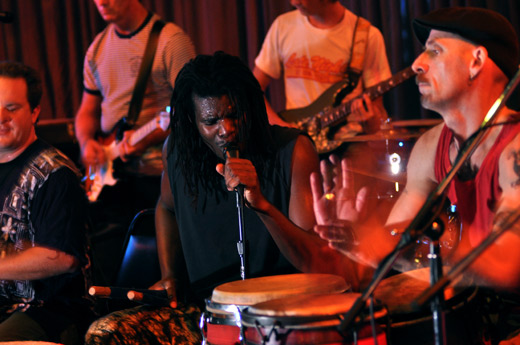
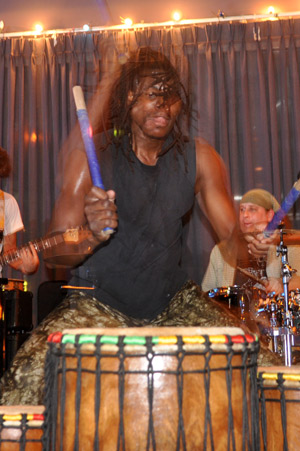
Baoku Moses and the Imaga Afro-beat Band at the Blue Wisp
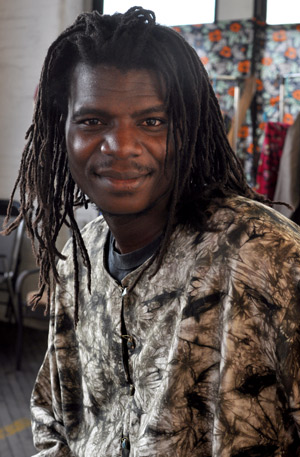
Bauko Moses
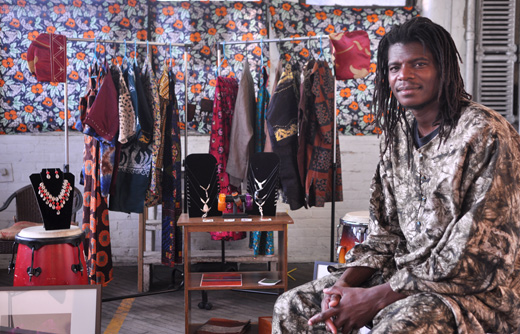
Baoku’s African Village
Slow shutter drum action
Jewelry and drum at the “African Village”
Recylced rubber sandals from Nigeria
Related Articles

Cheers to the sober life
Whether you’re all in on NA or a sober-curious beginner, our guide will help you order with confidence to match your tastes and your mood.
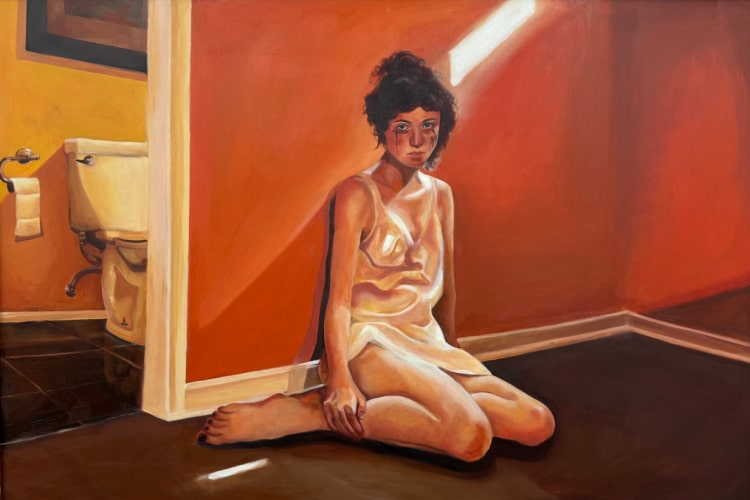
Kennedy Heights Art Center exhibition offers grief a place to surface and process
58 local artists approach loss as an environment, in spaces people learn to live inside.
Gift a book by a Cincinnati author from the literary list
Use this list of the latest local releases and favorites for last-minute gifts.