
Finding Design Inspiration in Over-the-Rhine
Maya Drodz and Michael Stout are a testament to the adage ‘opportunity is where you find it.’ In this case, the pair of local designers relocated to Cincinnati and found their inspiration in a new neighborhood, turning it into an opportunity to expose their work to the rest of the world.
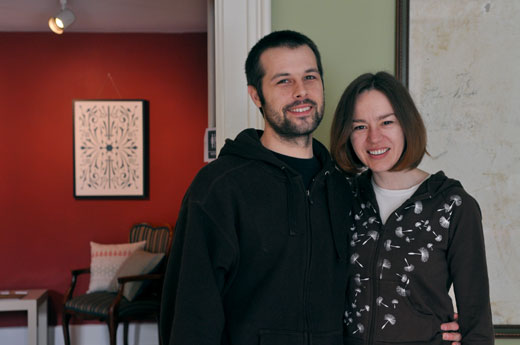 Maya Drodz and Michael Stout are a testament to the adage ‘opportunity is where you find it.’ In this case, the pair of local designers relocated to Cincinnati and found their inspiration in a new neighborhood, turning it into an opportunity to expose their work to the rest of the world.
Drodz attended Cornell, earning her BA and her MFA in 2D Design from the prestigious Cranbrook Academy of Art in Michigan. Stout was born and raised in Indianapolis where he earned his BFA in Visual Communication from the Herron School of Art and Design. Visualingual is the name of their small design and print business that they brought from Boston and relocated in Over-the-Rhine.
“It’s what we went to school for and that’s how we met.” “We found each other and became this creative partnership.”
 Separately, and together, the pair has lived in Poland, Brooklyn, and most recently in Boston where Stout taught design. Graphic Designers by training and education, a move to Cincinnati came two years ago when Stout wanted to pursue a Masters in Planning at UC.
“Michael started looking at grad programs. He chose Cincinnati, and I didn’t want to stay in Boston by myself for two years. It was a very limited time frame and I thought it would be an adventure,” she says.
And what an adventure it’s become. “By the time he graduated we didn’t want to leave.”
As a Midwesterner, Stout had visited the Queen City. This was Drodz first visit.
“After living in Boston for four years it was kind of appealing to live in the Midwest, where the cultural offerings and the creative opportunities were more accessible than in a city of a larger size,” she says.
The couple ended up in Over-the-Rhine.
“We knew Over-the-Rhine was where we wanted to be. It was centrally located and we needed a walkable community,” Stoudt says. Drodz agrees.
“As soon as we moved her we knew that if we were going to stay, this is it. I wouldn’t want to live in any other neighborhood. I don’t drive. I would never give up the urban existence. That’s the kind of walkable life we want to be living,” she says.
While Stout began school, Drodz began doing corporate design for F&W, but the creative limitations of the average design job ultimately made her quit her job and reassess what she was interested in. “I wanted to do work that had to do with this place,” she says. 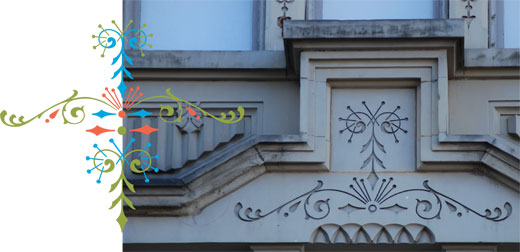
While Stout and Drodz say Visualingual had its beginnings in Boston, the move to Cincinnati really stoked their creative fire and created an opportunity as unique as the neighborhood around them.
“We really drew inspiration from our surroundings and I think that’s what reignited and put us in a direction of making prints and products and things for the home. It was a new direction for Visualingual being in Cincinnati.”
Drodz started designing coasters as Visualingual’s first offering. Early designs incorporated their new neighborhood’s wealth of Italianate architecture.
“As outsiders we had a different perspective on the city – not the same baggage. Certain things that struck us about Cincinnati and Over-the Rhine. Things that are a little more obvious to us than someone who has lived here all their lives and perhaps took it for granted.”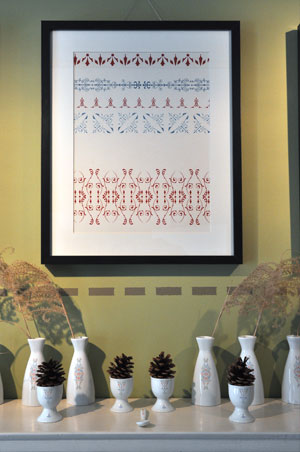
Oddly enough, it was a simple product and design that has drawn the most attention to the pair. Their ‘seed bombs’ began as a simple idea: to imprint their unique designs on a muslin bag full of wildflower seeds native to an area of the country. This “grass roots urban design” found an early home with some of the retailers in their neighborhood including Park & Vine. Dan Korman says the pair offered something synergistic with his local green store that offers unique items.
“We get a lot of inquiries to carry locally-made goods. Maya set herself apart from the herd, because she and Michael create wares that get their direct inspiration from our neighborhood and fit the vibe of our store.” “[They] have a real knack for using their craft as a way to spotlight Cincinnati–and specifically Over-the-Rhine–through the eyes of artists transplanted from another city.” Outside’s Terry Lee agrees. “Their love of the area and Over-the-Rhine in particular, comes through in many of their designs.”
Stout says the simple idea is more than meets the idea.
“Seedbomb is kind of rooted in this idea of place and your environment. The idea came to us to package this thing and create this thing you can sell as a product but it has this other life,” he says.
“It’s very top down, this was one little product that could actually do that, really small scale empower you the neighbor to do something about your neighborhood.”
The success of Seedbombs in Cincinnati led Drodz to make contacts in Chicago with independent retailers. This exposure lifted Visualingual’s profile to the next level.
“It ended up with a life of its own,” she says. “The store in Chicago promoted it as a stocking stuffer with the kind of press leverage we don’t have.”
 Indeed, one year after introducing their Midwestern Seed Bombs, not only have they been featured in Vogue, House Beautiful, Woman’s Day, Frugal Bon Vivant, and Harper’s Magazine, among many other publications, they’re now expanding the concept with seed bombs for other regions, including the West Coast. And they’re popularity is about to take another big step: the success of Seedbombs in the Midwest attracted the attention of a buyer for Anthropologie stores. The national chain’s order, in the thousands, will see Seedbombs in their stores nationally. This means Stout and Drodz are about to get very, very busy.
“We’re quickly expanding our capacity, but staying rooted using neighborhood friends. We’re also renting a larger workspace,” Stout says.
Stout says it’s been an accelerated primer in how to make a young business successful, and even better tale of incorporating your art.
“It’s been a great business lesson for us about how this works. How a product like this works on this grassroots do-it-yourself urban design level and can then find a market beyond just doing it for you,” he says.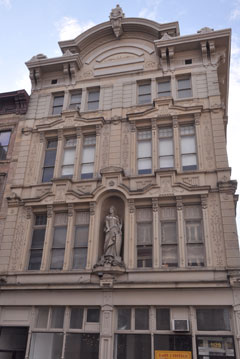
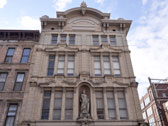
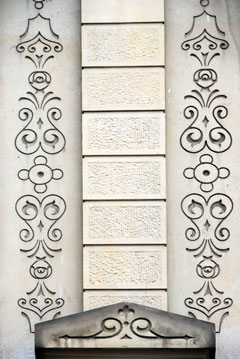
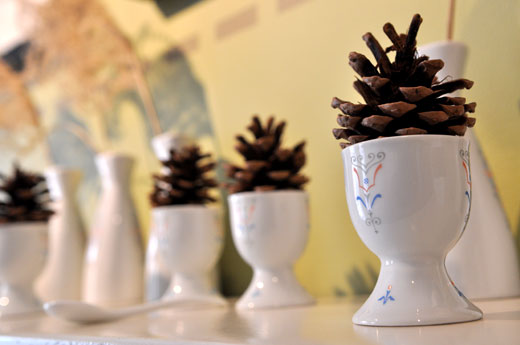
And that’s good news. Their most recent line is a limited-edition of home accessories entitled Flourishing, and bears the distinctive hallmarks of 19th Century architecture prevalent in some of their earlier designs. The Flourishing line began with photographs the pair took of 19th century buildings in their Over-the-Rhine neighborhood, including the iconic Germania building at 12th and Walnut. After digitally tracing the architectural ornamentation photographed, they create new patterns that are later applied to products including ceramic serving pieces, tabletop accessories and linen throw pillows and table runners. Each piece is one of a kind.
“There’s a general interest in architectural ornamentation and Victorian era design. On the one hand, OTR lovers and architecture geeks would love recognizing the buildings that inspired the designs. But even if you don’t know anything about the neighborhood you can still look at it with a fresh eye,” Drodz says.
In keeping with their art design aesthetic, the line was unveiled in an exhibition at the historic Betts House in the West End. Entitled HOME WORK, the exhibit can be seen through____________, and purchased online at Visualingual’s online shop.
“What we’re doing is a contemporary folk practice. The end result will delve deeper in to the specifics of the neighborhood but still going outside that to find other access points to the work. It’s a slightly more sophisticated way for us to talk about the neighborhood. But also still expanding our audience.”
The pair has recently started working with the Contact center to produce storefront signage. Given their affinity for OTR, it seemed like a good fit to design something that would have a visual presence in the neighborhood.
With the success of Seed Bombs, and the new line, have they run out of ideas and inspiration in their new neighborhood?
“That was the beginning of us trying to expand the conversation and I want us to continue doing that,” she says of the neighborhood. “It’s a very rich canvass.”
“If we can continue to carve out this existence, why not stay. I really like the idea that our practice is becoming more and more embedded in this place.”
Photography by Scott Beseler
Maya Drodz and Michael Stout
Germania detail
Design detail (provided)
Visual Lingual showing at The Betts House
Design homegoods by VL
Germania building at 12th and Walnut
Author

Related Articles
At the Taft Museum of Art, a 40-year legacy meets a living artist
The inspiration for the Duncanson program is literally painted on the walls inside.
This inclusive Cincinnati neighborhood thrives on people power
Grassroots organizations like NEST provide neighbors with the civic muscle and voice to create the kind of places they want to live in.
Cincinnati Form Follows Function (cf3) is raising awareness of the region’s endangered mid-century modern architectural form
The nonprofit’s approach unites education, awareness, and working with other preservation associations to advocate for these unique structures.